



Former Head of Indonesia’s Meteorology, Climatology, and Geophysics Agency (BMKG) for the 2017-2025 period, Professor Dwikorita Karnawati, stated that discussions surrounding the threat of a Java megathrust earthquake are not intended to alarm the public but rather to provide a vital basis for developing measurable mitigation and preparedness scenarios.
This is particularly important given the presence of seismic gaps (areas that have not experienced major earthquakes for an extended period) in critical zones such as the Sunda Strait, southern Java, and the Mentawai Islands, where tectonic energy has been accumulating for more than 200 years.
“This scientific data is necessary as a reference for emergency structural preparedness,” said Professor Karnawati during a disaster management seminar titled “20 Years After the 2006 Yogyakarta Earthquake and Anticipating the Java Megathrust Earthquake” held on Saturday (May 31) at the Multimedia Room of the UGM Central Building.
She urged the public to respond calmly to information about geological hazards, strengthen mitigation education and evacuation planning, and avoid misinformation so that communities remain prepared to respond to the worst-case scenario whenever a disaster occurs.
Although no scientific method currently exists to accurately predict earthquakes, Professor Karnawati emphasized that researchers continue to strive toward that goal, despite the limitations of existing results.
“Why do scientists spend so much effort studying something that remains difficult to predict? The purpose is to enable us to develop mitigation and preparedness strategies. Research findings are needed to build scenarios. A scenario is an assumption of what might happen. Without scenarios, we have no foundation upon which to base mitigation efforts,” she explained.
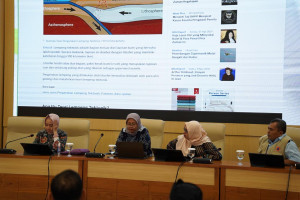
Earthquake expert from UGM’s Department of Geological Engineering, Dr. Gayatri Indah Marliyani, explained that geological understanding of active faults and the megathrust potential south of Java is crucial as a foundation for disaster mitigation rather than a cause for public panic. She noted that science is still unable to precisely predict when earthquakes will occur and highlighted the challenge of fading collective memory among younger generations about disasters following the 2006 Yogyakarta earthquake.
“Rather than focusing on guessing when an earthquake will occur, our priority should be mitigating the risks posed by such disasters,” she said.
Dr. Marliyani also pointed out that megathrust earthquakes have, in fact, occurred twice in Java over the past 32 years: in southern Banyuwangi in 1994, accompanied by a destructive tsunami, and in Pangandaran in 2006, which also triggered a tsunami shortly after the Yogyakarta inland earthquake.
Regarding the megathrust threat, Dr. Marliyani called on both the public and government to invest in earthquake-resistant housing and preparedness measures.
“We must strengthen earthquake-resistant homes, establish and familiarize ourselves with evacuation routes, and rely on valid information so we are not misled by frightening hoaxes,” she reminded.
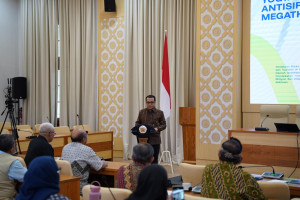
Indonesia’s Vice Minister of Communication and Digital Affairs and Secretary General of the Central Executive Board of the Gadjah Mada Alumni Family Association (KAGAMA), Nezar Patria, stressed the importance of strengthening disaster mitigation and sustained public literacy to address the earthquake threat posed by the megathrust zone along Java’s southern coast.
According to him, preparedness must be built by bridging science and effective public communication while maximizing the use of advanced technologies such as digital twins and Artificial Intelligence (AI) for simulations and seismic data analysis.
Nezar also underscored the necessity of pentahelix collaboration involving multiple stakeholders to ensure effective disaster management efforts.
“To this day, no science can accurately predict when seismic energy will be released, unlike weather phenomena such as rain or wind that can be forecast. However, through predictive analytics, we can estimate the potential impact of a megathrust event,” he said.
UGM Rector, Professor Ova Emilia, highlighted Yogyakarta’s ability to recover rapidly after the devastating 2006 earthquake, as well as the phenomenon known as the “Yogyakarta paradox,” in which the province records the highest life expectancy and the lowest maternal and infant mortality rates in Indonesia despite facing relatively high levels of poverty and disease. She conveyed these observations in her keynote address titled “Kearifan Lokal dan Masyarakat Tangguh Bencana di Yogyakarta” (Local Wisdom and Disaster-Resilient Communities in Yogyakarta).
Professor Ova Emilia explained that the accelerated post-disaster recovery was supported by strong social capital, such as gotong royong (cooperation) and andhap asor (humility), along with the spiritual value of nerimo ing pandum, accepting one’s circumstances with gratitude, which functions as a resilient coping mechanism and provides meaning in life beyond material measures.
“I believe this is a phenomenon we need to study as we prepare for future challenges. Yogyakarta possesses a wealth of social, cultural, and spiritual values,” she said.
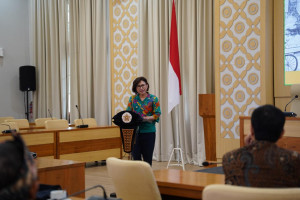
As is well known, the earthquake that struck on May 27, 2006, with a magnitude of 6.4, caused enormous losses in Yogyakarta and surrounding areas. Based on data compiled by Indonesia’s National Development Planning Agency (Bappenas), the Central Java Provincial Government, the Special Region of Yogyakarta Government, and several international partners, the 2006 Bantul earthquake claimed approximately 5,700 lives and injured around 70,000 people. The disaster also destroyed approximately 154,000 homes and severely damaged another 260,000 houses, with total losses estimated at IDR 29.1 trillion.
Mujahid Amrudin, Head of the Bantul Regional Disaster Management Agency (BPBD), in his presentation titled “Bantul Bangkit 2006, Bantul Siap untuk Selamat” (Bantul Rises 2006, Bantul Ready to Survive) emphasized that the successful recovery following the 2006 earthquake, which was supported by a culture of cooperation, spiritual values, and cross-sector collaboration, has now become a key foundation for facing future megathrust threats.
“In addition, structured post-earthquake disaster management accelerated the recovery process, although many studies have noted weaknesses in certain management aspects,” he explained.
As a preventive measure, the Bantul Regency Government has implemented comprehensive structural and non-structural mitigation strategies along the southern coastal area. These include the establishment of UNESCO-standard Tsunami Ready Communities, the preparation of dozens of temporary and final evacuation points, the installation of Early Warning Systems (EWS) that are tested regularly, and disaster education programs reaching the family level.
To further optimize preparedness and achieve minimum-risk targets, the Bantul administration has openly invited UGM academics to evaluate and improve the existing mitigation systems.
Author: Leony
Editor: Gusti Grehenson
Post-editor: Rajendra Arya
Photo: Salwa