


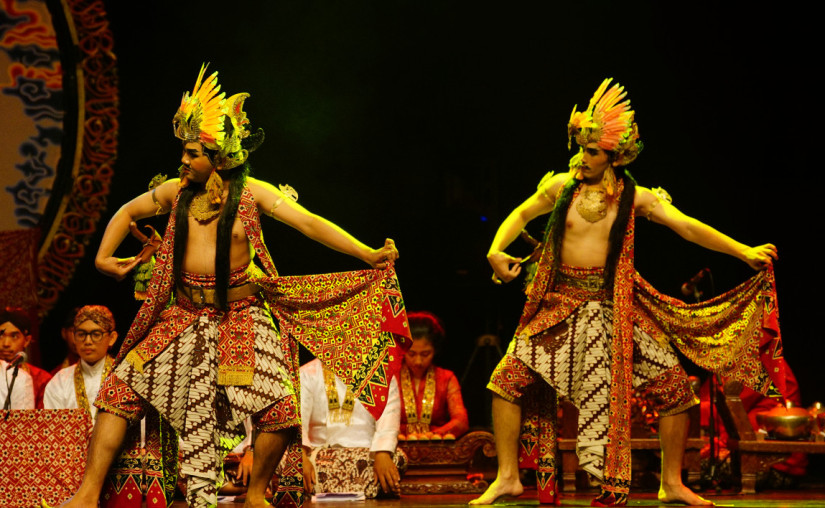
Swagayugama, a UGM student activity unit (UKM) dedicated to preserving Yogyakarta-style Javanese performing arts, held a major performance titled “Cakra Laksana” on Saturday, October 24, at Taman Budaya Yogyakarta. The biennial event, attended by GBPH Prabukusumo and GBPH Yudhaningrat, gave students a chance to develop their creativity while introducing Javanese performing arts to the public.
Lulu Damayanti, head of the production team, said that 210 people were involved in the performance. Included production crew members, performers, alumni, trainers, and other parties who contributed to the event.
“A total of 210 people were involved in this performance, including the production and performance teams, alumni, trainers, and everyone who helped make the event possible,” Lulu said.
She explained that the program featured four main performances: the Klana Alus Cengklek dance, the “Teguh Jiwa” karawitan concert, Beksan Menak Wiragama, and the dance drama “Bahara Gatimaya.” One of the performances portrayed Prince Mangkubumi’s struggle through the performing arts.
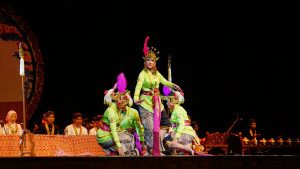
Swagayugama Chair Arnetta Rosana Putri said that the performance was not only to showcase visual beauty but also to convey moral messages and cultural values to the audience.
“We have presented a performance that goes beyond visual beauty. We hope the moral messages and cultural meanings embedded in the performance are conveyed effectively and leave a lasting impression on the audience,” Arnetta said.
She added that preparations for Swagayugama’s 2026 grand performance were guided by the spirit embodied in Mars Kebanggaan, Swagayugama’s anthem that reflects the group’s pride and identity. This spirit inspires students to continue creating artistic works while preserving Javanese arts and culture within UGM.
Swagayugama advisor Dr. Novi Siti Kussuji, M.Hum., said traditional arts performances not only offer beautiful spectacles but also preserve Javanese culture. Behind every dance movement, gamelan accompaniment, sung melody, costume, and stage arrangement lies a lengthy process and the involvement of younger generations in sustaining cultural traditions.
“Culture does not remain alive simply because we acknowledge the past. Culture lives when generations are willing to learn it, practice it, reinterpret it, and pass it on,” she said.
The four performances demonstrated that traditional arts remain relevant amid changing times. Swagayugama also provides a space to develop sensitivity, discipline, and a sense of togetherness through dance and karawitan, a traditional Javanese musical ensemble.
“The artistic process teaches students that a performance is the result of collaboration among various parties who bring together their efforts, ideas, and goals,” she said.
Novi also appreciated the executive committee, the organizing committee for the 2026 Swagayugama Grand Performance, performers, dancers, gamelan musicians, production team, sponsors, partners, and everyone who supported the event.
She hoped the performance would be more than a memory of a completed show and would instead encourage students to remain involved in preserving Javanese culture.
“May there always be younger generations who, amid rapid changes, choose to stand on the cultural stage, look toward the future without losing their roots, and embrace modernity without becoming detached from their traditions. Let us continue to preserve Javanese culture,” she concluded.
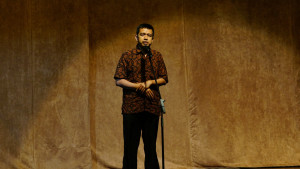
UGM Director of Student Affairs Hempri Suyatna said developing students’ soft skills was one of the university’s student development priorities. Through its soft skills development programs, UGM encourages students to build a range of skills from their first semester through graduation.
These programs aim to develop students who are analytical, ethical, relational, adaptive, practical, beneficial, and innovative. These qualities are expected to help students produce creative work, achieve success, and develop innovations that positively affect society.
He also encouraged Swagayugama students to continue developing Javanese arts and culture through innovation. Cultural preservation can go hand in hand with developing creative works that reach wider audiences, including through digitalization and commercialization.
“Students are expected not only to preserve Javanese culture but also to develop innovations in various forms so that it can become more widely known,” he said.
Student innovation is essential to addressing the challenges of globalization and the digital era. He hoped UGM students’ artistic and cultural works, particularly those produced by Swagayugama, would continue to be developed, digitally documented, and introduced to the public to gain wider recognition and appreciation.
Author: Zabrina Kumara
Editor: Gusti Grehenson
Post-editor: Jasmine Ferdian
Photos: Swagayugama Student Organization Documentation