


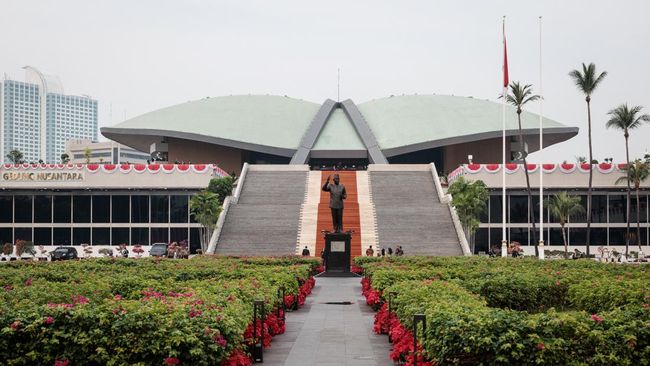
The dominance of government-supporting parties in Indonesia’s House of Representatives (DPR) risks weakening parliamentary oversight of the government. This situation could lead Parliament to accommodate the interests of political elites rather than fulfill its role as an institution that represents and advocates for the public.
Alfath Bagus Panuntun El Nur Indonesia, a lecturer in the Department of Politics and Government at the Faculty of Social and Political Sciences, Universitas Gadjah Mada (Fisipol UGM), said that strong political support in Parliament does not necessarily guarantee effective and democratic governance. In his view, political stability must be balanced by robust oversight to ensure that the exercise of power remains subject to scrutiny.
He explained that political science recognizes the concept of party cartelization, in which parties that should compete instead cooperate to secure their interests and access to power. If this continues, political competition risks losing its meaning, while the house’s functions become increasingly detached from the interests of the public.
“Political stability is indeed necessary, but we must not allow it to become merely an illusion of stability,” Alfath said on Wednesday (October 28).
Alfath added that the main problem is not the house’s lack of authority to oversee the government. Under the Constitution, the house has several oversight instruments, including the right of interpellation and the right of inquiry.
However, the exercise of these powers can be constrained when political parties prioritize compromise to maintain their relationships with the government.
As a result, criticism of government policies may weaken, reducing parliamentary oversight to a mere formality. Yet oversight is essential to ensuring that government policies serve the public interest and that the government can be held accountable for its decisions.
According to Alfath, this situation is also linked to the opposition’s relatively weak position in Indonesia’s political system. When most political parties join the governing coalition, political forces have less space to independently scrutinize the government.
Beyond the governing coalition’s dominance in the house, Alfath highlighted cabinet reshuffles amid ongoing political dynamics. He argued that ministerial changes should be based on competence, performance, and the achievement of government targets, rather than serving solely to balance the interests of political parties within the coalition.
He explained that if cabinet reshuffles are driven primarily by the distribution of political positions, they could disrupt program continuity and coordination between ministries. The government risks becoming more preoccupied with accommodating elite interests than ensuring that policies are implemented effectively and address the needs of the public.
To strengthen the house’s oversight function, Alfath argued that reforms must begin upstream in the political process, particularly within party and electoral systems.
“One important step is to promote internal democratization within political parties so that decision-making does not depend solely on party leaders or elite groups,” he said.
In addition, the party needs greater transparency in political party financing and stronger capacity among its members. Legislators should have access to expert support and data, as well as the ability to communicate public concerns and follow up on the issues raised by their constituents.
Beyond the house, the roles of the press and civil society organizations also need to be strengthened. Both can serve as counterbalances when parliamentary oversight fails to function effectively.
“The essence of this reform is not simply to impose the existence of opposition parties, but to build a political ecosystem in which the public can exercise meaningful oversight over those in power,” he concluded.
Alfath emphasized that strengthening democracy requires more than looking at the number of parliamentary seats held by political parties or the number of cabinet positions they obtain.
More importantly, representative institutions must remain able to oversee the government and advocate for society’s interests.
Author: Adinda Putri Rahma
Editor: Gusti Grehenson
Post-Editor: Priyananda
Photo: AFP