


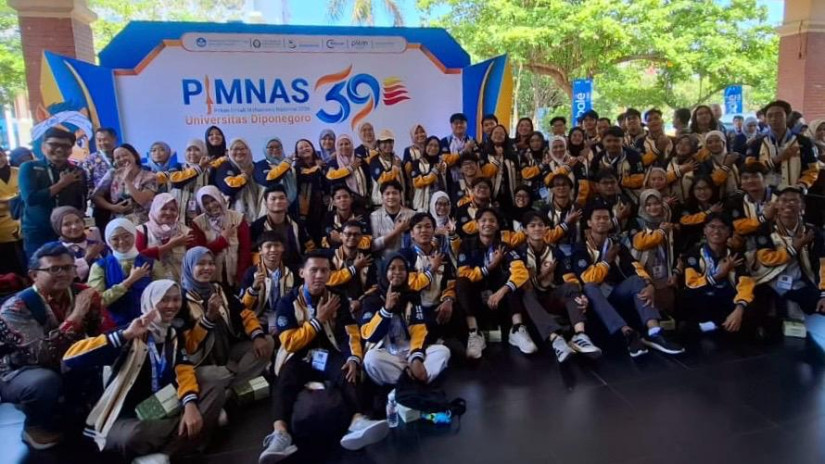
The participation of 43 UGM teams in the 39th National Student Scientific Week (PIMNAS) reflects the hard work and dedication students put into developing their research and innovative projects. The long process up to the competition did not always go smoothly.
They faced difficulties collecting data, limited time, and multiple opinions within their teams. These became part of their journey before they presented to the panel of judges. Three UGM teams shared their experiences preparing their projects and taking part in the judging at PIMNAS 39, held at Universitas Diponegoro in Semarang.
Upik Maulia, a student at UGM’s Faculty of Social and Political Sciences (Fisipol UGM), and her teammates from Clickbait Gang competed in the Social Sciences and Humanities Research category of the Student Creativity Program (PKM-RSH). Their research grew out of clickbait content in affiliate marketing on the social media platform X.
This occurs when posts that initially present news or information are used to draw users’ attention to product promotions. The phenomenon led to an investigation of digital communication practices shaped by commercial interests.
“Our initial idea came from our concerns about affiliate content on X,” Upik said on Friday (Nov. 5).
Clickbait Gang faced challenges when its data collection coincided with the Community Service Program (KKN-PPM) activities of several team members. Individual schedules made coordination and time management more difficult.
The team also could not secure one of the research subjects they had originally planned to interview. As a result, they had to adjust their research approach, switching from interviews to content analysis.
“We initially used interviews, but because we could not reach the subject we had targeted, we eventually had to change our method to content analysis,” she explained.
Upik said the question-and-answer session with the judges was one of the most challenging experiences during PIMNAS. Some questions were unexpected and went beyond what was prepared during practice sessions.
Nevertheless, she and her teammates did their best to provide convincing answers that clearly explained their research findings. Looking ahead, Clickbait Gang also plans to develop a social campaign to raise public awareness of clickbait content and affiliate marketing practices.
“We hope to win gold in both the presentation and poster categories, and, of course, we hope UGM can reclaim the Adhikarta Trophy and become the overall champion at PIMNAS 39,” she said.
A different story came from Davin Izhrel Ngilamele, a student at UGM’s Faculty of Dentistry (FKG UGM) and leader of the PRIME team, which competed in the Student Creativity Program for Innovative Works (PKM-KI). PRIME stands for Phantom Realistic Instruction Model for Extraction. The idea started with dental students practicing tooth extraction before performing the procedure on patients.
Together with his teammates, Davin developed a tooth-extraction simulator that undergraduate dental students and professional dental students can use for practice. The device is expected to help students improve their clinical skills and readiness through a safer learning process.
“We wanted to offer a solution in the form of a tooth-extraction phantom, so undergraduate students and clinical trainees can practice with the device before treating patients,” he said.
During PRIME’s development, Davin acknowledged that communication and time management were the main challenges. Since its members came from different faculties, they had to coordinate their schedules to find time to meet and work on the innovation together.
Team dynamics were not always smooth, as each member had their own commitments and perspectives. Although their motivation occasionally waned during preparations, they kept working until the judging stage.
“The biggest challenge was, of course, working as a team. Communication was essential. Time management was particularly challenging because we came from different faculties, so finding a suitable time to meet took some effort,” he said.
Davin felt relieved after the PRIME team completed its presentation before the judges. He even felt the team performed better during the judging session than in earlier practice sessions. The team members were able to answer the judges’ various questions based on their preparations. Davin hoped their hard work would lead to the best possible results and create opportunities to develop the innovation.
“Of course, we hope to win, but above all, we hope that all the effort we have put in will bring the best possible results,” he said.
Meanwhile, the Runner Space team presented research titled “Merangkai Pola Perkotaan: Studi Sosial Spasial Transformasi Ruang Publik Menuju Ruang Hidup melalui Aktivitas Komunitas Pelari” (“Mapping Urban Patterns: A Socio-Spatial Study of the Transformation of Public Spaces into Living Spaces through Running Community Activities”). Represented by Allysta Putri from UGM’s Faculty of Psychology (Psychology UGM), the team examined the growing presence of running communities in urban spaces.
The phenomenon caught their attention because running activities in public spaces can overlap with pedestrians and other road users. The team seeks to understand how running community activities can be better organized and integrated with urban spaces.
“We wanted to explore how running activities could be better organized and structured within urban spaces,” Allysta said.
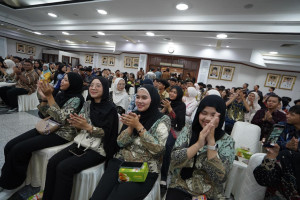
During the research process, the Runner Space team faced several challenges, including differences of opinion among team members and repeated revisions requested by their academic supervisor. Each round of feedback required the team to revisit their research approach and discuss how they had structured their work.
Differences in perspective sometimes led to debates, but these became part of the process of refining their research. Through intensive practice, the team felt better prepared to answer judges’ questions about the theoretical foundation, methodology, and significance of their research.
“We sometimes received repeated revisions from our supervisor, and there were also differences of opinion. But disagreements are a normal part of working as a team,” Allysta said.
The Runner Space team hopes to develop its research further through scientific publications and by expanding the study area. Although the current research focuses on Yogyakarta City, the team sees opportunities to extend it to other areas of the Special Region of Yogyakarta.
Its approach, which connects social and spatial aspects, also offers opportunities to enrich research on urban planning and community activities in cities. For the team, participating in PIMNAS was an opportunity to test their research while appreciating the hard work of every member.
“What matters is that we feel relieved and proud of our team and the other teams from UGM,” Allysta concluded.
Author: Triya Andriyani
Post-editor: Jasmine Ferdian
Photos: Firsto