


A research team from the Faculty of Mathematics and Natural Sciences at Universitas Gadjah Mada (FMIPA UGM), with PT Pertamina Hulu Energi (PHE) through its Upstream Innovation program and PT Elnusa Tbk., has successfully conducted a trial of an underwater seismic sensor, or underwater earthquake sensor, at Saguling Reservoir, West Java, on September 28–29. Known as Prameya (Perangkat Rekam Aktivitas Mikroseismik dan Ekspedisi Yudha Akuatik), the shallow-water ocean-bottom seismometer (OBS) technology was developed for submerged deployment. It is a vibration sensor designed to be placed on the bottom of a body of water to record seismic activity, with a target operating depth of up to 100 meters.
FMIPA UGM lecturer and head of the Prameya development project, Dr. Wiwit Suryanto, said the underwater sensor continues UGM’s previous research on the Gamadu land-based earthquake sensor.
“This is actually a continuation of the sensor we developed before, Gamadu. That was an earthquake sensor, but for land-based applications,” Wiwit said in an interview on Friday (Oct. 2).
The sensor was extended to underwater environments, since Indonesia is predominantly a maritime country and needs technology to monitor seismic activity at sea. Indonesia currently has no underwater earthquake sensor that can be installed and operated continuously. This was one reason the team continued developing the sensor, ultimately producing Prameya.
“We do not yet have an underwater earthquake sensor that can be installed continuously. So, we are trying to develop one ourselves so that we can monitor underwater earthquake activity,” he said.
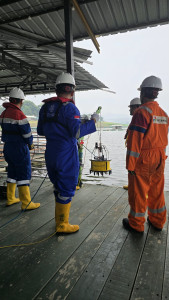
The first trial involved installing the device overnight to test its durability and watertightness while submerged. The test was conducted at a depth of approximately 30 meters, while the reservoir can reach around 80 meters under normal conditions. This stage was selected as an initial test before the device is tested in a marine environment, which requires more complex preparations.
“We installed it overnight to see how it would perform going forward because, as it turns out, making a device watertight underwater is not easy,” Wiwit said.
According to him, withstanding underwater conditions is one of the main challenges in developing Prameya. The previous version was tested only to a depth of about 10 meters, while the latest version is now being tested at depths of up to 30 meters.
In addition to the watertight system, the team is developing a buoy system so the device can be submerged and retrieved.
The initial test results showed that Prameya performed relatively well compared with standard equipment. However, one component of the horizontal sensor still needs improvement. Prameya has three sensor components for recording vibrations, but one of them is still experiencing technical issues and is currently being refined.
“When we tested it on land, the results were actually quite good compared with standard equipment. However, there is still a minor issue with the horizontal component. There are three sensor components that we installed, and one of them is still having problems, but we are currently working to improve it,” Wiwit said.
From a technological perspective, Prameya operates on a principle similar to conventional OBS systems: recording vibrations from the bottom of a body of water. However, the UGM team has developed Prameya with more comprehensive specifications. The device is equipped with a webcam and lights that allow the team to observe the sensor’s position on the bottom of the water, including the surrounding conditions.
“In principle, it is actually quite similar, but we wanted it to have more comprehensive specifications. So, it has a webcam and a camera monitor to see the position of the sensor underwater,” Wiwit explained.
The camera also helps the team observe underwater conditions, where the bottom is not always flat and may be covered with mud. In murky water, the camera’s visibility is limited to approximately 20–30 centimeters, while in clearer water, the device can be seen from a greater distance.
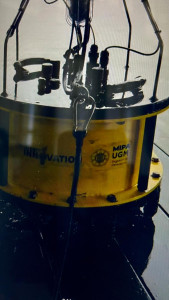
The camera and lights are part of the team’s effort to ensure the device not only records seismic data but also provides information about the equipment’s condition while it is on the bottom.
Developing the device with comprehensive specifications is part of the team’s strategy to build technological capabilities incrementally. By developing the device to higher specifications first, the team can later simplify the technology to meet users’ needs.
“We are aiming for the highest specifications first. If we can make that work, then we will certainly be able to develop versions with lower specifications,” he said.
Following the trial at Saguling Reservoir, Prameya will enter its next testing stage in the open sea in November 2026. The test is planned to take place at Pertamina Hulu Kalimantan Timur (PHKT)’s offshore field, with facilities provided by Pertamina and Elnusa. This stage will involve more complex testing because the device must be lowered from a vessel and weighs approximately 70 kilograms, requiring a crane.
“In November, it will be at Pertamina Hulu Kalimantan Timur, or PHKT. They have an offshore field, and we will use facilities provided by Pertamina and Elnusa,” Wiwit said.
Under the development scheme, Pertamina will finance the research at UGM FMIPA. Once the technology has been developed into a product, Elnusa will take on a role in operating and downstreaming the device. The offshore test is expected to be an important step in assessing Prameya’s readiness before broader applications.
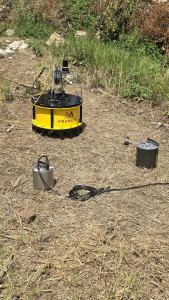
Prameya is not intended solely for monitoring underwater earthquakes. As a vibration sensor, the device can be used for a range of applications, from oil and gas and geothermal exploration and disaster mitigation to monitoring underwater volcanic activity and detecting vessel activity.
“This innovation could become one of the tools for monitoring underwater volcanoes. It can also be used for exploration. This is essentially a vibration sensor, so it has many applications. It can be used for exploration, disaster mitigation, and earthquake monitoring. It can even monitor vessels, as vessel activity can be detected,” Wiwit explained.
Wiwit hopes Prameya can support exploration activities by companies in Indonesia and abroad. In addition, the device is expected to be utilized by the Meteorology, Climatology, and Geophysical Agency (BMKG) to monitor earthquake activity in deep-sea areas, which remain largely unmonitored.
“If this is successful, it can be used to support exploration by exploration companies in Indonesia and abroad. We also hope that BMKG can eventually use it to monitor underwater earthquakes. Our deep-sea areas have not yet been extensively explored, even though they actually have enormous potential,” Wiwit concluded.
Author: M. Aidil Syahputra
Editor: Gusti Grehenson
Post-editor: Jasmine Ferdian
Photograph: Research Team Documentation