


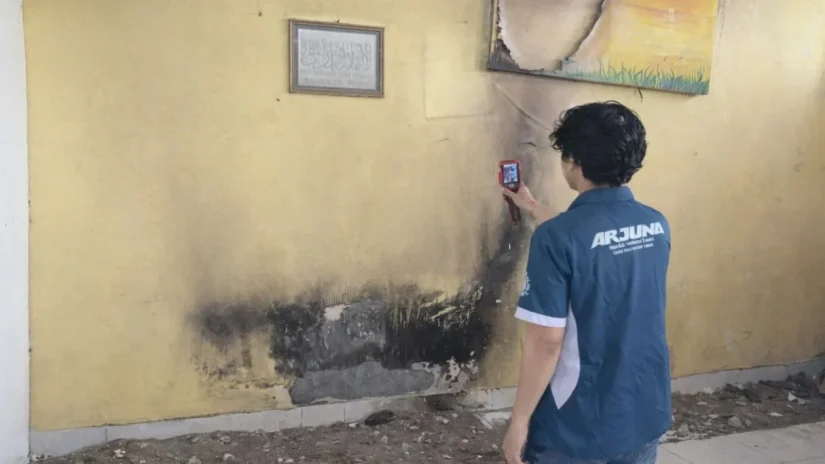
A series of unexplained fire incidents has occurred at a resident’s home in Kasuran Hamlet, Margomulyo Village, Seyegan District, Sleman, Yogyakarta. A team from the Center for Entropy Deceleration Studies (PKPE), Faculty of Engineering, Universitas Gadjah Mada (FT UGM), has conducted direct field observations to investigate the factors triggering the fires at the residence. The investigation also involves experts from Universitas Pembangunan Nasional Veteran, the Center for Geological Disaster Technology Research and Development, and local authorities.
Burned household items found in various parts of the house indicate that the fire hotspots have appeared unpredictably across different locations. Mutfiana, the homeowner, first discovered a fire hotspot on Saturday (May 23). In the days that followed, the number of fire occurrences continued to increase, reaching 65 hotspots. By the time the expert team conducted its second observation on Monday (Jun. 1), the fires had reportedly occurred approximately 73 times. On some days, fires are estimated to emerge as many as seven to nine times within the house.
Before the latest monitoring, the team had conducted an initial observation on Saturday (May 30). Led by Professor Alva Edy Tontowi, the team examined several areas that had experienced fires, including water pipeline networks, wastewater channels, the age of the infrastructure, and the locations of the fires. He explained that the occurrence of fire is closely related to the interaction of the elements within the fire triangle. These elements consist of heat, oxygen, and fuel or combustible material.
“A fire occurs when the three elements of the fire triangle are present in optimal conditions. The ignition occurs within the materials involved. In this case, one of the media was a T-shirt, while previous incidents involved plastic and other materials,” he explained.
Following the initial assessment, the expert team obtained information indicating that the residential area had been a swamp, characterized by moist conditions and abundant organic material capable of generating significant amounts of methane. Based on this finding, the team conducted field measurements using a thermal gun.
Dr. Sardju Winardi, a lecturer in the Department of Geological Engineering, explained that, in theory, water contaminated with methane does not immediately ignite while still underground because combustion requires a specific concentration.
“Combustion occurs when the water reaches the surface and interacts with oxygen, allowing the methane to escape. It is the release of methane from the water that makes it combustible,” he said.
In addition to wastewater and methane gas, the experts also examined the electromagnetic field surrounding the property. The source of the fires has been determined to be non-electrical, as under certain conditions, fires can occur spontaneously without an electrical ignition source.
In this case, wastewater is suspected to be the primary trigger. As a result, the team collected samples of wastewater, piped water, and well water from the area for further analysis.
The collected samples will be examined using laboratory test results to comprehensively and objectively identify the source and mechanism of the fires. The findings will serve as the basis for determining appropriate mitigation measures.
Professor Tontowi stated that his team is currently conducting laboratory analyses using data gathered during field observations. The scientific test results are expected to be released in the near future to determine the cause of the recurring fire outbreaks at the residence.
Author: Ika Agustine and Naufal (Faculty of Engineering UGM Public Relations)
Editor: Gusti Grehenson
Post-editor: Rajendra Arya
Photo: VivaNews and Faculty of Engineering UGM Documentation