


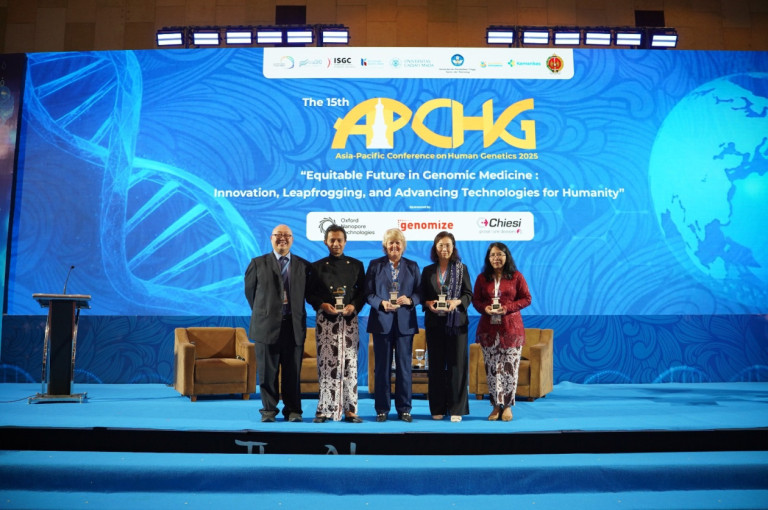
Advances in biotechnology and genetic research continue to progress rapidly, yet not all countries are able to integrate genomic medicine into their healthcare systems. Through the 15th Asia-Pacific Conference of Human Genetics (APCHG) 2025, hosted by the Faculty of Medicine, Public Health, and Nursing of Universitas Gadjah Mada (FK-KMK UGM), various scientific breakthroughs are expected to help identify strategies to ensure that genomic medicine is applied fairly and equitably.
The Minister of Health of the Republic of Indonesia, Budi Gunadi Sadikin, stated that behind the wealth of knowledge being shared today, stakeholders are building hope by strengthening collaboration and advancing ethical, inclusive, and human-centered genomic medicine.
He therefore expressed his appreciation for the convening of the APCHG 2025. According to him, the conference demonstrates Indonesia’s ability to take on a strategic role in global collaboration.
“This conference brings together academics, clinicians, policymakers, and innovators with a shared mission to advance scientific knowledge for the benefit of humanity,” he said.

The five-day APCHG 2025 conference, held on November 4 to 8, 2025, at The Alana Hotel and Convention Center, Yogyakarta, adopted the theme “Equitable Future in Genomic Medicine: Innovation, Leapfrogging, and Advancing Technologies for Humanity”.
Through this theme, the conference aims to support the realization of equal access to genomic medicine. The event was attended by scientists, physicians, and researchers from various countries across the Asia-Pacific region.
Professor Gunadi, Chair of APCHG 2025 and President of the Indonesian Society of Human Genetics, expressed his hope that the five-day forum would serve as a meeting ground for genetic experts to share their research findings.
He also encouraged participants to develop collaborative initiatives and discuss the future of genomics-based treatment, emphasizing that the greatest challenge in genomic medicine lies not only in scientific development, but also in ensuring its direct impact on patients.
“It is not enough to understand genomics as a science. The real challenge is transforming innovation into accessible care and ensuring that every patient benefits from genomic medicine. Yogyakarta offers rich cultural heritage and a strong collaborative spirit, making it an ideal place to build new partnerships for advancing human-centered genomic medicine,” he explained.

He further noted that APCHG 2025 was organized by FK-KMK UGM in collaboration with the Indonesian Society of Human Genetics (InaSHG) and the Asia-Pacific Society of Human Genetics (APSHG), with support from the Indonesian Society of Genetic Counselors (ISGC), the Yogyakarta Provincial Health Office, and the Indonesian Ministry of Health.
According to Professor Gunadi, this collaboration represents a collective effort to bridge knowledge gaps in genomic medicine so its benefits can reach all segments of society.
“Beyond high-income countries in the Asia-Pacific region, this inter-institutional collaboration reflects a shared commitment to overcoming disparities in genomic knowledge so that advancements in genetics can eventually be enjoyed by all,” he stated.
In addition to plenary sessions and symposia, APCHG 2025 also featured workshops, including the Genome Sequence and Variant Interpretation Workshop, the Inborn Errors of Metabolism Workshop, and the PSGCA Genetic Counseling Workshop, organized by the Professional Society of Genetic Counselors in Asia (PSGCA).
All sessions were designed to expand participants’ capacity to apply genomic techniques, offering opportunities to discuss practices, challenges, and the implementation of technology in modern genetics.
Author: Ika Agustin
Editor: Agung Nugroho
Post-editor: Rajendra Arya