


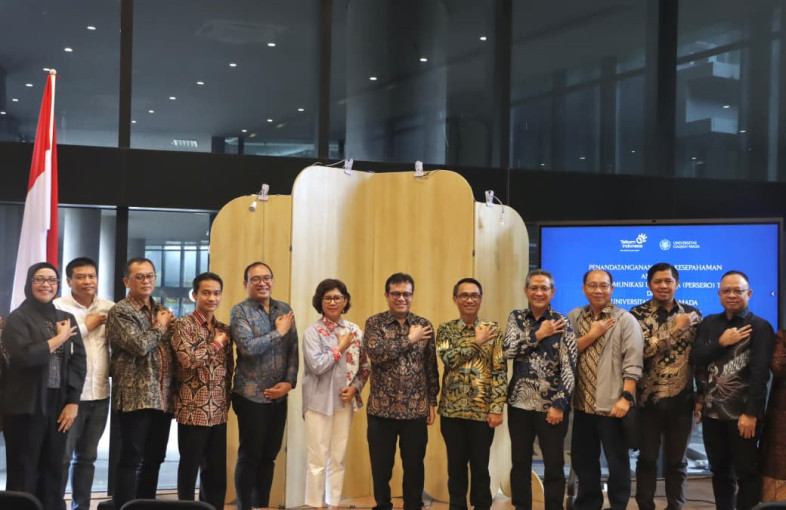
Following the launch of the Artificial Intelligence Center of Excellence (AI CoE), PT Telkom Indonesia (Persero) Tbk has accelerated efforts to strengthen the national AI ecosystem by partnering with Universitas Gadjah Mada (UGM). This commitment was formalized through the signing of a Memorandum of Understanding (MoU) at the UGM Innovation and Creativity Hub (GIK UGM) last Saturday (Nov. 15), marking a strategic effort to bolster digital talent and promote inclusive AI utilization for Indonesia’s digital advancement.
The collaboration was signed by the Senior General Manager of Telkom Corporate University, Muhammad Subhan Iswahyudi, and UGM Vice-Rector for Research, Business Development, and Partnerships, Dr. Danang Sri Hadmoko.
The signing ceremony was witnessed by the Deputy Minister of Communication and Digital Affairs of the Republic of Indonesia, Nezar Patria; Telkom Digital IT Director, Faizal Rochmad Djoemadi; and UGM Rector, Professor Ova Emilia.
The Deputy Minister of Communication and Digital Affairs, Nezar Patria, commended the establishment of the AI CoE at UGM as an important form of collaboration in an era of rapidly advancing technology.
“The AI Center of Excellence to be established at UGM represents a form of collaboration. We need broader, more extensive, and more intensive collaboration in various fields because we are racing through a very crucial era for 21st-century development,” he explained.
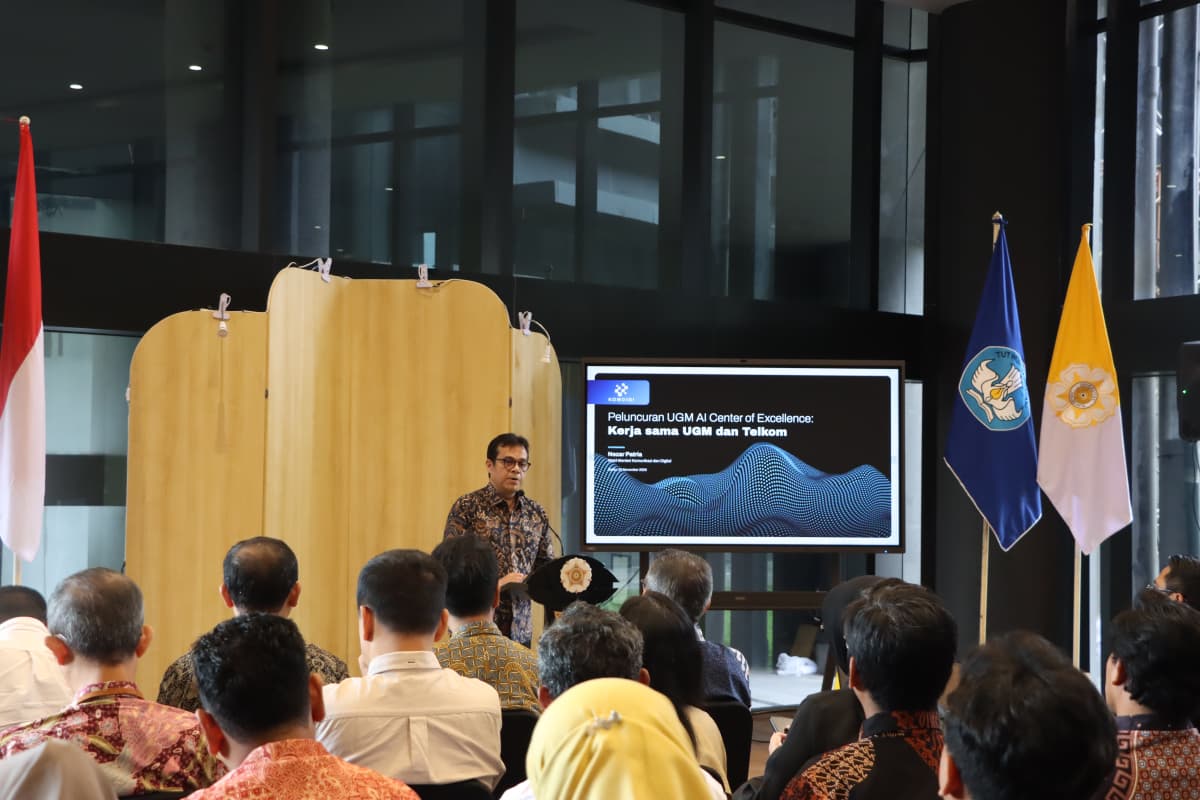
He emphasized that adopting technologies such as AI is a strategic step to help Indonesia escape the middle-income trap. For this reason, technology adoption must begin as early as possible to enable the nation to move beyond this challenge.
Professor Emilia noted that interest in AI at UGM is very high, even beyond the engineering faculties.
“Our 2024 digital transformation study shows that 70 percent of non-engineering researchers are interested in developing AI-based research,” she said.
However, this growing interest still faces several challenges, including infrastructure, access to computational devices, and supporting ecosystems. The rector explained that AI has become a fundamental necessity in advancing the university’s tridharma.
“There is so much we can leverage, from automation to speed and accuracy. All of these elements support what we are striving to achieve, from transforming education and research to improving services and administration,” she emphasized.
Given this context, the rector affirmed that the AI CoE will serve as a strategic solution for strengthening Indonesia’s AI ecosystem.
“With this AI CoE initiative, we hope to establish a strategic entity for the university, not only for UGM, but also for universities across Indonesia and for the nation, enabling us to build strong infrastructure, a hub for collaboration, and a catalyst for impactful innovation,” she said.
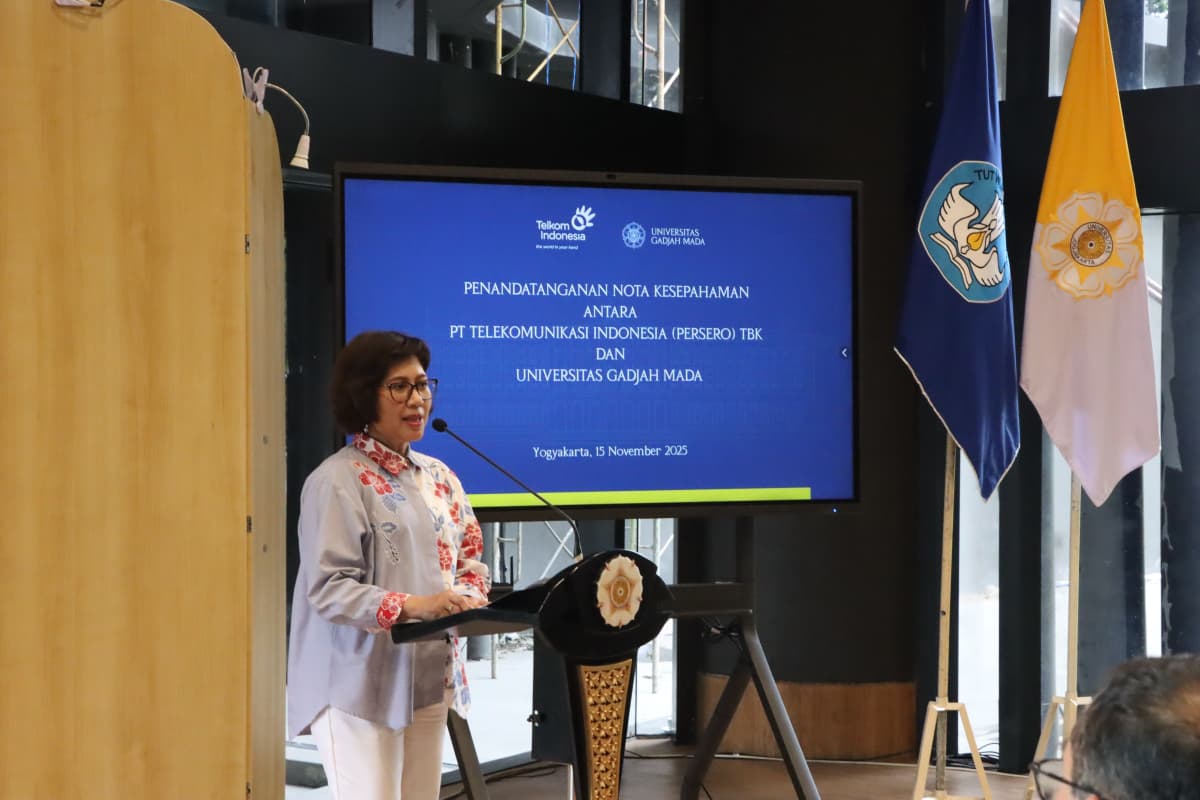
From the industry perspective, Telkom Digital IT Director, Faizal Rochmad Djoemadi, viewed the collaboration as an ideal synergy between higher education and industry. He explained that Telkom holds strengths in understanding market needs.
“Our skills are pull-based; whatever the market requires, we look for the solution,” he said.
Djoemadi also underscored the importance of innovation and collaboration.
“Innovation cannot be carried out by Telkom alone. It must be supported by others. Upstream innovation lies in universities, while downstream innovation lies in industry. When these two entities come together, the results are extraordinary,” he concluded.
The AI CoE is a Telkom initiative to strengthen the national AI ecosystem through four key pillars that connect universities, research, practitioners, and industry solution development.
Through this partnership with UGM, development will focus on exploring innovations in the energy sector, such as the use of acoustic sensors on fiber-optic networks, and on downstreaming health research through technologies such as e-Tongue and e-Nose.
To support the advancement of digital talent, both institutions will also establish an AI Learning Center, develop learning modules, and create capacity-building programs with experts.
Author/Photographer: Aldi Firmansyah
Editor: Triya Andriyani
Post-editor: Rajendra Arya