


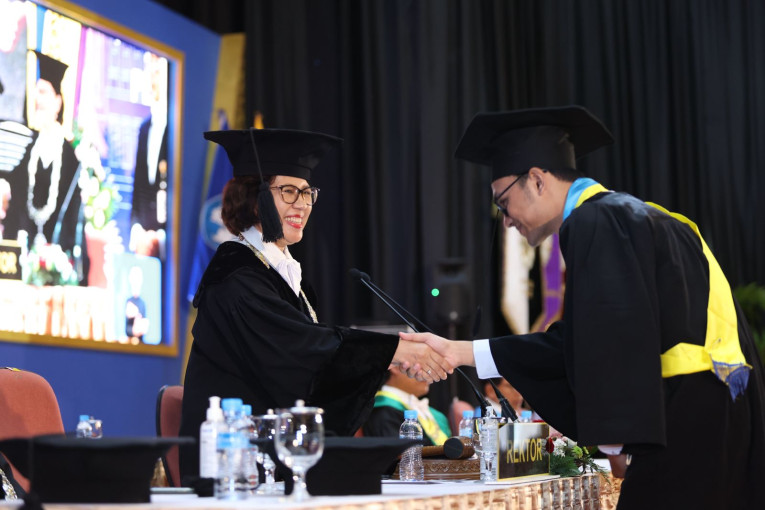
Universitas Gadjah Mada (UGM) graduated 1,729 Bachelor’s students and 423 Applied Bachelor’s students at the First Period of the Bachelor’s and Applied Bachelor’s Graduation Ceremony for the 2025/2026 Academic Year. This period’s graduation was held over two days, and on the first day, UGM conferred degrees upon 1,040 Bachelor’s and Applied Bachelor’s graduates from seven faculties: the Faculty of Philosophy, Faculty of Law, Faculty of Pharmacy, Faculty of Mathematics and Natural Sciences, Faculty of Animal Science, Faculty of Psychology, Faculty of Social and Political Sciences, and the Vocational College.
Presiding over the first day of the ceremony, UGM Rector Professor Ova Emilia, stated that preparing excellent human resources and advancing research to generate impactful innovation has become a new paradigm in higher education.
She expressed hope that research and innovation outcomes would open more opportunities for collaboration with industry while strengthening an innovation ecosystem that supports national self-reliance, expands employment opportunities, and contributes to the growth of the creative industry.
“Congratulations to all graduates who have successfully earned their Bachelor’s and Applied Bachelor’s degrees at Universitas Gadjah Mada. UGM’s Bachelor’s and Applied Bachelor’s programs consistently strive to prepare excellent graduates who are ready to enter the workforce with comprehensive knowledge and skills,” she said at Grha Sabha Pramana, on Tuesday (Nov. 25).
The rector noted that the awarded degrees should serve as a starting point for graduates to contribute to national development.
Through community service programs such as MSME empowerment and the promotion of inclusive education, UGM continues to encourage students to hone their competencies and develop critical thinking skills by engaging directly with the dynamics of social realities.
With the various stages they have undergone, UGM graduates are expected to embody the mindset of “new leaders,” agents of renewed change, new paradigms, and fresh innovations, by optimizing their potential within their respective professional fields.
Rector Emilia expressed confidence that UGM graduates possess strong competencies, independence, critical thinking abilities, and social responsibility.
“I also hope that you will become graduates and development actors who are creative, innovative, and competitive in the future. We are grateful that in September 2025, UGM once again recorded a national achievement as one of the top three universities with the highest number of successful proposals, 48 research proposals, selected for the 2025 Priority Research Downstreaming Program by the Ministry of Higher Education, Science, and Technology. This achievement further reinforces UGM’s commitment to advancing research and innovation that benefits society,” she concluded.
Dr. Heru Dewanto, Expert Board Member of KAGAMA representing the KAGAMA Central Board, stated that UGM equips its graduates not only with knowledge but also with noble values, particularly empathy and a people-centered spirit.
“UGM teaches us not only to be intelligent but also to care. Graduates are expected to be intellectually capable while remaining sensitive to their surroundings,” he said.
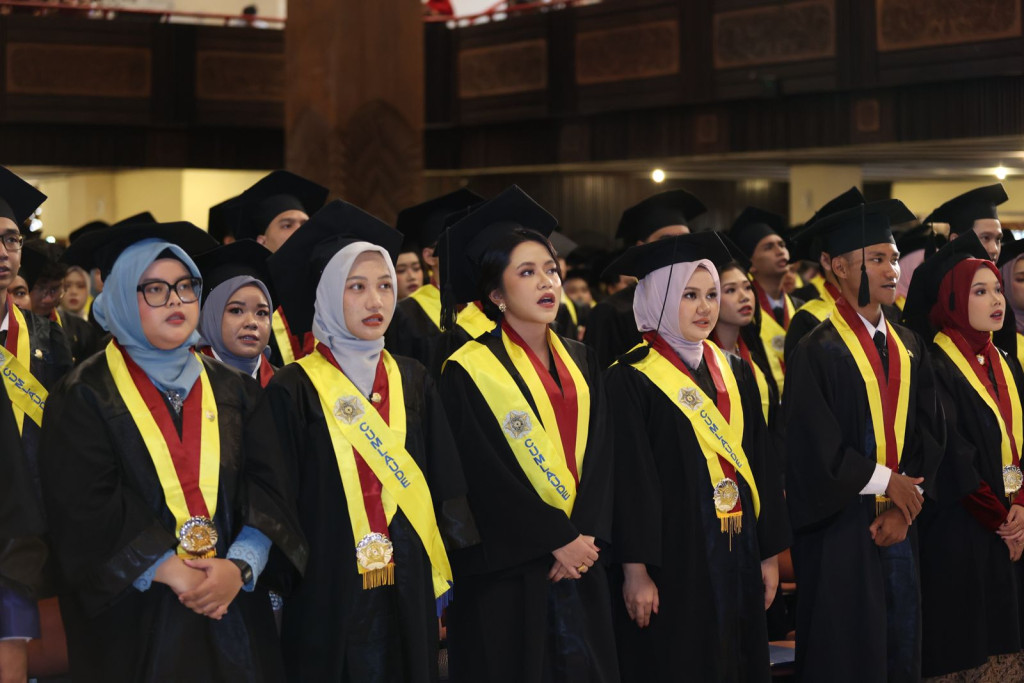
Another essential value expected to remain embedded in every UGM graduate is humility.
According to Dr. Dewanto, UGM alumni are known for being humble, unpretentious, and grounded, yet courageous, hardworking, and resilient. Graduates are also encouraged to cultivate the spirit of srawung or fellowship.
“It is expected that graduates will be able to build friendships, networks, and relationships across regions, faculties, and even generations. In today’s hyper-connected world, networking is not only a tool for finding jobs but also for creating them. By nurturing these three values: empathy, humility, and networking, UGM graduates will be able to thrive anywhere, in any era,” he explained.
Representing the graduates, Ismail Ahmad Nabil Abdurrahim shared that studying at UGM is not merely an intellectual pursuit but also a moral responsibility.
Earning a degree, he said, is not the end of the journey but an invitation to work with greater honesty, sensitivity, and courage in contributing to society.
“In a rapidly changing world, new challenges will always emerge, and the future demands not only intelligence but also integrity, empathy, and the willingness to continue learning,” said the graduate from the Bachelor’s Program in Pharmacy, Faculty of Pharmacy.
During this graduation period, female graduates numbered 1,235 (57.39%), while male graduates totaled 917 (42.61%).
The average study duration for the Bachelor’s Program was 4 years and 4 months, with the fastest completion achieved by Trixi Karinina Dewi Sindhutomo from the Public Policy and Management Program, Faculty of Social and Political Sciences, who completed her degree in 3 years and 27 days.
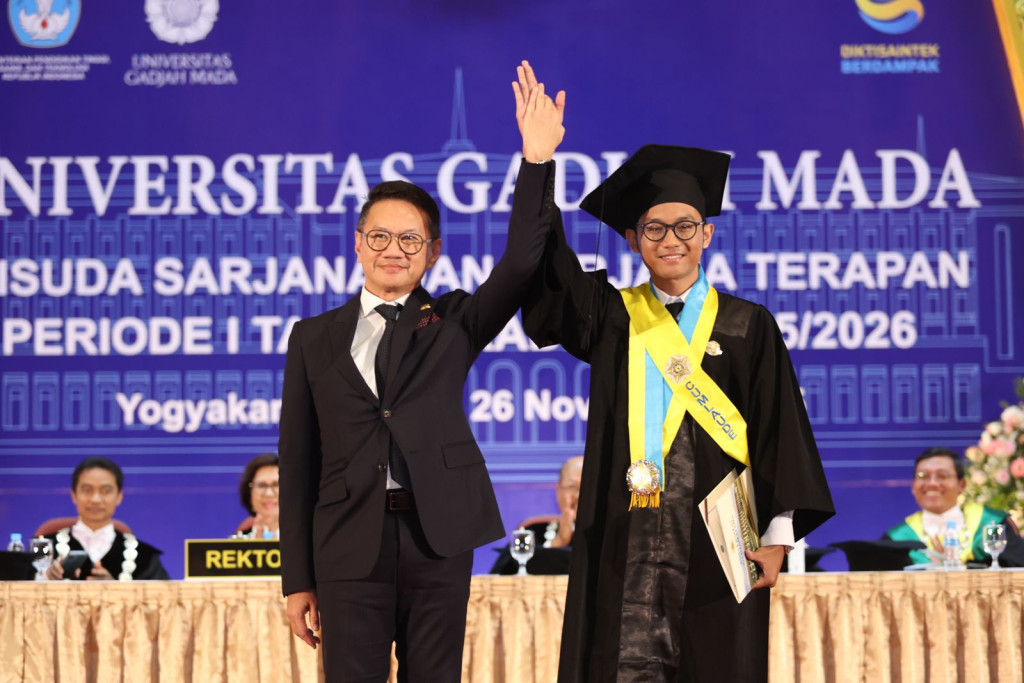
The average age of Bachelor’s graduates was 22 years, 6 months, and 15 days, with the youngest graduate being Farras Ulinnuha from the Medical Education Study Program, Faculty of Medicine, Public Health, and Nursing, who completed the program at 19 years, 8 months, and 17 days.
The average GPA for Bachelor’s graduates this period was 3.51, with 1,045 graduates (60.44%) earning cum laude, 623 graduates (36.03%) earning very satisfactory, 36 graduates (2.08%) earning satisfactory, and 25 graduates (1.45%) graduating without honors.
The highest GPA among Bachelor’s graduates was achieved by Sania Nadlirotullubba from the Computer Science Program, Faculty of Mathematics and Natural Sciences, who earned a 3.98 GPA with cum laude honors.
Meanwhile, the Applied Bachelor’s Program recorded an average study duration of 4 years and 1 month, with the shortest study period achieved by Prima Azha Tridayana from the Civil Construction Engineering Technology Program at the Vocational College, who completed the program in 3 years, 11 months, and 1 day.
The average age of Applied Bachelor’s graduates during this period was 22 years, 6 months, and 15 days, with the youngest graduate being Aji Bambang Sasongko from the Instrumentation and Control Engineering Technology Program at the Vocational College, who graduated at 20 years, 8 months, and 28 days.
The average GPA for Applied Bachelor’s graduates this period was 3.64, with 139 graduates (32.86%) earning cum laude, 282 graduates (66.67%) earning very satisfactory, and two graduates (0.47%) graduating without honors.
The highest GPA was achieved by Sukma Nurfadilah from the Health Information Management Program at the Vocational College, with a 3.98 GPA and cum laude honors.
Author: Agung Nugroho
Post-editor: Lintang Andwyna
Photographer: Firsto Adi