


Universitas Gadjah Mada (UGM) hosted a visit and the signing ceremony of a memorandum of understanding with PT Cosmo GFRP Indonesia at the Rector’s Reception Room, UGM, on Thursday (Dec. 4). The agenda marked the opening of opportunities to strengthen partnerships between the UGM Faculty of Engineering (FT UGM) and PT Cosmo GFRP Indonesia in advancing education, research, and community service.
The company operates in the general manufacturing industry, focusing on the production of environmentally friendly construction materials. It manufactures products using Glass Fiber Reinforced Polymer (GFRP) technology, which is considered to have significant potential to meet future material needs that demand greater strength, corrosion resistance, and efficiency.
The Vice Rector for Research, Business Development, and Partnerships, Dr. Danang Sri Hadmoko, expressed his appreciation for the initiative. He noted that GFRP technology and products are highly relevant to research and development needs at FT UGM, particularly in civil engineering.
“We hope this collaboration can be followed up more concretely, especially in joint research and product development,” said Dr. Hadmoko.
He added that the collaboration could be expanded beyond UGM and Cosmo by involving Seoul National University (SNU), which has long been a partner of UGM. According to him, a three-party synergy could accelerate the development of globally recognized products, joint research initiatives, and student exchange programs.
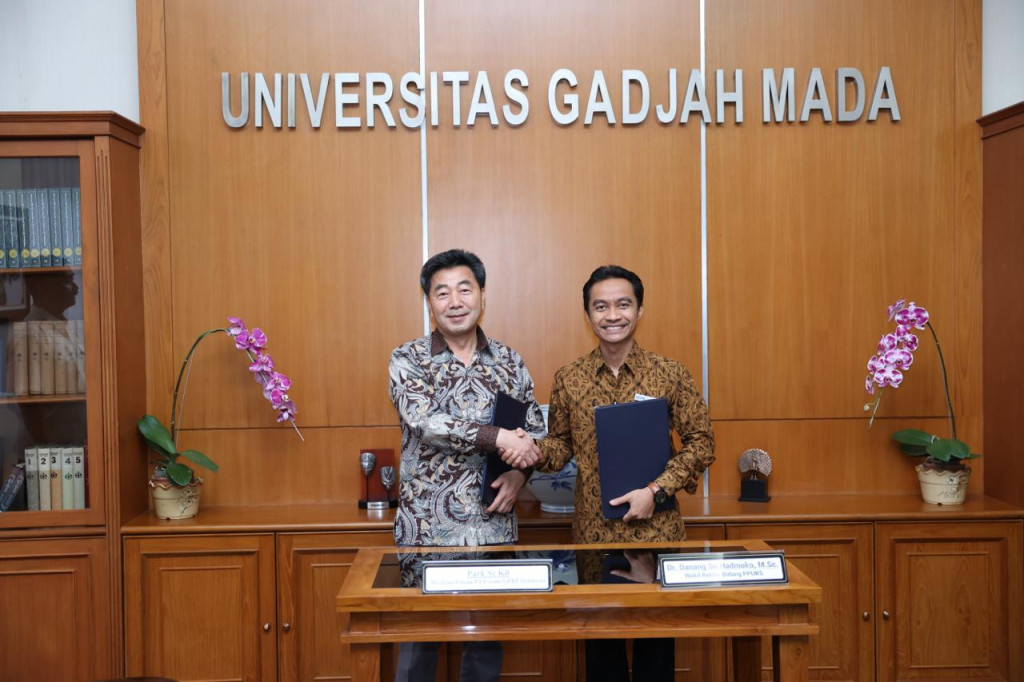
A representative of PT Cosmo GFRP Indonesia, Mr. Park Se Kil, conveyed the company’s enthusiasm for opening collaborative opportunities with UGM. He revealed that extensive research on glass fiber and composite materials is currently underway at SNU, and this opportunity could be linked to UGM’s research capacity.
Park explained that Indonesia has vast potential for raw materials, including silica derived from volcanic activity. These resources present long-term opportunities to develop domestic glass fiber production in Indonesia.
“If Indonesia can produce its own glass fiber raw materials, the market potential is enormous. We hope collaboration with universities can expand research and generate innovations,” he said.
Professor Ali Awaludin, from FT UGM, also noted that Indonesia faces serious challenges related to high corrosion rates, particularly in coastal areas and regions with heavy rainfall. Therefore, corrosion-resistant GFRP materials are seen as an appropriate solution for long-term construction.
“If we can produce the fibers ourselves, that will be the key. We have abundant mineral resources,” he added.
Dr. Hadmoko concluded the meeting by emphasizing that collaboration between industry and universities represents an ideal model for accelerating innovation and advancing knowledge. He expressed optimism that the partnership would not only benefit UGM and Cosmo but also open opportunities for international collaboration.
“We are ready to support efficiency research, product development, and other research and development activities,” he said.
Author: Hanifah
Editor: Gusti Grehenson
Post-editor: Rajendra Arya
Photographer: Firsto Adi