


Six dalang (traditional Javanese puppeteers) enlivened the Rajamala Ruwat wayang kulit (shadow puppet) performance held to commemorate the 76th Anniversary of Universitas Gadjah Mada (UGM). The wayang kulit performance, staged at the Joglo of the UGM Innovation and Creativity Hub (GIK UGM) on Sunday night (Dec. 14), was a Wayang Kulit Purwa madya ratri (midnight) performance presented by members of the UGM academic community and Gadjah Mada Alumni Association (Kagama) across generations.
The six dalang were Ki M. Rafi Nur Fauzi (student of the Faculty of Cultural Sciences), Ki Gymna Cahyo Nugroho (student of the Vocational College), Ki Faizal Noor Singgih (Kagama from the Faculty of Agricultural Technology), Ki Gilang Thomas Kumoro (Kagama from the Faculty of Geography), Ki Jack Haryanto (staff at the UGM Secretariat), and Ki Professor Suryono (Dean of the Faculty of Dentistry and Chair of the 76th UGM Anniversary Committee).
The performance opened with the Umbul Donga Kebangsaan ritual, followed by the inaugural staging of Bedhaya Sesanti Gadjah Mada, accompanied by the Karawitan Ensemble of the Student Arts Family.
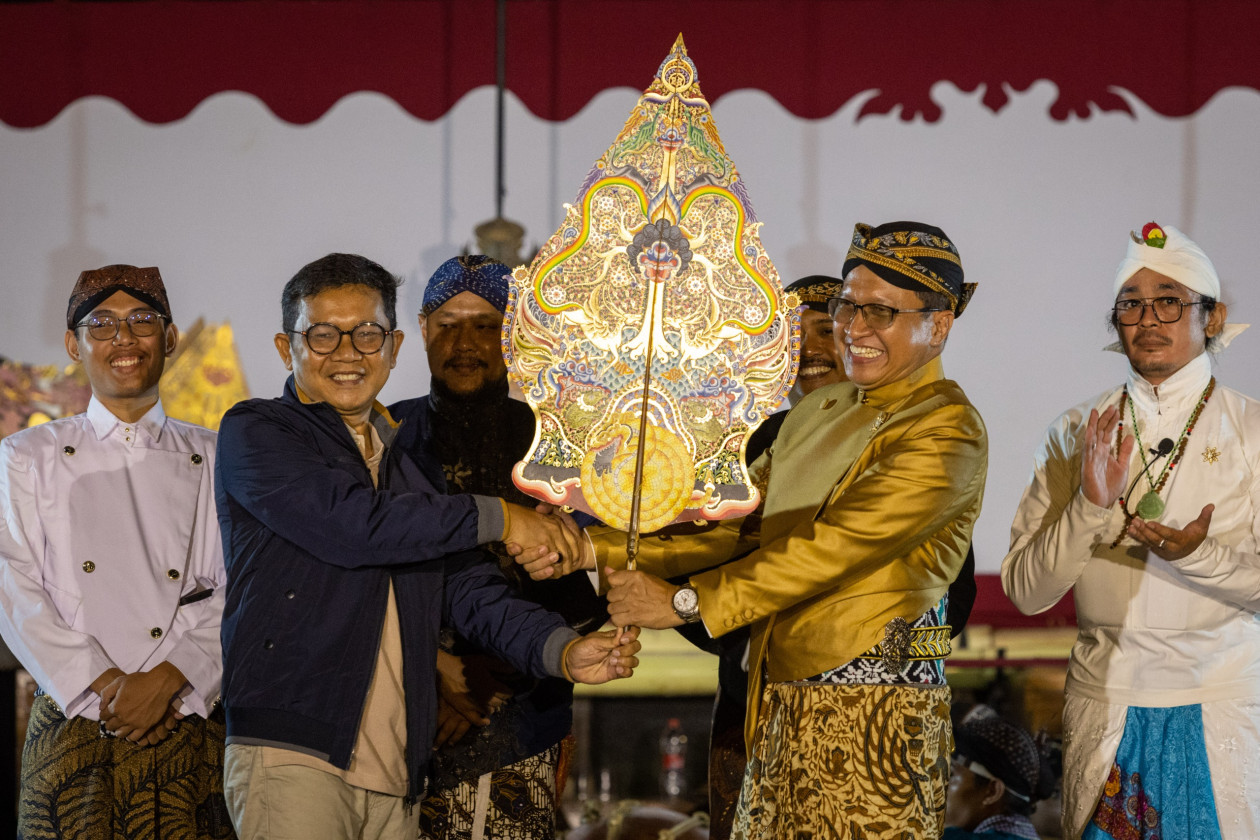
UGM Vice Rector for Student Affairs, Community Service, and Alumni, Dr. Arie Sujito, stated that the wayang kulit performance organized by UGM is a long-standing tradition held as part of the university’s anniversary celebrations.
This year, UGM presented the Rajamala Ruwat story, a narrative closely associated with efforts to build traditions that place culture as both an instrument and a source of knowledge in advancing civilization and public welfare.
Stories such as this, he noted, serve as reminders of life’s historical journey and can function as mirrors for reflection.
“This time, I would like to express my gratitude and pride because we have Rafi Nur Fauzi, a student puppeteer from the Faculty of Cultural Sciences, Ki Gymna Cahyo Nugroho from the Vocational College, Ki Gilang Thomas Kumoro from the Faculty of Geography Kagama, and Ki Faizal Noor Singgih from the Faculty of Agricultural Technology Kagama,” Dr. Sujito said.
“With two students and two alumni participating, I extend my sincere appreciation. What is also interesting is the presence of dalang limbukan, who add color to the performance, namely Ki Jack Haryanto and Ki Professor Suryono.”

According to Dr. Sujito, the wayang kulit performance is part of an effort to reaffirm UGM’s identity as a people-oriented university and a cultural institution committed to preserving and nurturing historical values and the depth of civilizational knowledge.
“Art performances like this have long been observed and appreciated, and for thousands of years before the Common Era, they have served as forms of expression rich with moral messages for practical life. During the era of the Wali Songo, Sunan Kalijaga, for instance, disseminated teachings through Ringgit Purwa performances,” he explained.
The synopsis of the Rajamala Ruwat: The Dusk of Malady storyline tells of the Pandawa’s disguise in the Kingdom of Wiratha, which was not merely an act of exile but a noble mission to ‘heal’ the chronic illness.
Viruses or bacteria did not cause this illness; instead, it took the form of social maladies (corruption, collusion, and nepotism) perpetrated by Wiratha’s oligarchic elite circle, involving Kencaka, Rupakencaka, and Rajamala.

Ki Jack Haryanto explained that the Rajamala Ruwat performance’s synopsis focuses on a narrative that highlights and critiques current socio-political conditions. The depiction of state officials selected for political reasons, leading to nepotism and incompetence, serves as social criticism of elites who disregard the struggles of grassroots communities.
“The Pandawa’s decision to disguise themselves as ordinary people represents a bottom-up social movement aimed at driving fundamental change in the nation’s condition, a movement to ‘ruwat’ or cleanse a country burdened with complex problems,” he concluded.
Author: Agung Nugroho
Post-editor: Rajendra Arya
Photographer: Donnie Trisfian