


Floods and landslides that have struck Aceh, North Sumatra, and West Sumatra have caused extensive damage and losses for local communities. According to the National Disaster Mitigation Agency (BNPB), as of December 18, the death toll across the three affected provinces has reached 1,059 people and may continue to rise. In addition, 192 people remain missing, and around 147,000 houses have been damaged. In response, the government plans to promptly construct temporary and permanent housing for affected residents.
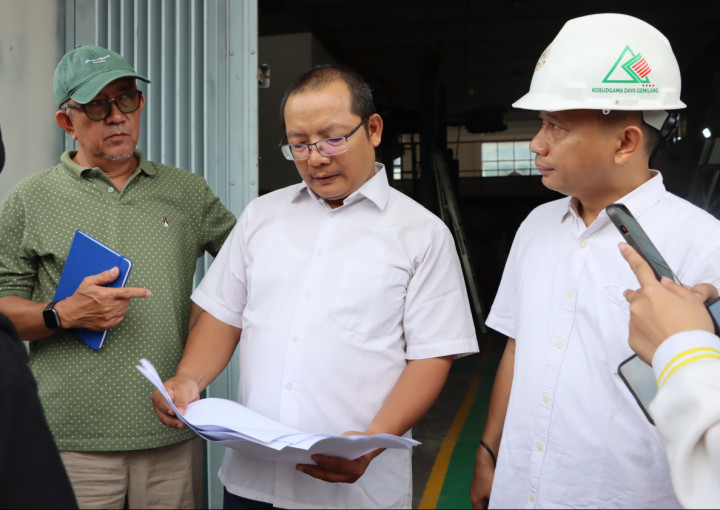
Universitas Gadjah Mada (UGM), through the “Tangguh” research group collaboration between Architecture, Civil Engineering, and Urban and Regional Planning, is currently preparing a project to design decent temporary housing for disaster survivors.
The researchers involved in this group include Professor Ikaputra, Dr. Ashar Saputra, Maria Ariadne Dewi Wulansari, Dr. Atrida Hadianti, and Dr. Ardhya Nareswari.
Dr. Nareswari, one of the researchers, explained that the concept emerged in response to on-the-ground conditions.
The huge number of victims, extensive building damage reaching tens of thousands of units, and the remoteness and limited accessibility of affected areas mean that recovery and permanent housing construction will take a long time, potentially taking years.
Meanwhile, survivors do not yet have decent places to live while waiting for permanent housing to be built. She believes that tarpaulins and emergency tents alone are not adequate to accommodate residents for such an extended period.
“It is very likely that residents will remain in these locations for a long time before permanent housing is available. In that sense, relying only on tarpaulins or temporary tents feels inhumane,” she said on Friday (Dec. 19), during the construction of the temporary housing mock-up at the Structural Laboratory of the Department of Civil and Environmental Engineering, Faculty of Engineering (FT UGM).
According to her, the principles of transitional housing must prioritise human dignity by providing standard-sized, family-based housing rather than communal shelters. The design also uses local, recyclable materials, which in this case are driftwood carried by floodwaters, readily available on site. In addition, it employs simple technology with wooden connections without complex joinery.
“Equally important is involving survivors in the construction process to strengthen their sense of ownership,” she explained.
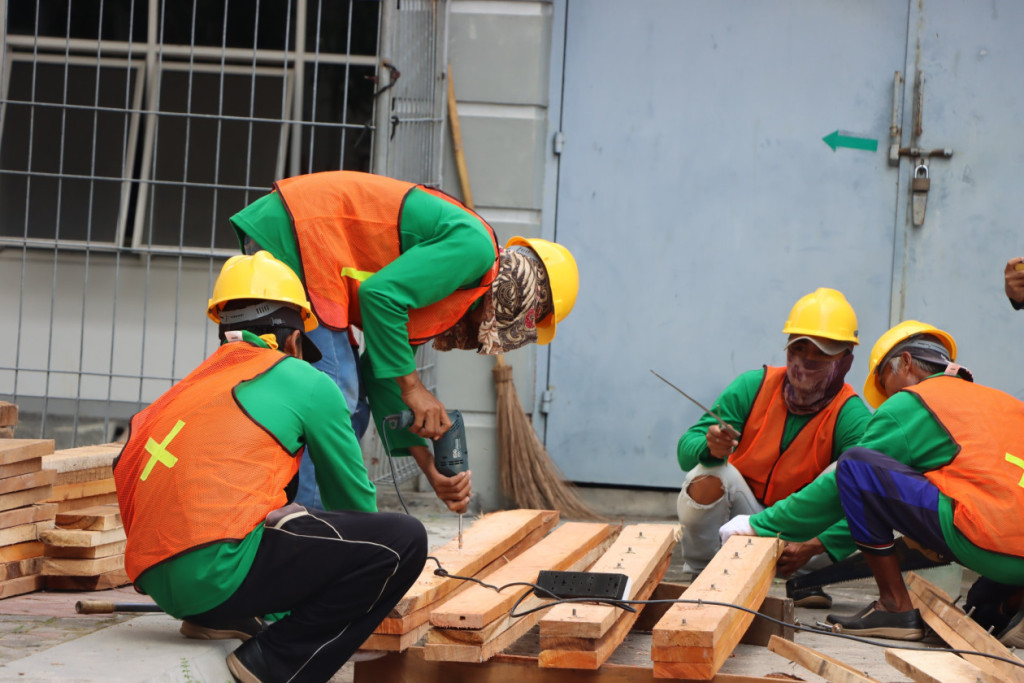
Regarding the structural design, Dr. Ashar Saputra stated that the concepts for both temporary and permanent housing use wooden planks measuring 3 x 12 cm. The primary material selected is wood sourced from flood debris, which is relatively durable for up to three to four years under various weather conditions.
“The structure uses only bolts, and the only tool required is a drill. The idea is to keep it very simple so that laypeople can build their own homes, attach, clamp, and bolt,” he said.
Furthermore, adopting a self-build approach can realise housing more quickly.
“Rather than waiting for houses to be completed one by one, community involvement will speed up the process. People will also feel a stronger sense of ownership because they are directly involved in building their homes,” he emphasised.
As for its lifespan, Dr. Saputra estimates the housing can be used for around three to five years, considering that the planning of permanent housing takes considerable time, from preparing hazard maps to determining suitable and relocation sites.
Similar projects have previously been implemented in other disaster-affected areas, such as Yogyakarta, Lombok, and Palu. Therefore, Dr. Nareswari noted that each location has its own distinct characteristics.
Designs are adjusted to the availability of materials, soil conditions, topography, local culture, patterns of space use (such as terraces for social interaction), and existing social capital within communities. Nonetheless, the designs adhere to the established minimum standard of 36 square metres.
“In Lombok, for example, steel was used because it was still feasible to transport steel from Java. In Sumatra, this is more challenging, so material selection is highly location-dependent,” she explained.
Dr. Nareswari also added that the project is currently at the mock-up and technical design stage. The next phase will involve preparing brochures, posters, and training modules so that local communities can independently build transitional housing and recover more quickly after disasters.
“We hope to develop training modules as well, because we want residents themselves to carry out the construction so they can regain their homes sooner,” she concluded.
Author: Leony
Editor: Gusti Grehenson
Post-editor: Rajendra Arya
Photographs: Tangguh Research Team