


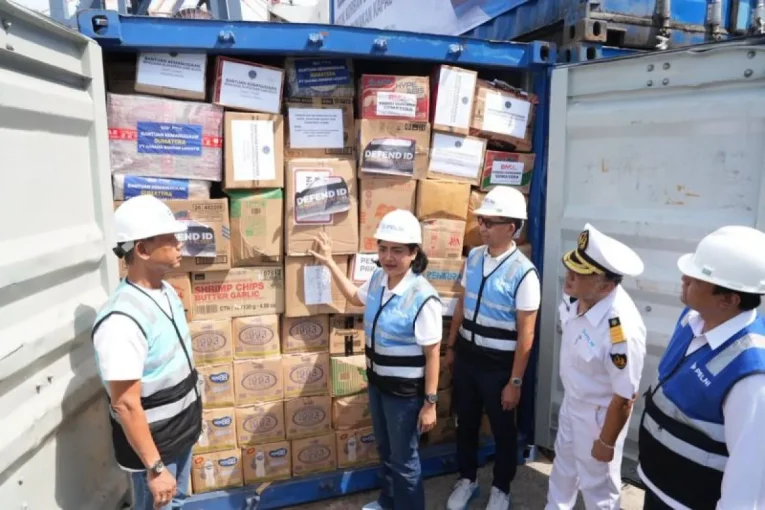
The floods that struck Aceh, North Sumatra, and West Sumatra have dealt a severe blow to Indonesia this year. Based on data from the National Disaster Management Agency (BNPB) as of Dec. 14 2025, the disasters have resulted in 1,140 fatalities, 163 missing persons, and more than 399,172 displaced residents.
Data from the Ministry of Public Works (PU) recorded 1,666 infrastructure damage points across the three provinces due to flash floods and landslides. The situation has been further exacerbated by damage to critical logistics infrastructure, including 271 bridges and land transportation routes.
“The impact is immediately felt, with disrupted distribution, halted supplies, and the emergence of social panic among communities,” said the Head of the UGM Center for Transportation and Logistics Studies (Pustral UGM), Professor Siti Malkhamah, in a statement to journalists on Monday (Dec. 29), referring to the outcomes of the webinar titled “Building Disaster-Resilient Food and Energy Logistics in Sumatra”.
According to Professor Malkhamah, the government and academics need to identify vulnerabilities, conduct policy analyses, and jointly formulate concrete recommendations to strengthen resilient logistics systems.
“At present, breakthroughs are needed in transportation network design, reserve management, and emergency response coordination,” she stated.
Professor Malkhamah further explained that when Sumatra is affected, Indonesia as a whole is impacted, as Sumatra serves as the backbone of the national economy. In the food sector, North Sumatra contributes up to 2.15 million tons of milled dry paddy rice and 1.37 million tons of maize production.
Meanwhile, in the energy sector, Sumatra is a national energy hub. Data from PLN North Sumatra in 2022 show that 40.06 percent of the region’s electricity mix comes from new and renewable energy, alongside gas at 23.23 percent and coal at 32.89 percent.
UGM expert in Logistics and Supply Chain Management, Professor Kuncoro Harto Widodo, elaborated on the vulnerability of transportation and logistics networks for food and energy in Sumatra.
According to him, three key issues require attention: improving transportation and logistics infrastructure, addressing delays in the delivery of logistics aid, and enhancing the design of resilient, adaptive nodes and networks.
“Constraints at transportation nodes and networks disrupt food security in the region,” he explained.
He noted that the main logistics challenges in Sumatra include infrastructure vulnerability due to the absence of alternative routes in disaster-prone areas, as well as coordination barriers among stakeholders that slow down aid distribution.
Addressing these challenges requires a shift from short-term solutions to long-term, resilient network designs, including route redundancy, dynamic routing, decentralized logistics warehouses, and strengthened maritime connectivity, to create an adaptive and resilient system.
Deputy for Coordination of Food Accessibility and Security at the Coordinating Ministry for Food, Dr. Nani Hendiarti, stated that current Government Rice Reserve (CBP) stocks in disaster-affected areas amount to around 87,000 tons in Aceh, 31,000 tons in North Sumatra, and 7,700 tons in West Sumatra. These stocks can be utilised for affected communities through a tiered distribution mechanism.
“This is what we can actually use in terms of how government food reserves can be channelled for disaster response and distribution,” she explained.
However, challenges in distributing food aid to disaster locations include damaged infrastructure, fuel supply constraints, and electricity outages. Currently, only around 10,000 tons of food aid have been distributed out of the 24,000 tons prepared, due to distribution obstacles.
“We are also utilising Service Units originally designated for the Free Nutritious Meals (MBG) programme to be converted into emergency public kitchens, serving more than 1.5 million affected residents,” she added.
Meanwhile, Hari Purnomo, Director of Engineering and Land Infrastructure at PT Pertamina Patra Niaga, explained the mitigation efforts undertaken by Patra Niaga to continue distributing fuel and LPG to affected communities. Nevertheless, conditions in several areas remain isolated due to landslides that have cut off bridges.
To accelerate distribution, Pertamina mobilised cross-island support by deploying 54 fuel tanker trucks and 137 personnel from various regions, as well as adding LPG tanker fleets from Bali and Java.
In addition, distribution route engineering strategies were implemented using roll-on/roll-off (Ro-Ro) vessels to supply areas such as Sibolga and Aceh, where land access was severed.
For isolated regions like Gayo Lues and Bener Meriah, distribution has been carried out using specialized methods, ranging from pickup trucks to air transportation via aircraft and helicopters with sling-load techniques to deliver fuel and LPG.
Author: Leony
Editor: Gusti Grehenson
Post-editor: Rajendra Arya
Photograph: Antara