


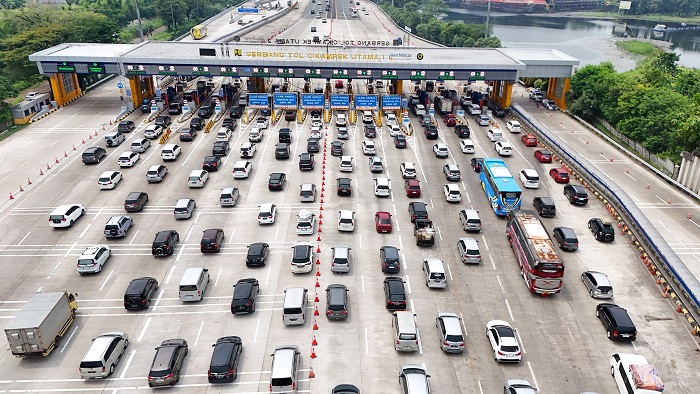
The Christmas and New Year (Nataru) holiday period, as well as the annual Eid homecoming (mudik Lebaran), often pose significant challenges for the government in terms of infrastructure readiness and transport policy coordination. The surge in public mobility during holiday travel is significant. To date, responses have primarily relied on conventional approaches. Without a fundamental strategic transformation, however, static infrastructure capacity will inevitably struggle to keep pace with the continuous annual growth in private vehicle use.
A transportation expert from the UGM Center for Transportation and Logistics Studies (Pustral UGM), Dr. Dewanti, assessed that managing public mobility during the 2025 Nataru period cannot rely solely on reactive measures such as opening temporary command posts or offering toll fare discounts.
Peak travel periods generate extremely high, short-term demand, leading to overcapacity in transportation facilities and infrastructure.
“Although the government has implemented various safety programs, the problem has not been fully resolved because demand continues to accumulate at the same time,” Dr. Dewanti said on Thursday (Dec. 31).
As a solution, she encouraged the government to optimize Transport Demand Management (TDM) strategies to reduce vehicle congestion.
This approach includes imposing disincentives for private vehicle use, such as progressive tolls and parking tariffs at congestion points, as well as more institutionalized travel time management through staggered public holidays or flexible working-hour schemes.
Dr. Dewanti also offered a critical note on the effectiveness of free homecoming (mudik gratis) programs, which have long been a flagship government initiative. With a quota of around 33,000 passengers, the program is considered insufficient to reduce private vehicle use nationwide.
“In this context, the free homecoming program functions more as a symbolic initiative and a form of social assistance, rather than as a strategic instrument of travel demand management,” she explained.
According to her, low public interest in the program in several regions is not merely a matter of limited quotas, but an indication that the program’s design has yet to hit its intended target.
“The low level of public interest in free homecoming programs in some areas shows that the main issue lies not in the quota size, but in the program’s design and procurement methods,” she stressed.
She explained that the program’s low competitiveness compared to private vehicles stems from several crucial factors, including routes that do not align with passengers’ origin–destination patterns, rigid schedules, and limited integration with onward transport modes.
In addition, perceptions of service comfort also contribute to the program’s reduced appeal compared to private vehicle travel.
Furthermore, for densely visited tourist destinations such as Yogyakarta, which is projected to receive 5.15 million visitors, Dr. Dewanti underscored the importance of synchronization between central and regional governments. She argued that local traffic control must be supported by national-level instruments.
“These include time-based restrictions on private vehicles and nationally integrated travel information systems. Meanwhile, local governments should focus on managing internal movements, including regulating access to tourist areas, parking management, and strengthening feeder transport such as shuttle services and tourist transport,” she explained.
According to her, with a clear, synchronized division of roles, tourist surges can be managed not merely reactively, but in ways that distribute infrastructure burdens across space and time, allowing Yogyakarta to continue functioning as a tourism destination without experiencing mobility paralysis.
Author: Aldi Firmansyah
Editor: Gusti Grehenson
Post-editor: Rajendra Arya
Photograph: Sinpo.id