


The idea of developing smart cities continues to evolve alongside rapid digital advancement. However, this approach is considered insufficient if it focuses solely on technology. In response to this concern, a professor in the Department of Management, Faculty of Economics and Business, Universitas Gadjah Mada (FEB UGM), Professor Wakhid Slamet Ciptono, has developed the concept of the Smart and Wise City—an urban development approach that is not only technologically intelligent but also grounded in wisdom, cultural values, and humanity.
The concept was refined by Professor Ciptono in collaboration with two colleagues: first, Tri Wahyuningsih, his supervised student in the Master of Management Science Program at FEB UGM, and second, Professor Joe Ravetz from the University of Manchester, author of the book “Smart and Wise City.”
Professor Ciptono explained that the collaborative research began in June 2025 and was driven by concerns over smart city concepts that have predominantly emphasized technological aspects.
“A smart city is necessary but not sufficient without a wise city. A smart city is important, but it is not enough if it is not combined with a civilized and wise city,” he said on Monday (Dec. 29).
He assessed that the wise city concept operates at a higher level, as it does not rely solely on knowledge management but also on meta-knowledge that emphasizes the values of wisdom and humanity.
Reinforcing this perspective, Professor Ciptono referred to the second principle of Pancasila, Just and Civilized Humanity, which underscores that a smart city must be balanced with civility.
According to him, the highest human dignity is achieved through justice and civility, making this concept highly relevant in the Indonesian context.
In this study, Yogyakarta was selected as the case study location and is considered to have strong potential to become Indonesia’s first Smart and Wise City.
Professor Ciptono described Yogyakarta as a miniature of Indonesia, rich in cultural values and local wisdom. The research employed qualitative methods through in-depth interviews and focus group discussions (FGDs).
A total of 29 informants participated, including the deputy governor and mayor, as well as government officials and community representatives from various associations. This, he noted, was essential to capture the concept from diverse perspectives.
According to Professor Ciptono, the uniqueness of the Smart and Wise City concept lies in the integration of two inseparable dimensions, much like the two sides of a coin.
“Smart and wise are like two sides of the same coin; they cannot be separated. Smart without wise will lose civility, while wise without smart will be left behind,” he explained.
He emphasized that this approach would not alter Yogyakarta’s identity but rather strengthen its uniqueness.
“This will not change Yogyakarta; instead, it restores Yogyakarta’s distinctive identity, such as manners, courtesy, and prioritizing fundamental human obligations before rights,” he said.
The research journey was not without challenges. Initially, the manuscript was rejected by a reputable international journal because it was still conceptual and lacked empirical data. However, the feedback became a catalyst to strengthen the study.
As a next step, the research team aims to publish the work in a Q1-ranked international journal as an initial milestone before broader implementation.
“After publication, we will present it to UGM and then to the Regional Government of the Special Region of Yogyakarta,” said Professor Ciptono.
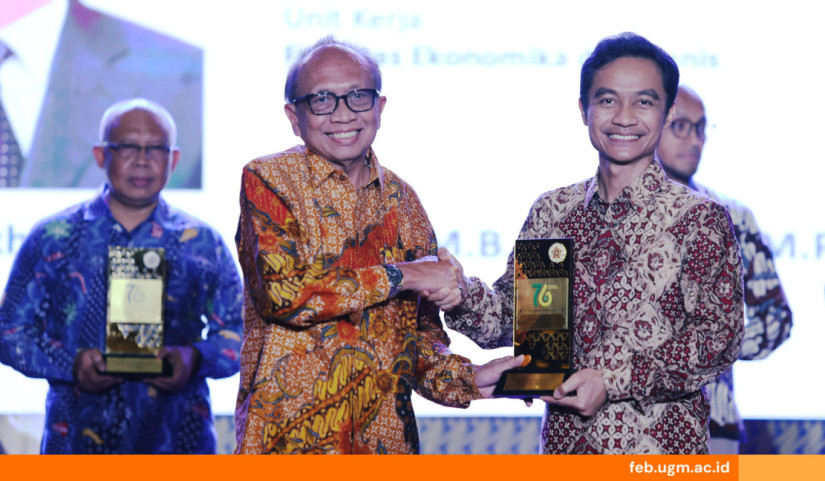
Without aiming for awards, the research team later submitted the work through an internal UGM scheme. This led to positive recognition, culminating in an award at the UGM Outstanding Individuals Award 2025 in the Collaborative Research on Socio-Cultural Resilience category.
“We never aimed for an award. Our sole intention was to convey the idea, but it turned out that the reviewers were able to capture and appreciate it,” he remarked.
In closing, Professor Ciptono expressed hope that the Smart and Wise City concept could inspire the development of other cities across Indonesia. Indonesia, he emphasized, needs cities that are not only smart but also wise.
“Once there is a role model, it can be further developed in other cities,” he concluded.
Authors: Hanifah and Ika (FEB UGM)
Editor: Gusti Grehenson
Post-editor: Rajendra Arya
Photographs: FEB UGM