


Indonesia and the Middle East are geographically distant and culturally distinct regions. Despite being separated by thousands of kilometers, the two share a long-standing relationship. This connection is reflected in Indonesia’s consistent foreign policy stance on Middle Eastern conflicts, particularly its ongoing support for peace and regional stability, as seen in its proactive position on the Palestinian issue through a geopolitical lens.
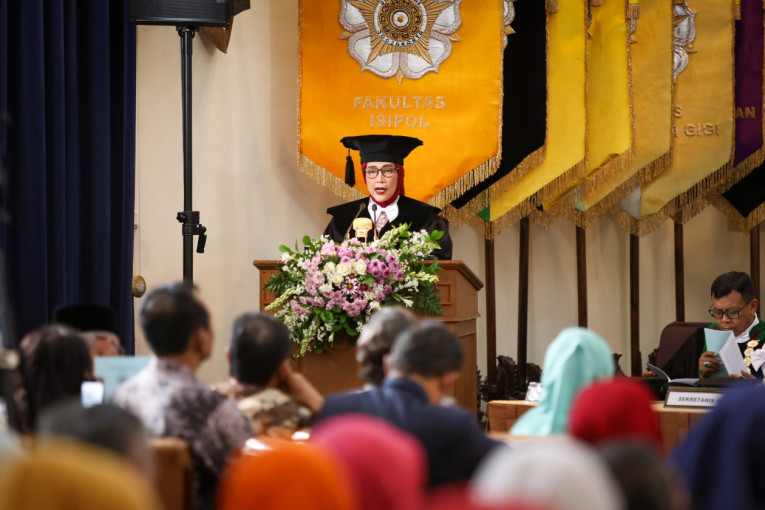
This was conveyed by Dr. Siti Mutiah Setiawati, Lecturer in International Relations at the Faculty of Social and Political Sciences, Universitas Gadjah Mada (Fisipol UGM), during her inauguration as Professor of Middle East Geopolitics at the Senate Hall, UGM Central Office, on Thursday, Jun. 19, 2025.
In her professorial speech titled “Indonesia’s Consistency in Foreign Policy Toward the Middle East: Between Normative Values and Geopolitical Rationality,” Professor Setiawati examined how Indonesia navigates the region’s complex conflicts.
She stated that Indonesia adheres to at least three key foreign policy principles.
“First and foremost is the principle of free and active foreign policy. This principle embodies Indonesia’s stance amid international tensions between the Western and Eastern blocs: not aligning with either side while remaining actively involved in resolving global issues,” she explained.
The second principle is enshrined in the Preamble to the 1945 Constitution of Indonesia, which states that “colonialism must be abolished because it is not in accordance with humanity and justice” and that Indonesia shall “participate in establishing a world order based on freedom, lasting peace, and social justice.”
The third is the good neighbour policy, or a commitment to maintaining good relations with other nations.
Professor Setiawati emphasized that in practice, Indonesia’s foreign policy consistently supports the Palestinian struggle for independence and contributes to resolving conflicts in the region.
This unwavering stance positively reinforces Indonesia’s global position as a nation committed to peace and international order.
However, she acknowledged that Indonesia’s support for Middle Eastern conflicts is not without dilemmas.
“These conflicts rarely involve Indonesia directly, yet Indonesia must still uphold its foreign policy principles,” she added.
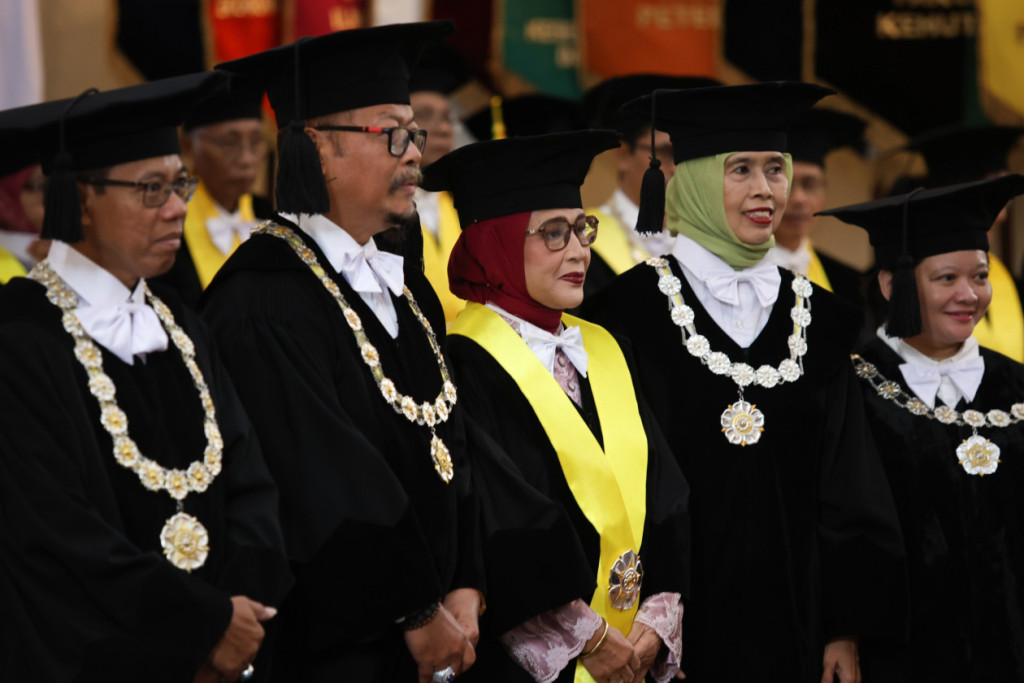
According to Professor Setiawati, the current situation in Palestine is increasingly dire, reaching what she described as a stage of genocide.
Indonesia has faced several challenges in extending support to Palestine, including deep internal divisions among Palestinian groups, primarily between Hamas, which controls Gaza, and Fatah, viewed as more moderate and based in the West Bank.
Moreover, Israel, which occupies Palestinian territories, enjoys strong backing from the United States, a dominant global power whose political will largely determines the outcome of peace negotiations.
“Indonesia must understand the geopolitical positioning and dynamics between these powers to ensure its support is not misdirected. At the same time, Indonesia struggles to mediate between the Palestinian factions in facing the common threat posed by Israel,” she explained.
Challenges also arise from Arab countries within the Arab League, which, while treating the Palestinian issue as a shared concern, often lack the solidarity and cohesion needed to support Palestine’s independence.
Many of these nations are embroiled in internal and inter-state conflicts.
Professor Setiawati further noted that some Arab countries previously active in supporting Palestine have now established diplomatic relations with Israel, such as Egypt and Jordan.
The normalization of relations with Israel has also accelerated following the 2020 Abraham Accords, as seen with the United Arab Emirates and Bahrain.
“Negotiations between Arab-Palestinian parties and Israel have never explicitly addressed Palestinian independence. In cases involving colonizers and the colonized, such recognition should be a fundamental prerequisite,” she stated.
The Indonesian government has consistently supported Palestine both materially, through humanitarian aid such as clothing, food, water, and medicine, and politically, via diplomacy.
Indonesia’s political support for the people of Gaza is expressed through intensive diplomatic efforts at the bilateral, multilateral, and regional levels.
“These diplomatic missions aim to urge veto-wielding nations to enforce a ceasefire and permanently end the conflict. Although the responses have yet to yield substantial support, such diplomacy marks an important contribution to Indonesia’s efforts toward global peace and the abolition of colonialism, as mandated by the 1945 Constitution,” she explained.
According to Professor Setiawati, Indonesia’s international position is clear: principled, consistent, and unwavering in its support for Palestinian independence. Indonesia officially recognized the State of Palestine in 1988, following the Palestinian Liberation Organization (PLO)’s unilateral declaration by PLO Chairman Yasser Arafat.
“This consistency has become a hallmark of Indonesian diplomacy. Prioritizing the Middle East is not without its challenges, especially when Indonesia must choose between upholding its foreign policy principles and national interests or yielding to pressure from other countries to take sides,” she said.
She concluded, “Indonesia’s free and active foreign policy has proven to be a guiding principle, allowing the country to navigate unpredictable global geopolitics without compromising its values.”
Author: Lazuardi
Editor: Gusti Grehenson
Post-editor: Lintang Andwyna
Photographer: Donnie Trisfian