


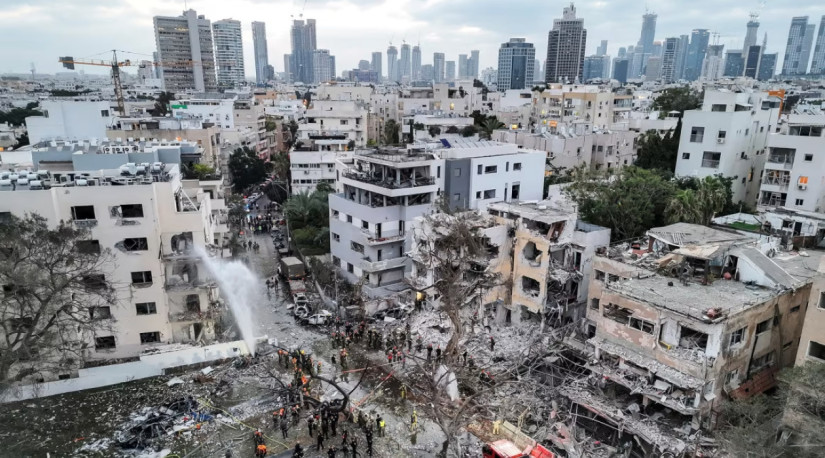
Tensions between Iran and Israel have now entered a new phase before the Israeli attack on (Jun. 13), the first direct clash occurred in (Apr. 2024) when Iran launched a massive missile and drone attack.
This attack marked the most significant escalation in the history of relations between the two countries, triggering concerns about the outbreak of a broader conflict in the Middle East.
The international community began paying attention to the direction of this conflict, with many even calling it a real threat to global peace.
“This situation has become a focus for many parties because the involvement of major global actors can accelerate the dynamics towards global geopolitical tension,” said Muhadi Sugiono, a lecturer in International Relations at the Faculty of Social and Political Sciences, Universitas Gadjah Mada (Fisipol UGM), on Monday (Jun. 23).
According to Sugiono, this tension not only threatens regional stability but also has the potential to alter the global power balance.
The emerging political dynamics demonstrate how vulnerable the international system is to prolonged conflict.
The Iran-Israel conflict is not merely a battle between two countries but a reflection of long-standing ideological clashes, history, and power rivalries.
Sugiono believes that the recent Israeli attack on Iran is not merely a unilateral act.
Instead, it reflects a systematic effort to destroy Iran’s nuclear capabilities by attacking its facilities, scientists, and military officials.
The International Atomic Energy Agency (IAEA) 2024 report states that Iran has enriched uranium up to 60%, exceeding the stipulated limit.
However, to date, there is no evidence that Iran is actively producing nuclear weapons.
“Israel’s attack was carried out under the pretext that Iran violated the Nuclear Nonproliferation Treaty (NPT),” Sugiono explained.
He added, “But this is ironic because Israel itself has not signed the NPT and is not subject to the international nuclear regime.”
This escalation has turned into an open conflict, though neither side has officially declared war.
The prevailing hostile attitudes and mutual attacks already meet the criteria for leading to open warfare.
Sugiono underlined that direct military involvement, even without formal recognition, still indicates that the conflict dynamics have crossed the standard threshold of diplomacy.
Direct attacks, whether through missiles, drones, or cyberattacks, serve as proof that this is not merely political rhetoric.
“The absence of effective de-escalation mechanisms further magnifies the risk of conflict,” Sugiono stated.
The United States’ involvement in this conflict further complicates the situation.
After initially denying direct involvement, the US is now reported to have launched attacks on three Iranian nuclear facilities located in Isfahan, Natanz, and Fordo on Saturday (Jun. 21).
These attacks were in retaliation for Iran’s drone and missile attacks against Israel.
Sugiono noted that the involvement of the US, which is naturally on Israel’s side, will clearly increase the escalation of the conflict.
The US role in supporting Israel’s defense system also further blurs the line between strategic support and active involvement in warfare.
“This situation magnifies the risk of a widespread regional conflict that will be difficult to control if not immediately curbed through multilateral forums,” Sugiono advised.
This condition raises concerns that the Iran-Israel conflict could trigger a global war. This is because both countries have relations and support from countries in opposing blocs.
Sugiono said that if the conflict is not resolved soon, the involvement of other countries could turn it into a global-scale war.
This tension creates an international political atmosphere similar to the Cold War, where a single attack could trigger a chain reaction.
“Such a situation also disrupts the stability of other regional areas that have long been vulnerable, such as Syria, Yemen, and Lebanon,” Sugiono stated.
Sugiono also regretted that international bodies such as the UN have not been sufficiently effective in responding to this situation.
The UN Security Council often fails to reach agreements due to the conflicting positions of major powers.
Although the UN General Assembly can issue resolutions, their implementation heavily depends on political support, which is not always available.
The weak implementation of international decisions demonstrates the limitations of the current global structure in preventing conflicts.
“When multilateral diplomacy loses its bargaining power, state actors tend to take unilateral paths,” Sugiono noted.
Furthermore, Sugiono added that major countries like China and Russia have different preferences from the US and its allies regarding this conflict.
According to Sugiono, the differing positions among world powers further complicate the creation of a safe and peaceful world order.
These conflicting interests also reflect the international system’s failure to forge a consensus on common security.
Instead of mediating, major powers are strengthening their respective blocs, which are prone to triggering further conflicts.
“However, as permanent members of the UN Security Council, they have a responsibility to maintain global stability,” Sugiono revealed.
This conflict, Sugiono said, also affects Indonesia, both economically and in foreign policy.
Sugiono affirmed that, as an open economy, Indonesia would be affected if energy supply chains were disrupted by war.
Spikes in oil prices and global logistics disruptions could lead to domestic inflation.
Meanwhile, on the diplomatic front, Indonesia faces a dilemma between maintaining bilateral relations and the consistency of its free and active foreign policy principles.
“Additionally, Indonesia’s foreign policy position in the Middle East, especially regarding the Palestinian issue, will become even more complex,” Sugiono added.
As the country with the largest Muslim population, Indonesia needs to adopt a clear and firm stance.
Sugiono also emphasized the importance of Indonesia’s consistency in supporting nuclear disarmament by encouraging all Middle Eastern countries to become NPT members and to comply with international nuclear nonproliferation rules.
This step aligns with Indonesia’s commitment to global security and world order, grounded in independence, eternal peace, and social justice.
Additionally, Indonesia can strengthen its role through humanitarian channels, such as humanitarian aid initiatives or mediation in non-aligned international forums.
“Indonesia must condemn Israel’s attacks and encourage a diplomatic resolution,” Sugiono said.
Domestically, the Indonesian public’s response to this conflict is becoming visible, especially on social media and in public discussion forums.
Sugiono believes pro-Palestinian sentiment remains dominant in society but has not developed into a structured political stance.
According to Sugiono, the government needs to monitor public opinion to formulate foreign policies aligned with the aspirations of the people.
“Whether such responses will create significant social and political dynamics is currently uncertain,” Sugiono stated.
Amidst this global complexity, Sugiono believes Indonesia’s concrete step is to strengthen diplomatic and humanitarian channels.
Besides encouraging all parties to return to the negotiation table, Indonesia can also take the initiative to build a coalition of countries promoting de-escalation.
Indonesia can play an essential role in ensuring the region remains neutral and is not dragged into global geopolitical polarization.
“Indonesia needs to be an active moderate voice pushing for peace, while also striving for fair and consistent nuclear disarmament,” Sugiono concluded.
Author: Triya Andriyani
Post-editor: Afifudin Baliya
Photograph: CNN World