


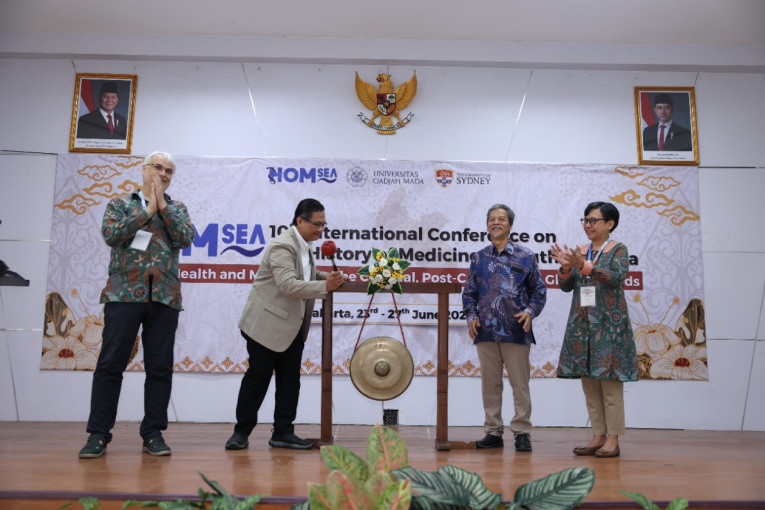
Universitas Gadjah Mada (UGM) hosted the 10th International Conference on the History of Medicine in Southeast Asia (HOMSEA), held from Jun. 24-27, 2025, at the Soegondo Building, Faculty of Cultural Sciences (FIB UGM).
This biennial forum serves as a meeting place for academics from various disciplines to discuss the history of health and medicine in Southeast Asia. This covers the colonial era to the present.
Participants attended not only as researchers but also as critical re-readers of history, examining colonial legacies and the social role of medicine.
With Yogyakarta’s rich historical and cultural atmosphere, the conference felt even more meaningful.
More than 150 participants from 14 countries attended in Yogyakarta to enrich cross-country, cross-disciplinary, and cross-generational perspectives.
These perspectives focused on health practices, medical knowledge, and the region’s cultural heritage.
The intensive four-day series of activities included various panels, symposia, book launches, and visits to historical medical sites.
Chairperson of the HOMSEA 2025 Organizing Committee, Professor Yayi Suryo Prabandari, referred to this forum as a ten-year milestone.
It integrates historical reflection with a reading of the future direction of health systems in Southeast Asia.
“We invite all participants to delve back into historical sources, listen to forgotten voices, and push the boundaries of cross-disciplinary studies,” Professor Prabandari revealed.
The HOMSEA conference is widely known as an open space for critical exploration, bringing together history, anthropology, medicine, and public policy.
This year, the grand theme was “Health and Medicine in the Colonial, Post-Colonial and Global Worlds.”
It included various sub-themes such as public health versus medical specialization, decolonization of knowledge, and medical ethics.
President of HOMSEA, Professor Hans Pols, expressed his gratitude to the organizers and volunteers with his characteristic warmth.
“If you meet the committee or volunteers at the registration desk or room door, just say thank you; they are the ones who make this event run,” Professor Pols said with a smile.

Cross-faculty involvement also enriched the organization of this conference.
FIB UGM and the Faculty of Medicine, Public Health, and Nursing (FK-KMK UGM) co-hosted, reflecting the interdisciplinary spirit that is the essence of HOMSEA.
Dean of FIB UGM, Professor Setiadi, emphasized the importance of a cultural approach in understanding medical practices.
“In our view, medicine is not just a clinical practice, but also a cultural practice profoundly influenced by language, healing systems, colonialism, local knowledge, and social structures,” Professor Setiadi explained.
Meanwhile, Dean of FK-KMK UGM, Professor Yodi Mahendradhata, highlighted that the history of medicine reflects the nation’s struggle to build social justice and public health.
He affirmed that his institution was founded with the spirit of nation-building and upholding social justice through a medical approach rooted in culture.
This conference also serves as a reflection ahead of FK-KMK UGM’s 80th anniversary, reaffirming the relevance of history in health education.
“Studying history is not just about looking back, but also about understanding the future more clearly and wisely,” Professor Mahendradhata noted.
In his speech, UGM Rector Professor Ova Emilia emphasized the importance of ethical and political reflection in health narratives in Southeast Asia.
She mentioned that the connections and differences in the region’s health history cannot be separated from colonialism, modernity, and the sustainability of local systems.
According to Professor Emilia, this conference is a space to strengthen local narratives to be on par with global health discourse.
“Let us begin this conference with curiosity, humility, and a shared commitment to develop knowledge that respects the past and is responsible for the future,” Professor Emilia said.

As the opening of the scientific session, keynote speaker Professor Harold J. Cook from Brown University explained how Europe’s understanding of Chinese medicine largely originated from interactions and documentation in Southeast Asia.
He showed that 17th-century European books on acupuncture and pulse detection were actually written based on manuscripts collected in Batavia, Makassar, and parts of Cambodia.
His presentation sparked a discussion of the relationship among knowledge, power, and cross-cultural movement in the history of medicine.
“I finally realized that much of the knowledge about Chinese medicine received by Europeans actually originated from Southeast Asia,” Professor Cook explained.
The conference series spans four days, including over 20 parallel panels, two keynote speeches, book launches, wayang kulit (shadow puppet) performances, and visits to historical hospitals.
These included Bethesda, Panti Rapih, Dr. Yap, and Dr. Suradji Tirtonegoro hospitals. All activities were curated to enrich the academic and cultural experience of participants from various countries.
HOMSEA 2025 is not only a platform for idea exchange but also a space to nurture memory, foster collaboration, and strengthen commitment to health based on local history and culture.
“Let us use this activity to connect, reflect, and imagine the future of Southeast Asian medical history together,” Professor Cook concluded.
Author: Triya Andriyani
Post-editor: Afifudin Baliya
Photographer: Firsto