


Amid the increasing risk of disasters, attention to mental health and psychosocial issues has become an urgent necessity to ensure that disaster management does not focus solely on physical aspects. Empirically, however, psychosocial support in disaster response is still often underprioritized, even though it is crucial given that each community possesses distinct local characteristics and lives in areas prone to multiple types of disasters.
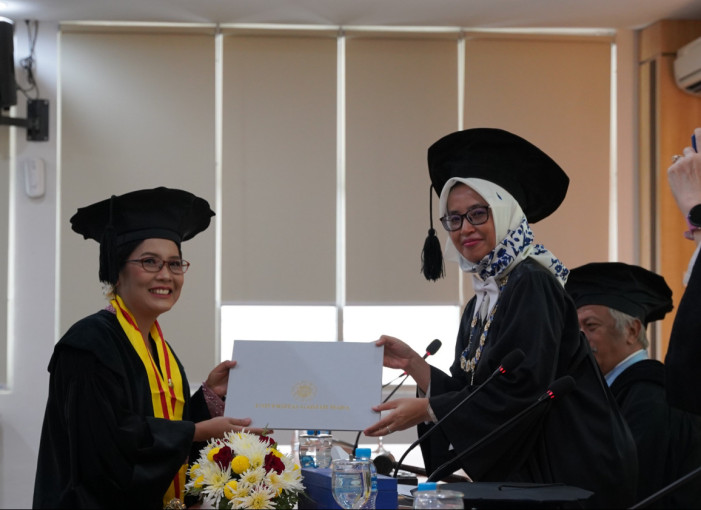
This issue was highlighted during the open doctoral promotion examination of Nevi Kurnia Arianti, held at Room A-203, Faculty of Psychology, Universitas Gadjah Mada (Psychology UGM), on Tuesday (Jan. 13).
In the examination, the doctoral candidate defended her dissertation entitled “Profiles and Strategies of Community-Based Psychosocial Support among Volunteers in Areas Prone to Multiple Types of Disasters in Yogyakarta.”
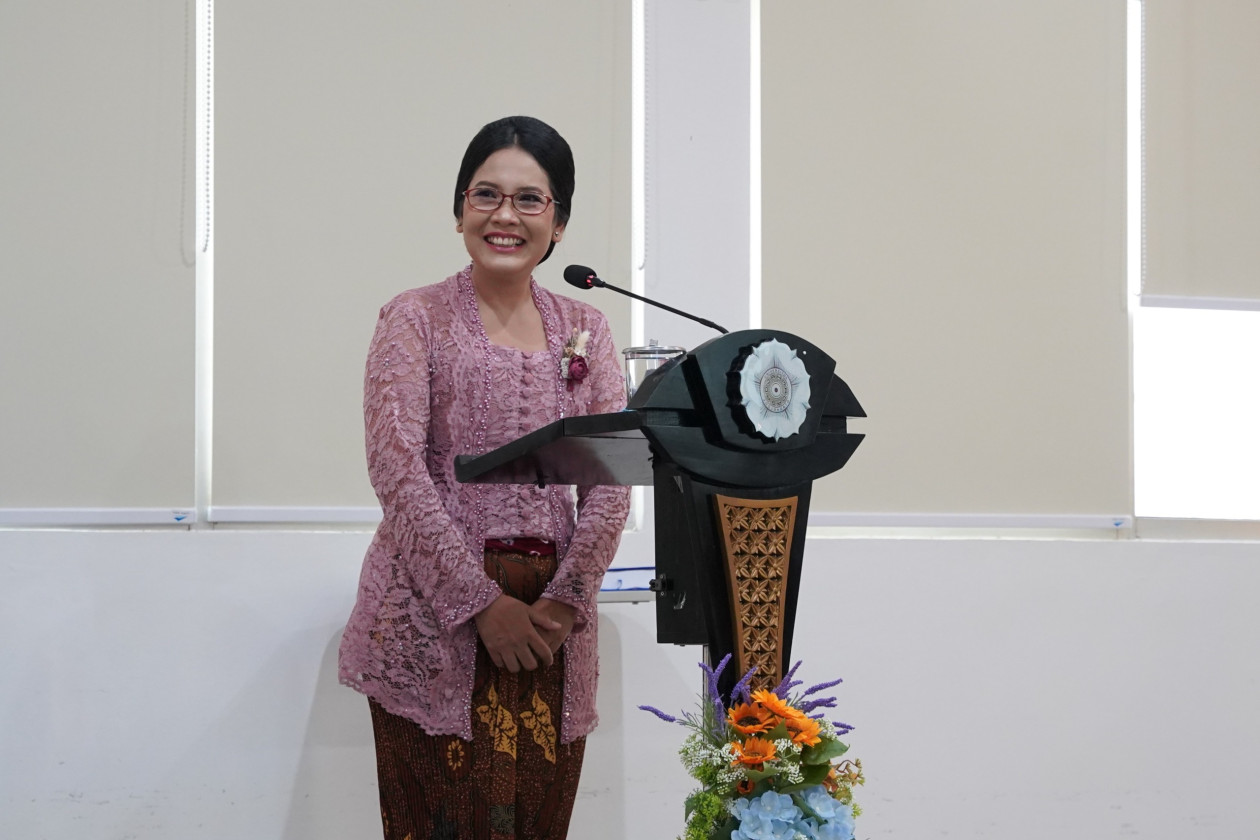
In her dissertation, Arianti employed a disaster psychology approach that views humans as part of an ongoing system encompassing the pre-disaster, disaster, and post-disaster phases as an integrated whole.
She positioned psychosocial support within the context of government policies and regulations, community behavior and culture, resource availability, and risk reduction.
“The impacts of disasters and recovery processes are intertwined with psychological, social, and inter-actor interaction dynamics,” she explained.
The research was conducted from Oct. 9, 2023, to Aug. 18, 2024, across three locations with different disaster threat characteristics.
The first site was Purwosari, Kulon Progo, which is prone to landslides.
The second was Girikerto, Sleman, an area threatened by eruptions of Mount Merapi.
The third was Girikarto, Gunungkidul, which is vulnerable to earthquakes and tsunamis.
According to Arianti, the three locations differ markedly in their cultural traditions, underscoring the need to strengthen psychosocial support grounded in local wisdom as both tangible and essential.
She cited the concept of Cakra Manggilingan in Javanese philosophy, which interprets life as a cycle with a beginning, process, and end that can be improved to start a better cycle.
This value is reflected in the volunteers’ attitudes of acceptance, whereby under pressure, they do not remain trapped in anxiety but can see what can still be done.
“In Girikerto, Sleman, volunteers are also very active in monitoring official information from the government, while serving as data supporters through radio communication networks (frekom),” she added.
According to Arianti, the study broadens the perspective that post-disaster recovery systems are not neutral, as they involve power relations and epistemological contestation.
She emphasized that local knowledge is not merely cultural, but a fundamental foundation in the social cycle of communities.
“Volunteers are viewed as producers of knowledge, not merely as complements to the system,” she said.
Arianti further explained that both local wisdom and modern science have their respective strengths and limitations, making their integration not only possible but urgent to reduce disaster risk and sustain community and environmental well-being.
She offered notes for stakeholders, stressing the importance of sustainability through internal regeneration, such as establishing registration divisions for young volunteers.
For government institutions, she encouraged adjustments to regional regulations to better align with social cycles informed by local wisdom, the development of mentoring programs, and the creation of training modules on financial literacy and emotional management for volunteers.
Meanwhile, for universities and research institutions, Arianti highlighted the importance of geospatial and ethnographic research to bridge the relocation of communities to safer areas without neglecting the values they uphold.
In the context of the disaster in Sumatra, Arianti explained that psychosocial support strategies need to combine local, scientific, and professional knowledge.
Regional morphology and topology also influence community dynamics, making each area unique and requiring careful study.
Although her dissertation focuses on the strengths of local community volunteers, Arianti emphasized that, under certain conditions, such as in Sumatra, external volunteers remain necessary, particularly when communities are at their most vulnerable.
“When individuals are in a very weak state, they cannot yet be asked to ‘run.’ They need assistance from outside first, and then gradually be involved again to regain empowerment,” she explained.
For example, Arianti noted that psychosocial approaches can be realized by revitalizing cultural practices and daily activities familiar to affected communities.
In Palu, for instance, there are artistic traditions such as dance during times of conflict that foster a sense of closeness and togetherness.
In Aceh, she added, a similar approach can be implemented through communal cooking of traditional foods rich in local spices and flavors.
According to her, support from external volunteers should not come solely with unfamiliar practices, but should begin with mapping local traditions that once existed or were lost due to disaster, and then reviving them as part of the community recovery process.
“For example, expressing gratitude in the Acehnese language, so that volunteers can better blend in with the survivors,” she said.
The open examination was supported by a supervisory team comprising Professor Koentjoro, a psychologist, as the main supervisor, and Professor Mohammad Baiquni as co-supervisor.
Arianti completed her doctoral studies in 4 years, 3 months, and 11 days, achieving a cumulative grade point average (GPA) of 3.93.
Author/Photographer: Hanifah
Editor: Gusti Grehenson
Post-editor: Rajendra Arya