


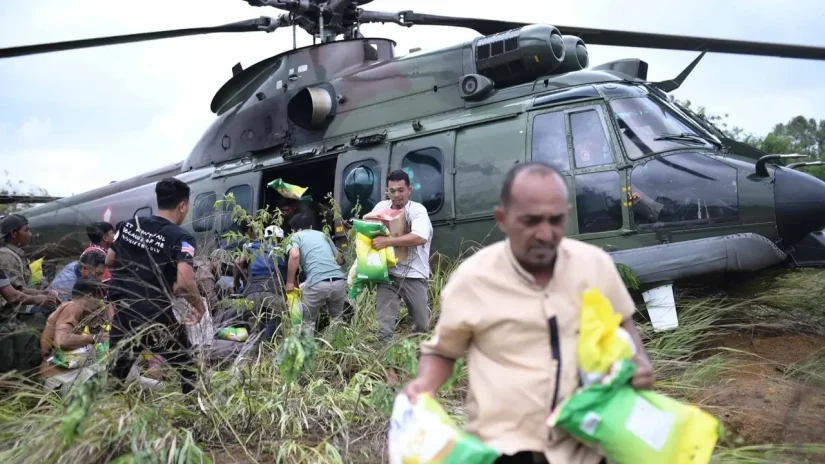
Disaster impacts in Sumatra, particularly in the Aceh region, have yet to subside, leaving several areas isolated after flooding. The scale of the disaster has been significant, leaving numerous regions cut off from the outside world. Overland routes to the affected areas have been severed and are challenging to reach.
As a result, some victims have not yet received logistical assistance, while aid distribution remains limited in several locations.
According to a report from the Central Aceh Regency Government, at least 26 villages in Central Aceh remain isolated, with damaged roads and bridges still awaiting repair.
The Aceh Provincial Government has extended the emergency response status for floods and landslides, effective from Jan. 9 to Jan. 22.
Environmental geomorphology expert Professor Djati Mardiatno stated that the isolation of disaster-affected areas can be anticipated by using air routes to deliver assistance.
“Yes, in conditions like this, the issue is clearly accessibility. If the situation remains as it is, it becomes necessary to find alternative access routes to reach the isolated areas. Inevitably, this must be done via air routes because there is no other option or possibly through river routes,” Professor Mardiatno said on Wednesday (Jan. 14).
Professor Mardiatno emphasized that in every emergency response situation, contingency plans should be prepared to assist isolated areas.
“Before a disaster occurs, such scenarios should already be included in contingency planning. If a contingency plan exists and a disaster happens, isolated areas should certainly become a priority for receiving logistical supplies so that residents can survive temporarily, especially in meeting basic needs,” he explained.
However, the magnitude of the floods and landslides in Sumatra has meant that contingency plans by both central and regional governments have not been fully effective.
According to Professor Mardiatno, this condition reflects weak regional connectivity planning in disaster-prone areas.
Furthermore, he explained that infrastructure damage can increase disaster risk, particularly when it is caused by deforestation that reduces the land’s capacity to absorb rainwater.
“When extreme rainfall occurs, more rainwater becomes surface runoff, which can trigger erosion, landslides, floods, and flash floods, as well as further infrastructure damage,” he concluded.
Author: Salwa
Editor: Gusti Grehenson
Post-editor: Rajendra Arya
Photograph: AP Photo