


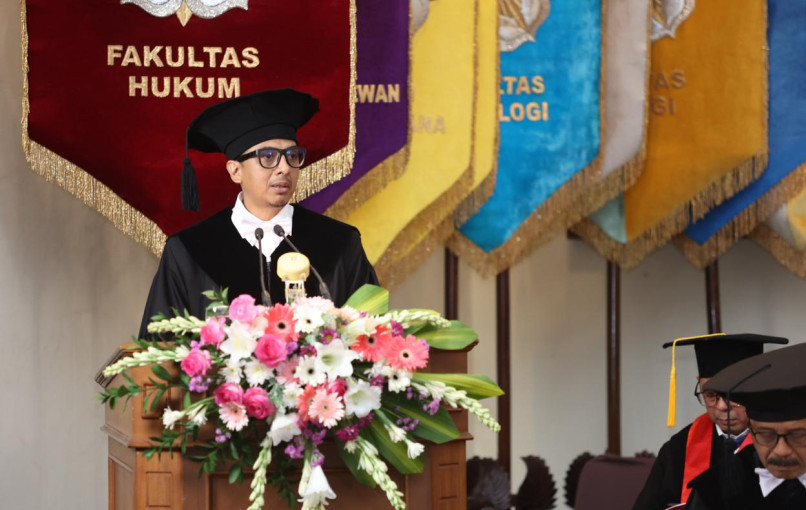
Lecturer of the Department of Constitutional Law, Faculty of Law, Universitas Gadjah Mada (FH UGM), Dr. Zainal Arifin Mochtar, was officially inaugurated as Professor of State Institutional Law on Thursday (Jan. 15) at the UGM Senate Hall. In his inaugural address entitled “The Rise of Conservatism and the Weakening Independence of State Institutions: Exploring Relationships and Uncovering Paths for Reform,” he highlighted the weakening of independent institutions as a consequence of the growing influence of conservatism and authoritarianism in Indonesia.
The new professor opened his address by expressing concern about the regression of independent state institutions over the past decade, coinciding with the rise of conservatism and authoritarianism in Indonesia, particularly within the judiciary and unelected independent bodies.
According to him, these institutions function as counterbalances to politically driven branches of power, namely the executive and legislative branches.
The weakening of these independent institutions, he explained, cannot be separated from global conditions marked by the strengthening of conservatism, which has also contributed to the erosion of independent state institutions, including in Indonesia.
In fact, the third wave of democratization, which began in the late 1970s and continued through the late 1990s, gave rise to independent state institutions.
In Indonesia, this phenomenon emerged after the 1998 Reform era, which created institutions tasked with safeguarding neutrality, transparency, and accountability, and serving as corrective mechanisms for the shortcomings of political institutions inherited from the New Order period.
“This phenomenon marked a shift in the architecture of state power from the classical model centered on three branches, executive, legislative, and judicial, toward a new pattern that places independent institutions as a fourth, fifth, or even sixth branch within the structure of governance,” he explained.
“The General Elections Commission (KPU), Corruption Eradication Commission (KPK), Constitutional Court (MK), Judicial Commission (KY), Indonesian Broadcasting Commission (KPI), Ombudsman, and National Commission on Human Rights (Komnas HAM) are concrete examples of this trend. This is what we refer to as the strengthening of unelected bodies after the third wave of democratization.”
The presence of unelected bodies, Professor Mochtar continued, demonstrates that democratization in Indonesia has materialized through the development of oversight institutions that reinforce the principle of checks and balances.
Independent institutions emerged from the need to preserve the integrity of a newly developing political system and to act as ‘institutional mediators’ between the executive, legislative, and civil society, while ensuring that democracy is not merely procedural but also substantive.
“There was a rebalancing of power due to public distrust in classical state institutions,” he noted.
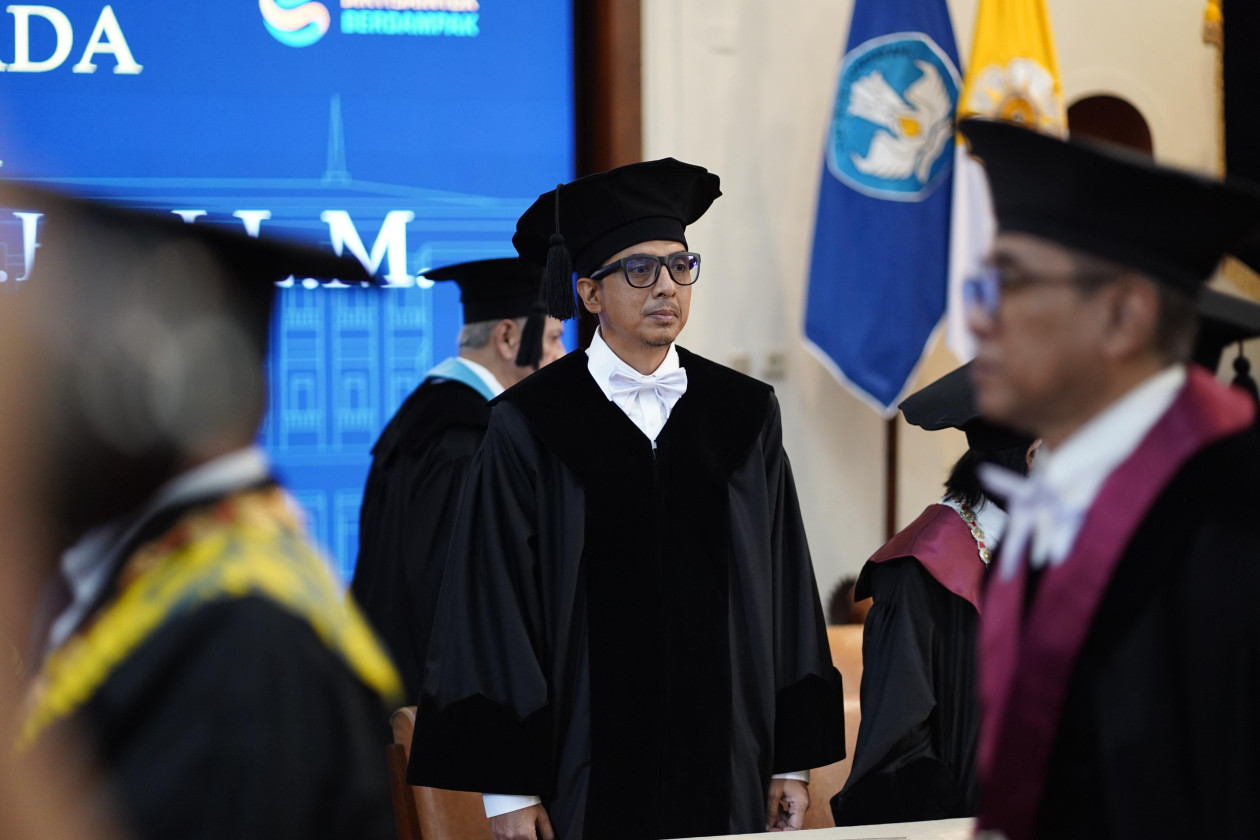
In recent years, the world has moved in a more conservative direction. Professor Mochtar pointed to a global context marked by waves of populism, conservatism, and electoral authoritarianism.
He observed that contemporary conservatism has been reinforced by populism’s ability to simplify the notion of ‘the people’ into a single voice expressed only through the ballot box, to suppress plurality, and to frame opposition as an enemy within the democratic process.
In the Indonesian context, he explained that the country is experiencing a conservative backlash that is not merely an ideological phenomenon but a political strategy emerging amid public fatigue with political conflict and a bureaucracy perceived as slow.
As a result, the idea of ‘disciplining democracy’ through renewed state control has gained moral legitimacy.
“Conservatism in Indonesia demonstrates an adaptive pattern. It does not necessarily dismantle institutions outright, but instead weakens them subtly through regulatory revisions, budgetary constraints, and personal co-optation of these institutions,” he said.
The construction of political interests within this context, he added, has caused independent institutions to function unstably and often to exist merely as products of democratization while simultaneously becoming arenas of political contestation that determine the direction of democratic consolidation itself.
According to Professor Mochtar, the fate of these institutions is highly dependent on political decisions made by the House of Representatives (DPR) and, at times, on the Constitutional Court’s (MK) legal interpretations.
“It is evident that the destiny of independent institutions is often determined by two major forces: politics in the DPR and law in the MK. The DPR controls the formation of laws, while the MK safeguards constitutional interpretation. However, in practice, politics tends to change more rapidly than legal principles, and political interests can even threaten the independence of the MK itself,” he explained.
For Professor Mochtar, the future of independent state institutions depends on the collective ability and willingness to recalibrate toward a more balanced direction and to move away from conservatism.
He emphasized that independent institutions must serve as spaces of compromise between major tendencies, institutions that should not be entirely detached from politics, yet must not submit to short-term power logic.
He further argued that alternative approaches are needed to address Indonesia’s current constitutional challenges.
“These issues cannot be addressed simply through classical approaches, such as merely improving regulations and institutions. Perhaps they cannot even be resolved through legislation alone. The catastrophe surrounding the Job Creation Law is more than sufficient to illustrate this problem,” he remarked.
Professor Mochtar explained that democracy is often trapped within an elitist context, as if it were owned solely by political elites and parties. In reality, democracy should be returned to the public by strengthening ‘creative minority’ and ‘rhizomatic’ approaches to safeguard democracy through the empowerment of civil society.
Additionally, external factors such as international organizations can encourage political liberalization through three mechanisms: pressure on authoritarian regimes, guarantees for domestic elites, and the socialization of democratic values.
“These findings are relevant to Indonesia’s context, where democracy appears hybrid in nature, shaped not only by internal civil society forces but also by external pressure from the international community. Unfortunately, this is often labeled as being ‘foreign agents,’ which then becomes a justification for authorities to narrow civic space and restrict civil society funding,” he explained.
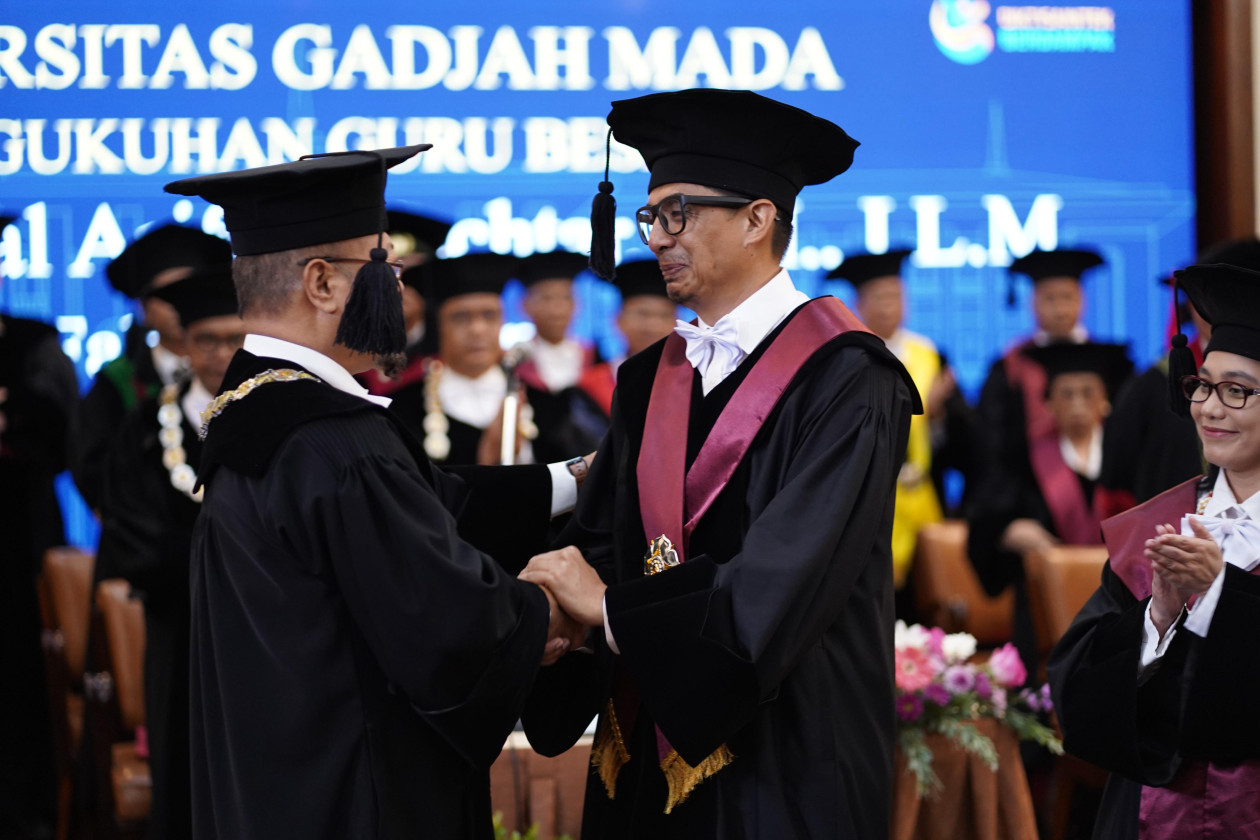
In closing, Professor Mochtar emphasized that charting pathways forward requires expanding the scope of constitutional law studies through multidisciplinary approaches, integrating insights from other disciplines to seek solutions for democratization and institutional reform.
“This is not solely the responsibility of the law. It is a responsibility and a calling for everyone. The banners in this hall carry the same responsibility to restore the wheels of democracy to a healthier path,” he concluded.
Chair of the UGM Board of Professors, Professor M. Baiquni, stated that Professor Mochtar is now one of 559 active professors at UGM. Within FH UGM, he is among 18 active professors out of a total of 29 professors at the faculty.
The inauguration ceremony was attended by several state officials, public figures, cultural figures, and anti-corruption activists, including the Attorney General of the Republic of Indonesia ST. Burhanuddin, former Vice President Jusuf Kalla, Ganjar Pranowo, Anies Baswedan, Mahfud MD, Butet Kartaredjasa, anti-corruption activist Novel Baswedan, Constitutional Court Justice Saldi Isra, and other guests.
Author: Cyntia Noviana
Editor: Gusti Grehenson
Post-editor: Rajendra Arya
Photographer: Firsto Adi