


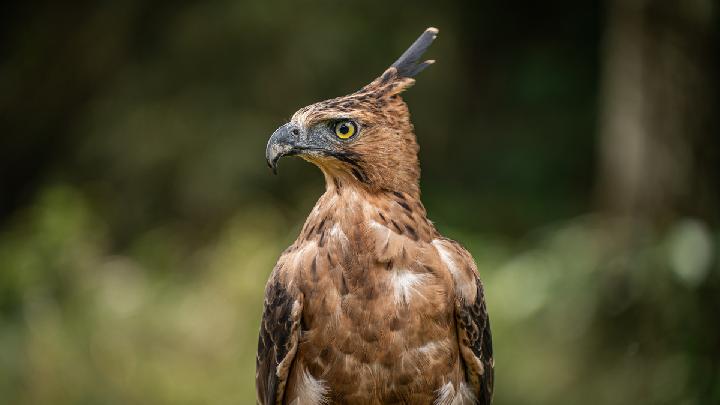
The population of the Javan eagle (Nisaetus bartelsi) is currently classified as near-extinct, with an estimated 511 breeding pairs, or approximately 1,000 individuals, remaining across 74 forest areas on the island of Java. As a result, the conservation of this rare species has become a priority for stakeholders seeking to ensure ecological sustainability. The main threats driving the Javan eagle’s decline include forest degradation and wildlife trade. As an apex species, the Javan eagle plays a crucial role in maintaining ecological balance.
A wildlife observer and lecturer from the Faculty of Biology, Universitas Gadjah Mada (Biology UGM), Donan Satria Yudha, noted that the Javan eagle’s near-extinction status is caused by multiple factors, chief among them habitat loss.
The species has highly specific habitat requirements, meaning not all mountainous or hilly areas in Java meet the necessary criteria. Suitable habitats must include tropical rainforests with high heterogeneity and tall emergent trees.
“Forest areas provide sufficient prey such as rats, squirrels, palm civets, jungle fowl, and others, and are typically located in mountainous or hilly regions with steep slopes,” he explained on Monday (Jan. 19).
Yudha added that many of these habitats have increasingly been encroached upon by humans for various interests. He therefore urged the need for shared land use between humans, animals, and plants.
“All living beings, including the Javan eagle, are creations of God and have the right to inhabit the Earth. We are obliged to share land with animals and plants,” he emphasized.
According to Yudha, the potential extinction of the Javan eagle would lead to changes in community structure and ecosystem health in affected areas. For instance, the Javan eagle preys on squirrels and black giant squirrels, which in turn consume fruits and seeds within forest ecosystems.
“If the Javan eagle becomes extinct, squirrel populations will explode due to the absence of natural predators. When their populations grow unchecked, fruit- and seed-bearing plants in the forest will be depleted before regeneration can occur,” he said.
He further explained that this situation would disrupt forest plant regeneration due to overpopulation and increased pressure on vegetation.
Beyond this, an overabundance of squirrels can lead to competition with other fruit- and seed-eating animals such as birds. As squirrel populations increase, bird species may gradually disappear from the forest.
“The carrying capacity of forest vegetation is limited, so animal populations dependent on plants must be controlled. This is a clear example of how biodiversity and ecosystem balance can be disrupted,” Yudha added.
He explained that the presence of the Javan eagle in a habitat as a top predator directly affects the existence and population sizes of other animals, particularly its prey, such as small mammals (rats, squirrels, monkeys, and civets), as well as reptiles (lizards and snakes).
“When the Javan eagle is present, the ecosystem remains balanced and healthy because populations of other animals are kept under control. Therefore, by saving the Javan eagle, other animals and plants within conservation areas are automatically protected,” he explained.
To address the declining Javan eagle population, Yudha stressed the need for dedicated habitat conservation areas, including nesting sites, home ranges, and hunting grounds, which must be protected by the government.
Additional conservation efforts include expanding existing protected areas or establishing new conservation zones adjacent to current ones. Such habitat conservation can take the form of National Parks or Nature Reserves.
In addition, stakeholders must collaborate across sectors, including government agencies, academics and researchers, non-governmental organizations, the private sector, and local communities.
He emphasized that community involvement is crucial, as residents are on the front lines of conservation efforts.
“The enforcement of hunting bans with strict and clear penalties must be accompanied by public outreach, alongside rehabilitation and release programs for the Javan eagle,” he concluded.
Author: Fatihah Salwa R
Editor: Gusti Grehenson
Post-editor: Rajendra Arya
Photograph: Shutterstock