



Before an audience of 1,200 academics and professors from various higher education institutions attending a meeting at the State Palace on Thursday (Jan. 15), President of the Republic of Indonesia, Prabowo Subianto, emphasized the strategic role of public and private universities as key drivers toward Indonesia Emas 2045.
The president encouraged universities to serve as centers for human resource development, science, and innovation so that research outcomes can be effectively downstreamed to the national industry.
Responding to the president’s remarks, Professor Sang Kompiang Wirawan, Acting Director of Business Development at Universitas Gadjah Mada (UGM), noted that several challenges remain in advancing the downstreaming of research-based innovations at universities.
He pointed out that strengthening human resource capacity and aligning research with industry needs remain complex tasks.
“It cannot be denied that downstreaming requires patience, as it is not an instant process. Strong standards for analyzing industry needs are essential to ensure that every innovation is truly relevant and impactful,” he said on Friday (Jan. 23) at UGM.
In line with the president’s vision, Professor Wirawan explained that UGM continues to strengthen its contribution to building the national research and innovation ecosystem.
One of the strategic initiatives supporting this effort is the Promoting Research and Innovation through Modern and Efficient Science and Technology Park (PRIME STeP) program, a government initiative designed to encourage campus-based research that is downstreamed and integrated with industry and society.
Professor Wirawan further explained that PRIME STeP plays a vital role in strengthening the innovation ecosystem and research downstreaming within the university environment.
UGM is one of four universities appointed as national pilot projects for the program. According to him, in an interview at UGM, PRIME STeP has significantly strengthened innovation funding for inventors.
“This funding targets not only lecturers, but also students and alumni, particularly those collaborating with industry and communities,” he said.
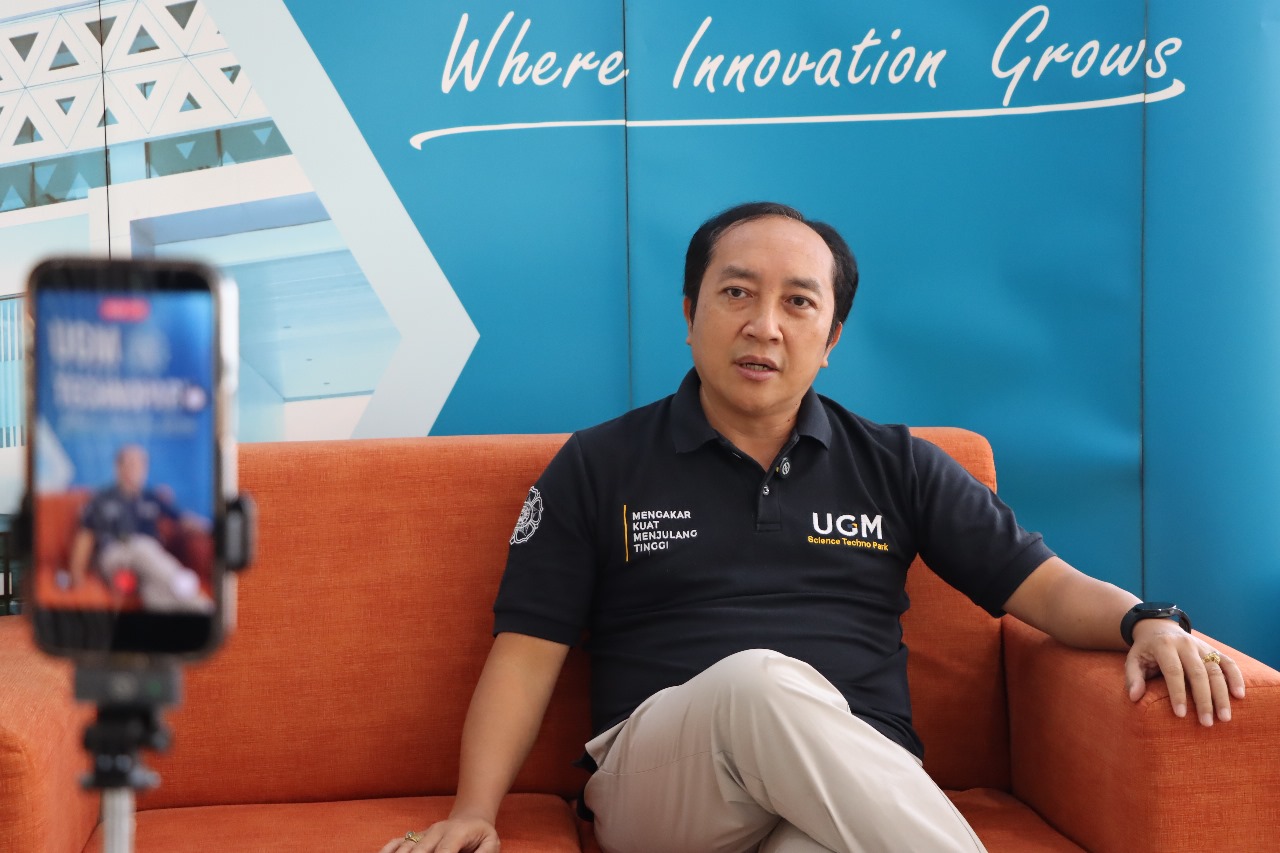
Unlike other research grant schemes, PRIME STeP offers a more comprehensive scope. The program focuses not only on research development but also on building innovation infrastructure, enhancing human resource capacity, and accelerating research outputs toward commercialization.
“PRIME STeP is designed to bridge research so that it truly reaches the stage of utilization by industry and society,” he explained.
According to Professor Wirawan, industry involvement is a key success factor of PRIME STeP. Industry partners are not only end users of innovations, but also strategic partners, mentors, and even investors.
“We are fostering a spirit of socio-entrepreneurship through two-way collaboration, encouraging the downstreaming of research to industry while also upstreaming industrial challenges as new sources of research on campus,” he said.
In addition, improving inventors’ mindset and attitude is a fundamental requirement for successful downstream innovation. This includes cultivating a habit of continuous innovation, openness to feedback, and commitment to outcomes.
Over the past three years, hundreds of innovations have received funding for product development until they are ready for downstream implementation.
Meanwhile, more than thirty innovations have entered the industrial adoption stage through intellectual property licensing or product development partnerships.
“Hundreds of startups have also received funding support during the pre-acceleration incubation phase and through pre-incubation programs,” he added.
Several PRIME STeP-assisted startups operate in sectors such as energy, fiber material development, laboratory equipment, and superior rice innovations that have now been incorporated into national programs.
To date, the valuation of UGM technologies downstreamed to industry through intellectual property licensing has exceeded Rp300 billion.
Professor Wirawan believes that university-driven innovation can stimulate economic growth, create job opportunities, and increase regional income in areas where industries are developing and expanding.
Author/Photographer: Hanifah
Editor: Gusti Grehenson
Post-editor: Rajendra Arya