


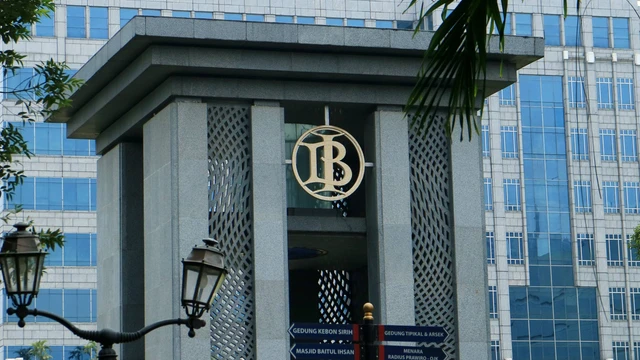
The appointment of Thomas Djiwandono as Deputy Governor of Bank Indonesia (BI) has sparked public debate, particularly regarding concerns over the independence of the central bank’s policymaking. The concerns stem from the fact that Thomas Djiwandono is the nephew of President Prabowo Subianto and previously served as a Gerindra Party official and as Deputy Minister of Finance.
Responding to the issue of BI’s independence, Professor Insukindro of the Faculty of Economics and Business, Universitas Gadjah Mada (FEB UGM), emphasized that discussions surrounding the background of BI’s officials, including the appointment of deputy governors or governors, cannot be separated from the institution’s well-established framework of systemic and collective independence.
According to Professor Insukindro, Bank Indonesia’s formal independence was established by the enactment of Law No. 23 of 1999, which separated BI from the government. Before the era of the Reformation, BI operated directly under the president and was even part of the cabinet.
“Since the enactment of Law No. 23 of 1999, Bank Indonesia has been independent from the government. Previously, BI was dependent on the government, and the BI Governor was a member of the cabinet,” he explained on Tuesday (Jan. 27).
He further explained that in post-reform practice, leadership positions at BI have not always been filled by internal candidates. Several BI governors and deputy governors have come from outside the institution, including from ministries, academia, and the banking sector; this should not be considered anomalous.
“Since 1998 or 2000, there have already been instances where BI governors and deputy governors came from outside the institution. So, in my view, this is quite normal,” he said.
Professor Insukindro emphasized that policymaking at Bank Indonesia is collective, conducted through the Board of Governors’ Meeting. Under this mechanism, decisions are not determined by a single individual, including the BI Governor.
“Policy decisions are not made by the governor alone. They are decided collectively in the Board of Governors’ Meeting. Therefore, no single person can dominate BI policy,” he asserted.
He explained that all policies related to monetary affairs, payment systems, and financial stability are prepared by technical departments using data and economic models and are subsequently discussed collectively at the regularly held Board of Governors’ Meetings.
“The organizational structure is already well established. Some departments prepare data, models, and analyses, then bring them to the Board of Governors’ Meeting for collective decision-making,” said the professor.
Regarding BI’s independence, Professor Insukindro outlined that, in theory, there are several dimensions of central bank independence, including functional, personal, and instrument independence, as well as financial independence.
However, in practice, this independence has undergone adjustments following the revision of Law No. 23 of 1999 into Law No. 3 of 2004.
“To be honest, BI was fully independent only until 2004. After that, there was a shift, whereby the government determined the monetary policy targets, while BI determined the instruments and their implementation,” he explained.
Nevertheless, he viewed this adjustment as a response to the dynamics of state governance, intended to ensure that BI does not become a “state within a state.”
In the context of crises, Professor Insukindro cited extraordinary policies during the COVID-19 pandemic under Law No. 2 of 2020, which allowed BI to directly purchase government bonds as part of a burden-sharing scheme with the government.
“In pressing situations, the government does indeed become dominant. That is regulated by law. BI is involved to ensure the economy continues to function, including financing vaccines and social assistance,” he said.
He added that this mechanism has now been adopted again in Law No. 4 of 2023 on Financial Sector Development and Strengthening (P2SK), which can be activated should the country once again be declared in a state of crisis.
From an economic impact perspective, Professor Insukindro cautioned that empirically, weaker central bank independence is correlated with higher inflation.
“Both theoretically and empirically, when central bank independence is high, inflation tends to decline. When independence is low, inflation rises, the cost of living increases, and there are impacts on the exchange rate and stock market,” the professor explained.
He emphasized that the key lesson in safeguarding BI’s independence lies not only in regulation but also in effective checks and balances between the government and parliament.
“Independence does not mean working in isolation, but working together without excessive mutual intervention. The key lies in the balance of power,” he concluded.
Author: Jelita Agustine
Editor: Gusti Grehenson
Post-editor: Jasmine Ferdian
Illustration: Shutterstock