


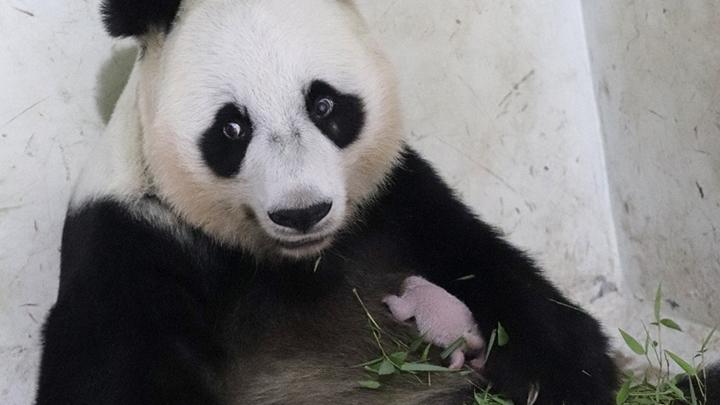
Indonesia has welcomed its first panda cub born at Taman Safari Indonesia, from a pair of giant pandas, Cai Tao (male) and Hu Chun (female), brought directly from China in 2017. The male cub was born on Wednesday (Nov. 27) and was named Satrio Wiratama by President Prabowo Subianto. The birth of the cub, affectionately known as Rio, represents a tangible success of conservation efforts that go hand in hand with diplomacy and international friendship.
A lecturer at the Faculty of Biology of Universitas Gadjah Mada (Biology UGM), Dr. Dwi Sendi Priyono, stated that the successful birth of a panda cub demonstrates Indonesia’s capability to protect wildlife.
He explained that panda breeding is highly complex because pandas’ fertile period is unpredictable and lasts only two to three days each year.
Pandas also have hormonal characteristics distinct from other species, making natural mating in captivity particularly challenging.
“Due to the complexity of panda breeding, the global success rate of panda captive breeding is only around 30 percent,” he said on Tuesday (Jan. 27).
According to Dr. Priyono, Taman Safari Indonesia plays a vital role in conservation, education, and recreation. During breeding, parent pandas require strict hormonal monitoring, intensive behavioral observation, and artificial insemination, in collaboration with experts from China.
Therefore, Rio’s growth and development must be carefully monitored before he is returned to China at the age of two to four years.
“Ex situ breeding aims to preserve genetic diversity and produce individuals suitable for release into the wild with high survival rates, thereby increasing the global population,” Dr. Priyono explained.
For Dr. Priyono, Rio has become a flagship species, attracting visitors to Taman Safari Indonesia and raising public awareness of wildlife conservation.
Moreover, this success demonstrates Indonesia’s ability to protect other endemic species such as orangutans, Sumatran tigers, and Javan rhinoceroses, thereby enhancing the country’s image in wildlife breeding and conservation.
“Going forward, diplomatic strategies like this could be studied further and potentially adopted for the conservation of endemic biodiversity,” he concluded.
Author: Jesi
Editor: Gusti Grehenson
Post-editor: Jasmine Ferdian
Photograph: Taman Safari Indonesia