


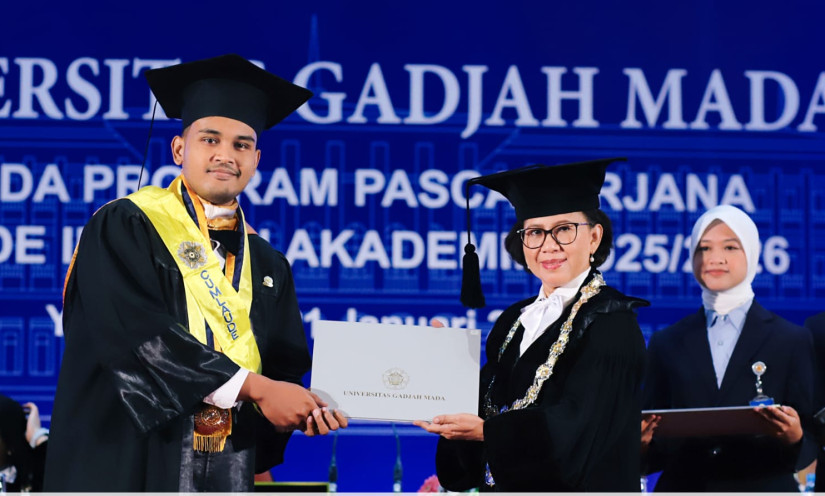
Aji Wikandaru (28) was one of ten master’s degree graduates who achieved a perfect Grade Point Average (GPA) of 4.00 at Universitas Gadjah Mada (UGM)’s postgraduate commencement ceremony, held on Wednesday (Jan. 21) at Grha Sabha Pramana.
In addition to earning a flawless GPA, the graduate of the Master’s Program in Agro-Industrial Technology, Faculty of Agricultural Technology (FTP UGM), completed his studies in approximately 1 year and 10 months.
By comparison, among the total 825 master’s graduates, the average study duration was 2 years and 2 months, with an average GPA of 3.71.
Wikandaru expressed his gratitude for achieving the highest GPA and graduating in less than two years, considering that he had spent three years in the workforce before deciding to pursue a master’s degree in the same field.
“After graduating, I worked in a retail company, then moved to manufacturing, and was assigned to various areas across Java,” he said on Tuesday (Jan. 27).
To continue his education at the master’s level, he had to let go of his job. However, with his parents’ support and blessing, his academic journey ran smoothly.
During his studies, he participated in a Student Exchange program at Kasetsart University in Bangkok, Thailand; undertook an internship at GS1 Thailand; attended an international conference in Japan; and gained experience as a student auditor with ASIIN, conducting an audit at Universitas Padjadjaran in Bandung.
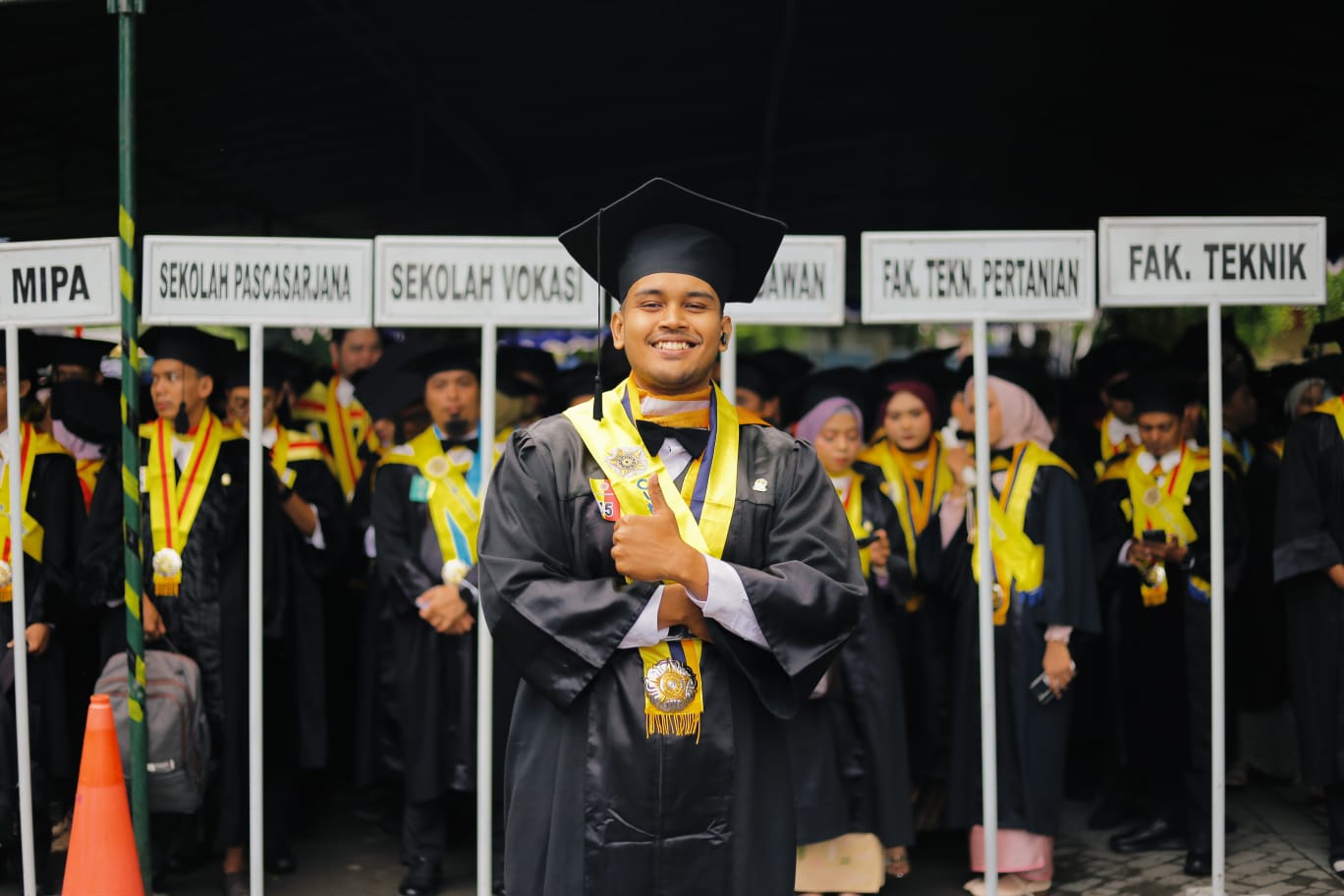
Throughout his studies, he also had the opportunity to pursue his passion for sports, particularly basketball. He shared that he remained active and even joined the Pascasarjana basketball team at Porsenigama in 2024 and 2025, marking the closing chapter of his academic journey.
“I never expected it. When we dare to take risks to become better and develop ourselves,” he reflected.
During his master’s studies, he also met many people who offered valuable life lessons. Interactions with individuals from diverse backgrounds helped sharpen his sense of empathy.
According to him, empathy plays an important role in shaping character and strengthening achievements.
Despite being busy with academic activities and participating in a student exchange program, he admitted he did not expect to graduate with honours at the ceremony.
He explained that he truly enjoyed the master’s journey because it was grounded in the principle of amanah, or responsibility, for the tasks undertaken. This was accompanied by seriousness, effort, prayer, and, most importantly, sincerity.
“Without sincerity, the ego is not ready to fail. When we make an effort, we should always leave some room to be wholehearted and accepting,” he said.
In addition, Wikandaru emphasized the importance of setting a clear timeline, such as his initial target to graduate in October.
However, challenges arose when he began his research and simultaneously sustained an ACL injury that required approximately six months of recovery, postponing his graduation and commencement plans.
In his research, Wikandaru focused his thesis on developing a virtual reality-based agro-industrial warehousing simulation application. He collaborated with Information Technology students to create an application designed to help students learn warehouse systems.
Intended for educational purposes, the system allows users to experience real-world warehousing activities, such as inbound, processing, and outbound operations, through VR technology.
Regarding the smooth progress of his studies and thesis writing, Wikandaru acknowledged that his prior work experience played a significant role in helping him understand real-world challenges.
According to him, this experience made the learning process more dynamic by fostering two-way discussions between students and lecturers.
“When students come with real problems they have faced, discussions flow more naturally,” he said.
Wikandaru also reminded students that education is a long-term investment, as it shapes mindset, character, and problem-solving skills needed in the professional world. However, theory alone is insufficient.
Practical experience, such as internships, part-time work, or organizational involvement, is essential to understanding workplace realities. Therefore, he encouraged students to remain open to change and challenges, to step out of their comfort zones, and to continue growing.
Author: Hanifah
Editor: Gusti Grehenson
Post-editor: Rajendra Arya
Photographs: Aji Wikandaru