


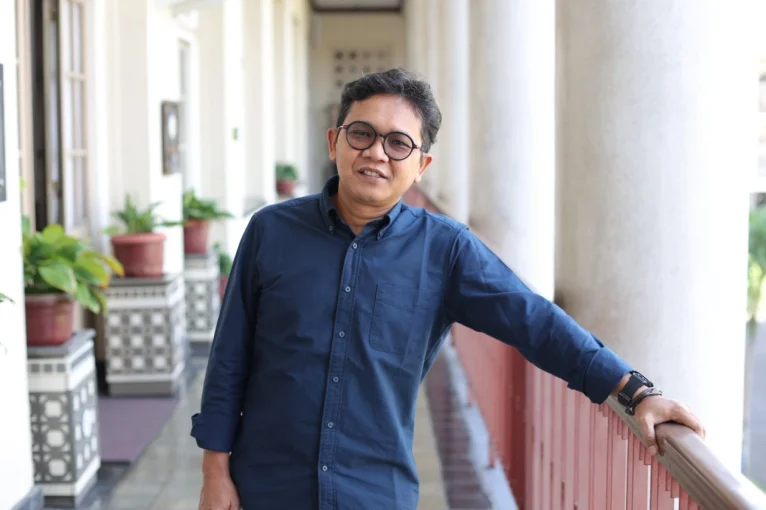
Yogyakarta is often described as a friendly, cultured, and tolerant city. Yet behind this image, issues of security and public order remain daily challenges for residents; street crime, social friction, and unease in public spaces have emerged alongside the dynamics of a city known for education and tourism. Responses that rely on enforcement often fail to address problems at the grassroots level.
According to UGM sociologist Dr. Arie Sujito, law enforcement cannot be separated from the social context in which the law operates. Social order, he noted, does not arise from fear but from shared awareness and a sense of collective ownership.
Dr. Sujito explained that a culturally based approach positions citizens as part of the solution rather than merely objects of enforcement. Dialogue and deliberation are seen as essential foundations for maintaining social harmony.
“The law should be present with both reason and compassion, understanding the lives of the communities it serves, not only appearing when problems have already escalated,” he said on Tuesday (Feb. 3).
Dr. Sujito observed that punitive approaches often dominate responses to security issues. Reactive enforcement is frequently applied without addressing the social backgrounds that give rise to problems.
As a result, similar cases recur readily, and public trust in law enforcement is at risk of erosion. The order that is achieved tends to be fragile and short-lived.
“When the law is present only in the form of punishment, social problems are never truly resolved and may even breed distrust,” he said.
He further explained that another issue stems from weak social participation in law enforcement. Overly top-down approaches often close off space for dialogue with residents.
In fact, communities have long-standing social mechanisms, such as neighborhood deliberations and consensus-based resolutions. When these mechanisms are ignored, the sense of shared responsibility also diminishes.
“Order will be stronger if it is built together with citizens through dialogue, not merely through instructions or enforcement,” he remarked.
Dr. Sujito highlighted the impact of increasingly rapid social change in Yogyakarta. Tourism flows, developments in information technology, and urban lifestyles have influenced patterns of social interaction.
Local values often confront new habits without an adaptive process. Conventional law enforcement systems frequently lag in responding to these dynamics.
“Changes of the times demand more contextual approaches so that the law remains aligned with the social lives of communities,” he said.
In this context, Dr. Sujito stressed that security issues cannot be borne solely by law enforcement agencies. Local governments play a significant role through preventive social policies.
When social policy and law enforcement operate in isolation, efforts to maintain order become less effective. Synergy among institutions is a prerequisite for creating sustainable security.
“Security needs to be built through collaborative efforts between local governments, law enforcement, and the community,” he said.
Dr. Sujito also argued that structural issues, such as poverty, social inequality, and bureaucratic unresponsiveness, influence law enforcement outcomes. Disorder often reflects unresolved economic and social problems.
Without improvements in public welfare, the law will continue to operate under constrained conditions. Just order grows from communities that feel protected and cared for.
“As long as the roots of social problems remain unaddressed, the law will always face challenges in maintaining public peace,” he emphasized.
Ultimately, Dr. Sujito underscored the importance of nurturing Yogyakarta as a shared living space. Values of cooperation, tolerance, and teposeliro, empathy, and consideration for others constitute social capital that must be continuously strengthened.
A culturally just approach to law enforcement opens the path toward order that grows from citizens’ awareness. This approach offers valuable lessons for other regions in Indonesia.
“Safeguarding Yogyakarta means caring for social relations with sincerity, so that a sense of security can grow naturally within the community,” he concluded.
Author: Triya Andriyani
Post-editor: Jasmine Ferdian
Photographer: Firsto Adi