


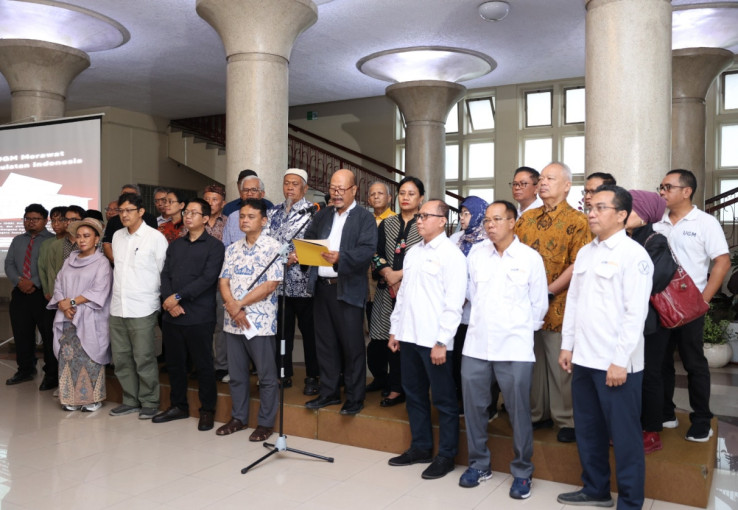
Professors, academics, and members of the academic community at Universitas Gadjah Mada (UGM) expressed a critical stance regarding the signing of the bilateral Agreement on Reciprocal Trade (ART) with U.S. President Donald Trump.
The contents of the ART are considered detrimental and potentially threatening to Indonesia’s national sovereignty. The ratification process is also alleged to violate Article 11 of the 1945 Constitution of the Republic of Indonesia (UUD 1945), while several provisions of the ART are deemed inconsistent with constitutional mandates.
Furthermore, the consequences of the ART would require Indonesia to amend dozens of laws, government regulations, presidential decrees, presidential regulations, Bank Indonesia regulations, Financial Services Authority regulations, and ministerial regulations, as well as draft numerous new regulations. Additional complexity arises from the U.S. Supreme Court’s ruling that struck down Trump’s global tariff policy.
Professor M. Baiquni, Chair of the UGM Professorial Council, expressed rejection of Indonesia’s foreign policy perceived as siding with aggressors, as reflected in Indonesia’s participation in the Board of Peace (BoP) and the signing of the ART, which he said undermines the sovereignty of the Republic of Indonesia.
“We call upon policymakers to carefully review the contents of the ART agreement, and specifically urge the Ministry of Foreign Affairs to assist the government in making corrections so as not to place the President in a position that violates the Constitution and existing laws,” he said while delivering the official statement at the Balairung UGM on Monday (Mar. 2).
According to Professor Baiquni, the signing of the ART was not preceded by consultations involving the House of Representatives (DPR) and was not ratified through legislation, thereby violating Article 11 of the UUD 1945, Article 10 of Law No. 24/2000, Article 84 of Law No. 7/2014, and Constitutional Court Decision No. 13/PUU-XVI/2018.
In the official statement, it was emphasized that the ART agreement is asymmetric, with the greatest benefits accruing to the United States, while Indonesia would bear the majority of costs due to the numerous obligations imposed on the government and its people. Significant financial, time, and human resources would be required to amend dozens of laws and regulations and to draft numerous new legal instruments.
“Another consequence of the ART is the creation of economic burdens, both in the short and long term,” he explained.
UGM academics further criticized various clauses within the ART as posing risks to Indonesia’s sovereignty, particularly given the country’s longstanding commitment to an independent and active foreign policy.
The agreement is seen as containing obligations for future policy compliance, even for policies not yet established, enabling unilateral policy determination by the United States and the transmission of U.S. policies to Indonesia concerning third countries.
“Therefore, careful and evidence-based policy studies are necessary regarding the ART provisions and their impact on Indonesia’s economy and sovereignty,” he said.
In addition, cross-disciplinary studies are necessary because ART spans multiple sectors. The analysis should focus on the agreement’s impact on Indonesia’s economy and sovereignty, as well as on risk mitigation to mitigate potential negative consequences.
“We call upon academics across Indonesia to jointly conduct multidisciplinary studies on the impact of the ART on Indonesia’s economy and sovereignty. As part of public accountability and knowledge dissemination, the findings should be communicated to the public through various media,” Professor Baiquni stated.
“At least eight provisions of the agreement are inconsistent with the fundamental principles of the 1945 Constitution.”
On this occasion, UGM academics urged the government to make prudent decisions that prioritize public welfare and national sovereignty in both the short and long term. Various complexities surrounding the ART, including the U.S. Supreme Court ruling, must be taken into consideration. If the ratification of the ART fails to accommodate the objectives outlined in statutory law and the UUD 1945, the government should renegotiate, postpone, or cancel its implementation.
“UGM academics stand ready to support all efforts to strengthen and safeguard Indonesia’s sovereignty across various sectors and spheres of life,” he added.
Meanwhile, Vice Rector for Education and Teaching, Professor Wening Udasmoro, emphasized that the academic community’s critical statement is purely academic in nature and not driven by any particular interests. Therefore, the statement will be followed up through scientific forums and scholarly discussions, with the results conveyed to the government.
Author: Agung Nugroho
Post-editor: Rajendra Arya
Photo: Firsto