


Air and missile strikes launched by the United States and Israel against Iran on February 28, 2026, targeted military bases, defense facilities, and Iran’s leadership structures in a joint military operation called Operation Lion’s Roar. The attacks prompted retaliation from Iran, which launched waves of ballistic missiles and drones toward Israeli territory, US military bases, and allied countries in the Gulf region in response to the aggression.
Responding to Indonesia’s diplomatic role in the Middle East conflict, the Institute of International Studies (IIS) of the Department of International Relations, Faculty of Social and Political Sciences, Universitas Gadjah Mada (Fisipol UGM), condemned the aggression by the United States and Israel against Iran. The military aggression constitutes a crime of aggression against peace, as it occurred amid ongoing nuclear negotiations between the US and Iran. The military actions by Israel and the US pose a real threat to stability in the Middle East and risk escalating into a broader war.
“As citizens, we call on the Indonesian government to condemn the military aggression by the US and Israel and bring this issue before the United Nations to impose firm sanctions and resolve the matter fairly,” said the Head of the Department of Communication Science, Ririn Tri Nurhayati, Ph.D., in a statement sent on Thursday (Mar. 5).
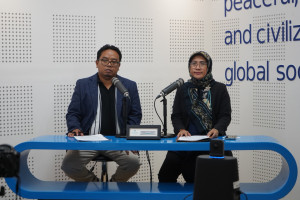
Responding to the first point, IIS UGM researcher and international activist for the Treaty on the Prohibition of Nuclear Weapons, Muhadi Sugiono, said that the remaining hope now lies in the international nuclear regime, namely the Nuclear Non-Proliferation Treaty (NPT). The NPT has three main pillars: non-proliferation, disarmament, and peaceful use of nuclear energy. In the current situation of military aggression, Iran no longer receives protection from the agreement.
“If the US and the NPT cannot guarantee their security, the only option is to develop nuclear weapons, and Iran has that potential. Therefore, nuclear proliferation will become highly significant,” Muhadi said.
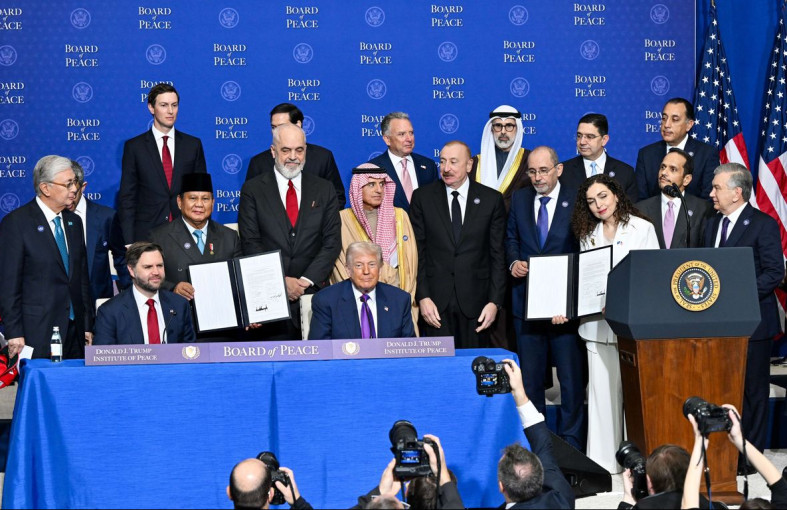
In the second point, IIS urged Indonesia to withdraw from the Board of Peace (BoP). The ongoing military aggression serves as a critical reflection on Indonesia’s decision to join the BoP. This is because two BoP members, the US and Israel, have become aggressors that pose a threat to Indonesia.
“Indonesia’s involvement in the BoP not only fails to strengthen Indonesia’s diplomatic role but also undermines the independence of Indonesia’s political policy. Therefore, we demand that Indonesia withdraw from the BoP,” Ririn said.

Regarding the second point, an International Relations lecturer, Dr. Diah Kusumaningrum, stated that the BoP is supposed to be a peace council, yet what is currently demonstrated is conflict. According to her, Indonesia needs to evaluate the reasons behind its decision to join the BoP. Under the current circumstances, Indonesia’s involvement in the BoP suggests that the country is not aligned with its national values, anti-colonial principles, the Bandung Ten Principles (Dasasila Bandung), and its foreign policy principles.
“For Indonesia’s reputation in the future, history will record that Indonesia became part of the aggressors if it remains in the BoP,” Diah said.
Furthermore, in the third point, IIS urged Indonesia to prioritize solidarity with the Global South amid brutal unilateral actions. Instead of responding to geopolitical dynamics and unilateral actions by joining activist groupings, Indonesia should strengthen regional cooperation and mobilize solidarity among countries of the Global South. Commitment to the Dasasila Bandung can serve as the foundation for sovereignty and solidarity among Global South countries as part of Indonesia’s diplomatic identity and values.
In line with these commitments and principles, another IIS UGM researcher, Dr. Randy Wirasta Nandyatama, stated that a crucial principle of foreign policy is that it must be grounded in domestic conditions and normative ideas within the country itself. Since independence, Indonesia’s longstanding struggle has reflected a commitment to the Global South, which has been the basis of Indonesia’s international reputation. This serves as an important element in building national credibility.
“To realize a peace-oriented role, the government must actively engage in international forums that can serve as a foundation for strengthening responses to the current political situation,” Randy explained.

The final point concerns resisting the personalization of foreign policy without meaningful public deliberation. The Indonesian government currently tends to reflect the president’s personal views in foreign policy decisions. This tendency is marked by the limited presence of public discussion.
Decisions based on personal political calculations risk contradicting Indonesia’s independent and active foreign policy and its global commitments. Re-institutionalizing foreign policy decision-making through the Ministry of Foreign Affairs, alongside reaffirming the role of public discourse, is considered essential.
This statement was also supported by Professor Poppy S. Winanti of the Department of International Relations. She said that the personalization of foreign policy must be viewed through the lens of Indonesia’s credibility in the eyes of the world, as Indonesia has long defined itself through an independent and active foreign policy. However, decisions taken in several recent events indicate a lack of public discussion.
“The absence of deliberation and public discussion processes could cause foreign policy decisions to deviate from the spirit of Indonesia’s independent and active foreign policy,” she said.
Author: Jesi
Editor: Gusti Grehenson
Post-editor: Jasmine Ferdian
Photo: Documentation of DIHI UGM and BPMI Setpres