



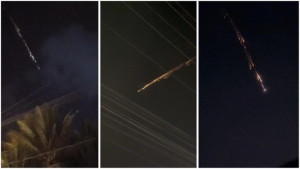
The National Research and Innovation Agency (BRIN) reported that the space debris observed in the skies over Lampung and Banten originated from a Chinese CZ-3 B rocket. The Chinese CZ-3B R/B rocket was tracked as it orbited Earth on April 4, 2026. Previously, residents in several areas in Lampung were startled by the appearance of a bright object visible in the night sky on Saturday. The object streaked across the sky and appeared to break into several fragments.
Responding to the discovery, a Physics lecturer at the Faculty of Mathematics and Natural Sciences (FMIPA UGM), Dwi Satya Palupi, stated that the government should be more vigilant regarding space debris entering Indonesian territory, as this is not the first such incident.
“There needs to be a dedicated team to monitor space debris that may eventually fall in Indonesian regions,” she said on Wednesday (April 8).
Dwi explained that such phenomena can be predicted in advance using applications that track objects entering Earth’s atmosphere, including space debris. With specialized applications, incidents such as falling space debris can be anticipated.
“If such applications are not yet available, Indonesia should begin developing them,” she added.
According to Dwi, any space debris entering Earth’s atmosphere at high speed will appear to glow. At a glance, it may resemble a rocket, comet, or shooting star. She noted that it is understandable for the public to mistake such objects for meteors or comets.
“They may look similar at first, but in fact, these objects can be distinguished,” she explained.
In light of this incident, she emphasized the need for the public to remain critical and informed. Space debris falling into densely populated areas could pose a serious threat to human life.
“If it were to fall onto residential areas, it would be extremely dangerous,” she added.
Fortunately, in this case, the debris from China fell into the sea. However, it still poses risks to marine ecosystems.
“It could endanger marine life, in addition to other potential hazards,” she said.
Dwi noted that while incidents of space debris falling into Indonesian territory have not yet become a major issue, they could pose significant risks if not anticipated. As the amount of space debris continues to increase, more objects may enter Earth’s atmosphere uncontrollably, creating a serious threat.
“The more debris there is, the higher the chance it could hit residential areas or even critical infrastructure, which would become a far more serious concern,” she explained.
In conclusion, Dwi emphasized that reducing the risks of space debris requires a strong global commitment. She acknowledged that addressing this issue is not easy, as it involves precise calculations and high costs.
“Companies that manufacture rockets or use launch services for satellite deployment must begin considering how to manage their debris so that it does not fall back to Earth,” she concluded.
Author: Fatihah Salwa Rasyid
Editor: Gusti Grehenson
Post-editor: Zabrina Kumara
Photo: iStockphoto and Detik