


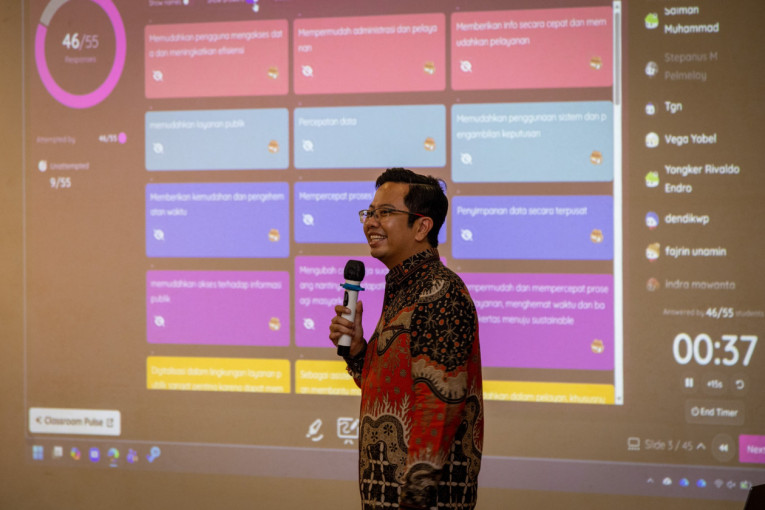
Digitalization and digital transformation within universities have become essential amid rapid advances in information technology to support the quality of higher education’s tridharma services. Therefore, computer administrators are required to possess strong capacity and competence to drive improvements in technology-based services.
This was highlighted during a workshop and benchmarking session to support digital transformation in university environments, organized by the Ministry of Higher Education, Science, and Technology of the Republic of Indonesia (Kemdiktisaintek RI) and Universitas Gadjah Mada (UGM) at the Grand Keisha Hotel Yogyakarta from April 6-10.
Director of the Directorate of Information Technology at UGM (DTI UGM), Professor Ridi Ferdiana, who is also a lecturer and researcher in software engineering, explained that digital transformation and digitalization are two distinct concepts. He explained that digitalization is the process of converting physical forms into virtual ones. Meanwhile, digital transformation is carried out through two approaches: business process reengineering and business process transformation.
“Digitalization promises a process called ‘efficiency,’ and digital transformation is not an easy undertaking,” he said.
Ridi noted that current digital advancements, particularly in Artificial Intelligence (AI), present both advantages and challenges in the university’s digital ecosystem. He emphasized that AI literacy must be carefully governed by humans. In terms of digital ethics, understanding concepts such as misinformation, law, and technology is crucial.
“Digital ethics generally includes network ethics and an understanding of misinformation, law, and technology,” he explained.
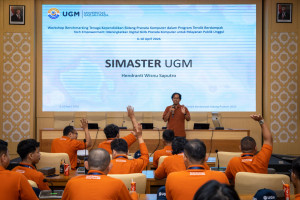
Meanwhile, Hendranti Wisnu Saputro, from DTI UGM, presented material on the Simaster UGM system. In his presentation, Hendranti explained that Simaster serves as a strategy for integration and centralized service governance to achieve a Smart Campus. According to him, in developing educational systems, feedback and suggestions must be accommodated to meet user needs.
“Whenever we develop a system, criticism and suggestions will inevitably arise. We must be prepared for that and use them as an evaluation to continuously improve our systems,” he explained.
Hendranti added that all systems should be integrated so that complaints from students, lecturers, or staff can be resolved through a single access point.
“All systems at UGM are integrated into Simaster,” he said.
To conclude the session, Hendranti highlighted the rapid development of Artificial Intelligence (AI), which has made it easier for the public to access information. Before the participants, he emphasized that the role of educational staff in computing remains essential despite the rapid growth of AI.
“Technology evolves very quickly, and AI often makes things easier. However, our basic knowledge must still be applied, especially in analyzing systems,” he concluded.
Author: Diyana Khairunnisa
Editor: Gusti Grehenson
Post-editor: Jasmine Ferdian
Photo: Donnie