


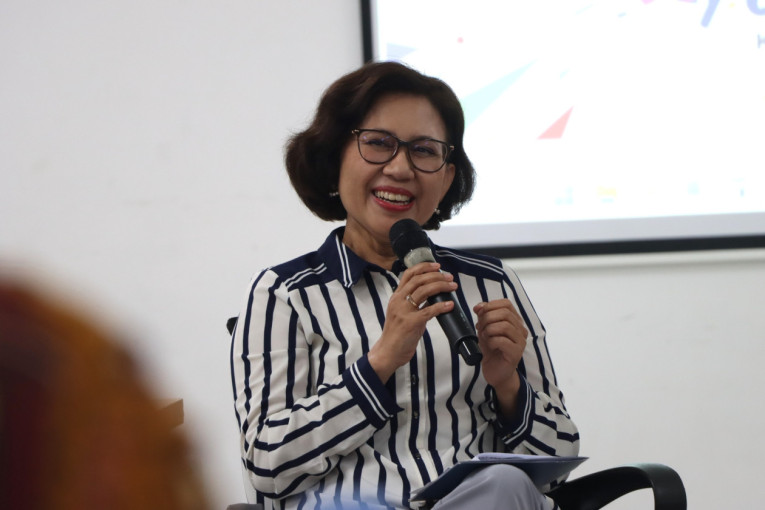
Building a city’s image has become a crucial tool for many regional governments to boost local economies by showcasing destinations and events that attract tourists, investment, and local economic activity. Through consistent city branding execution, regions such as Banyuwangi, Solo, Bali, and Yogyakarta have successfully transformed local potential into tangible economic stimulus. This success is reflected in the organization of activity calendars that directly stimulate regional economic circulation and encourage the growth of micro, small, and medium enterprises (MSMEs). These issues emerged during the Region City Branding Workshop held at the National Industrial Design Center (PDIN) Building in Yogyakarta on Saturday (May 23).
Rector of Universitas Gadjah Mada (UGM), Professor Ova Emilia, who spoke at the workshop, stated that alignment between an institution’s identity and its region plays a major role in strengthening a region’s image. She cited the image of UGM, with its “people-oriented” characteristic, and the image of Yogyakarta as an example of an organic communication strategy.
According to Professor Ova Emilia, this image has been built through direct engagement with communities, particularly through the UGM’s Community Service Program (KKN-PPM UGM), which serves as an indirect marketing instrument for promoting Yogyakarta’s character at the grassroots level.
“UGM is closely associated with Jogja, which is often seen as humble and grounded. Through KKN-PPM, UGM becomes closer to the community. For children in remote areas who aspire to study at UGM because they are inspired by KKN-PPM students, that becomes indirect marketing by UGM to attract people to Yogyakarta,” she explained.
Professor Ova Emilia also highlighted the potential for curriculum collaboration to address the brain drain from regions to major cities. According to her, in addition to strengthening social identity, the presence of well-established universities also functions as a talent magnet that supports regional competitiveness.
She noted that this idea is supported by regulations from the Directorate General of Higher Education (Dikti), which now permit dual-degree programs between local universities.
“Curriculum collaboration through double-degree programs between local universities and more established universities can become a solution. In addition, regional universities must be able to design unique local projects to attract and retain the best talents in their respective areas,” she said.
Meanwhile, Arief Budiman, the initiator of Jogja Istimewa, highlighted that implementing city branding within government institutions is often hindered by the difficulty of synchronizing creative concepts with budgeting and bureaucratic processes.
“Branding is about managing leading regional potential. There must be concrete programs accompanying it so that the brand carries meaning and can be proven tangibly,” he said.
He added that regional development planning agencies (Bappeda) within local governments could ensure that city branding creates added value that ultimately increases local government revenue.
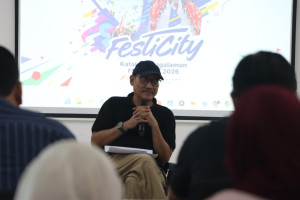
At the same event, Ngayogjazz Creative Board member Ajie Wartono stated that highlighting authentic historical values in every event location is the main key to the sustainability of regional events. Reflecting on the success of Ngayogjazz, which has moved from village to village since 2007, he explained that festivals should utilize the community’s “living spaces” rather than socially inactive venues.
“Ngayogjazz uses living spaces where social and community activities already exist, not empty spaces. The challenge is how we manage those spaces together with residents. We stimulate them by bringing events, all managed by the village and contributing to village revenue,” he explained.
Furthermore, Wartono added that regional branding strategies, including those for rural areas, must be more observant in uncovering unique narratives that can be transformed into contemporary attractions relevant to younger generations.
“There are still many villages that do not realize they have potential. Therefore, we need to guide them in creating distinctive village branding. For example, in Badui, Lebak, event taglines can be inspired by elements unique to the village,” he concluded.
Author: Aldi Firmansyah
Editor: Gusti Grehenson
Post-editor: Zabrina Kumara
Photo: Hanifah