


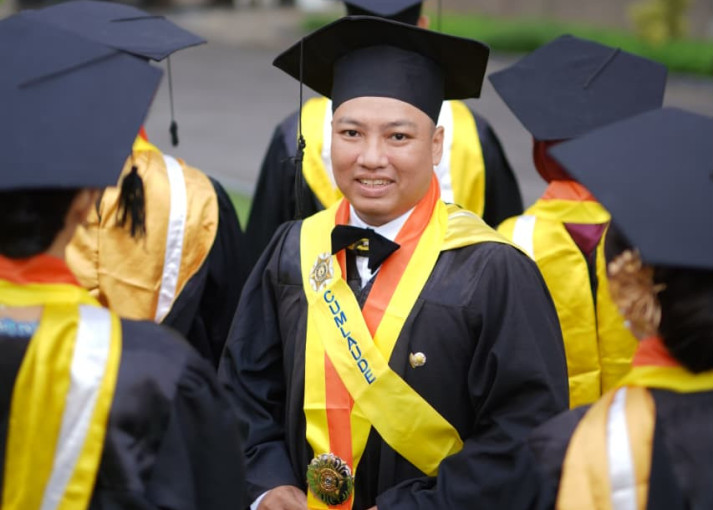
Martin Anggiat Tampubolon, a graduate of the Master of Management Program (Jakarta Campus) at the Faculty of Economics and Business, Universitas Gadjah Mada (FEB UGM), never expected to become the fastest graduate in his cohort, completing his master’s degree in just 1 year, 1 month, and 22 days. By comparison, the average study period among the 821 master’s graduates at the postgraduate commencement ceremony held on Wednesday (Jul. 22) at Grha Sabha Pramana was two years.
Martin admitted that the achievement had never crossed his mind. Throughout his studies, he focused on discipline and consistency. He expressed gratitude for the supportive environment provided by his workplace, family, and academic supervisors.
“In addition, as a civil servant granted a study assignment by the institution where I work, and with the full support of my family, I felt responsible for carrying out this trust to the best of my ability and completing my studies on time,” Martin said on Monday (Jul. 27).

During his studies, Martin encountered several challenges that ultimately became some of his most memorable experiences. The greatest challenge in the Master of Management Program was maintaining consistency while balancing his thesis work with the immersion program, a postgraduate learning method that places students in real-world professional environments. By setting realistic weekly targets and being open to feedback from his supervisors and fellow students, Martin was able to complete his research successfully.
At the same time, those challenges also became the highlight of his academic journey at UGM. He believes UGM’s academic culture encourages students to think critically while remaining humble and committed to learning. Classroom discussions also brought together students from diverse professional and academic backgrounds, broadening Martin’s perspective and helping him view problems from multiple angles.
“Those different perspectives taught me to examine issues more broadly and not just from the standpoint of my own work,” he said.
In addition, Martin benefited from a highly supportive learning community. His classmates at UGM Jakarta Campus regularly held discussions, collaborated on assignments, and encouraged one another throughout their studies, making his academic journey significantly easier.
“The friendships I built with my classmates became one of the most valuable parts of my experience. We supported, discussed, and encouraged one another until we finally completed our studies,” he explained.
Martin further described his master’s thesis, which focused on Human Resources and Organizations (HRO) and was titled “Pengaruh Kepemimpinan Etis terhadap Perilaku Kerja Inovatif dengan Keterikatan Kerja sebagai Pemediasi” (The Influence of Ethical Leadership on Innovative Work Behavior with Work Engagement as a Mediating Variable). His professional background in organizational management was the primary reason for selecting the topic.
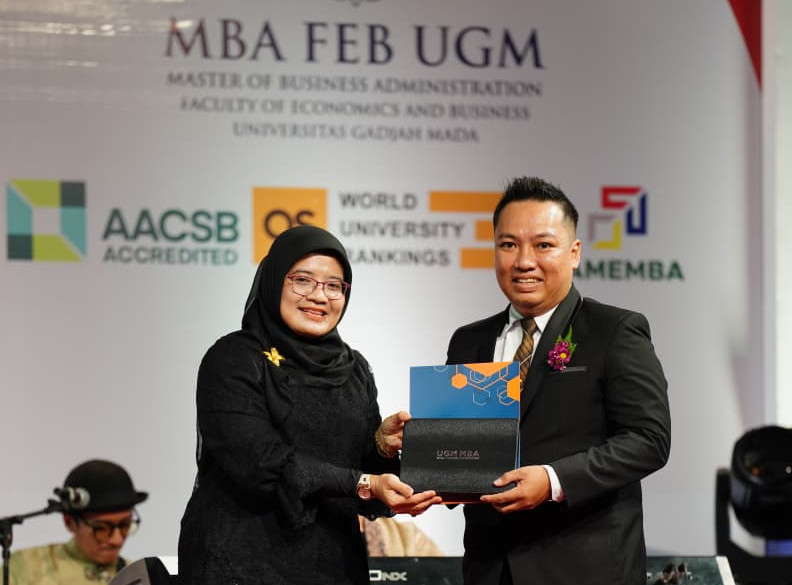
According to Martin, organizations can achieve long-term sustainability through the right strategies and strong human resources. Employees must continuously innovate through effective innovative work behavior managed by the organization. Martin explained that such behavior is strongly influenced by the quality of leadership and leaders’ ability to foster an organizational climate that supports innovation.
Through several stages of research, Martin found that ethical leadership significantly enhances employees’ innovative work behavior. Leaders who demonstrate integrity, fairness, and genuine concern for employees encourage greater work engagement and inspire employees to generate innovative ideas.
“In other words, when leaders demonstrate integrity, fairness, and concern for their employees, employees become more engaged in their work and are motivated to produce innovative ideas,” he said.
Martin hopes to apply the knowledge he gained to support organizational advancement and human resource development, ultimately contributing to improved public services and community satisfaction. He hopes his research will serve not only as an academic contribution but also for policymaking reference.
“I also hope that my research will not remain solely an academic work but can serve as one of the references for designing policies and leadership development programs, as well as initiatives to strengthen employee engagement in the public sector,” Martin said.
Concluding his remarks, the most valuable outcome of his studies was not merely the knowledge but also the way of thinking, one that enables him to analyze issues comprehensively, make data-driven decisions, and connect theory with real-world practice. The critical thinking skills he cultivated and the collaborative experiences he gained with many people are among the greatest benefits of studying at UGM.
“For me, graduating in the shortest time was never the ultimate goal. What matters most is ensuring that every stage of the learning process shapes the way we think, our character, and our ability to make a greater contribution to organizations and society. A degree marks the end of an academic journey, but it is also the beginning of a greater responsibility to continue creating meaningful impact,” Martin concluded.
Author: Zabrina Kumara
Editor: Gusti Grehenson
Post-Editor: Jasmine Ferdian
Photo: Courtesy of Martin