


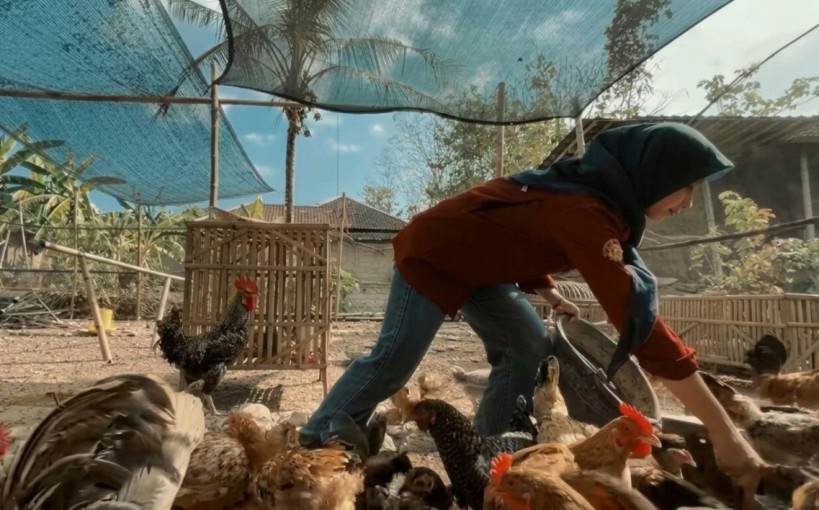
Where there is a will, there are endless possibilities. A UGM student has shown this by building a successful laying-hen business using scholarship savings. Starting with just Rp500,000, she established the business in Karangpakel Village, Klaten Regency, Central Java. It has since grown into an independent poultry farm with hundreds of chickens.
Drawing on the animal breeding knowledge she gained in college, Anjeli Astriani, a 2023 student at Universitas Gadjah Mada’s Faculty of Animal Science (Animal Science UGM), has developed a crossbreeding initiative involving Elba and Mardi chickens through her poultry business, Bejo Farm.
Her approach is based on understanding each breed’s characteristics. Elba chickens are known for their high egg production, while Mardi chickens have larger bodies. By crossing the two, Anjeli aims to combine egg-laying potential and body growth in their offspring.
“Elba chickens are prolific layers, producing around 280–300 eggs a year, but they have small bodies. Mardi chickens, on the other hand, are larger, but their egg production is average,” she explained.
Through crossbreeding, Anjeli hopes to produce offspring that grow quickly for meat while females retain their egg-laying potential. This approach reflects the animal breeding knowledge she gained during her studies at Animal Science UGM.
In addition to crossbreeding Elba and Mardi chickens, Bejo Farm also raises KUB and Kuntara 4 chickens.
“Currently, Bejo Farm produces around 15–20 eggs a day, supported by dozens of active breeding hens and chicks hatched on the farm,” according to the statement.
With commercial feed prices rising, Anjeli uses locally available food waste and other resources to cut operating costs.
“Since commercial feed has become expensive, I mix my own feed using rice bran, leftover food from events that is still safe for livestock, and seasonal fruits such as mangoes and water apples cut into pieces. I feed the chickens twice a day, in the morning and evening,” she said.
Beyond feed management, Anjeli also uses natural ingredients, such as garlic and papaya leaves, in her livestock care practices.
“Garlic can serve as a natural antibiotic, helping boost immunity and address cases where chickens isolate themselves or become lethargic. I give half a clove to adult chickens and a quarter to younger ones, either by feeding it directly or mixing it into their feed during the seasonal transition. I also use fresh papaya leaves as a deworming remedy by chopping them up and mixing them into wet feed once or twice a week to eliminate worms and stimulate appetite,” she explained.
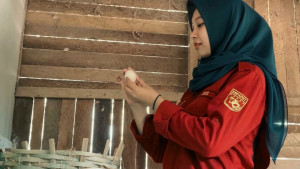
For egg sales, Anjeli offers on-site purchases and accepts online orders through WhatsApp and Facebook. Her products include fresh eggs, day-old chicks (DOC), and live free-range chickens.
Anjeli said sales revenue covers all daily operating and feed costs. Her net profit comes from the remaining proceeds from DOC and live free-range chicken sales. This achievement illustrates how applying animal science knowledge alongside business management can help build an independent poultry enterprise.
Bejo Farm’s journey has not always been smooth. Anjeli once suffered losses when chicks died during extreme weather fluctuations in Klaten. The experience prompted her to reassess coop sanitation and livestock care so the business could keep growing.
Anjeli explained why she established Bejo Farm. With only her scholarship savings as initial capital, she chose to invest in building a business based on what she learned in college.
“What’s the point of scholarship money if it goes to waste or is spent just following trends out of FOMO? It’s better to put it to good use, such as building my own poultry farm,” Anjeli said.
She also emphasized that her initial savings alone wouldn’t have been enough without applying what she learned at Animal Science UGM.
“Bejo Farm’s achievements are inseparable from disciplined financial management and the application of the knowledge I gained while studying at Animal Science UGM,” she said.
Through Bejo Farm, Anjeli shows how animal breeding knowledge can lay the foundation for innovation in poultry farming. By combining academic knowledge, crossbreeding experiments, and business management, students can improve livestock potential while building financial independence during their university studies.
Reporter: Satria/ Animal Science Public Relations
Author: M. Aidil Syahputra
Editor: Gusti Grehenson
Post-Editor: Priyananda
Photo: Anjeli Documentation