


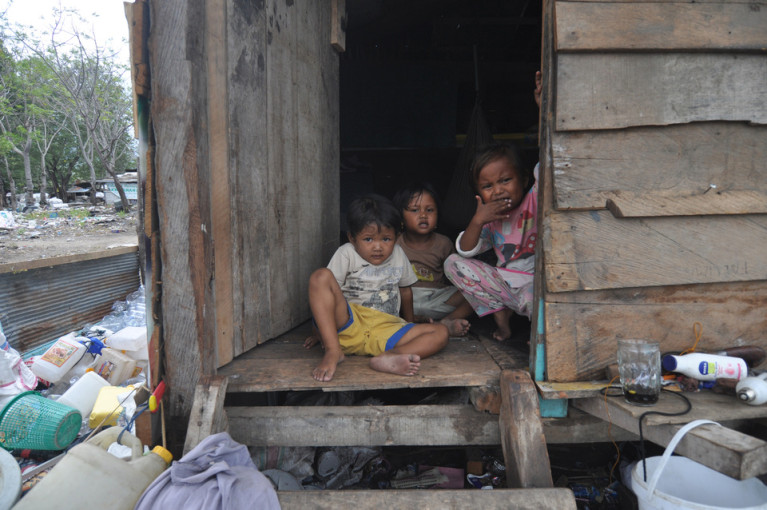
Poverty is not only a matter of income. Opportunities to access basic services and the social relationships that shape people’s lives can also determine whether they become trapped in poverty. For children, these issues can affect their opportunities to learn, access healthcare, play, feel safe, and make choices about their future. Research shows that approximately 37.4% of children in Indonesia experience multidimensional poverty, while 58.87% are vulnerable to monetary poverty.
These findings emerged during the Mubyarto Public Policy Forum discussion titled “Navigating Shrinking Middle Class, Lasting Poverty and Vulnerability,” which brought together domestic and international economists to discuss critical issues facing Indonesia. The forum was held on Friday (November 13) at Universitas Gadjah Mada’s Faculty of Economics and Business (FEB UGM).
UGM economist Dr. Wisnu Nugroho of FEB UGM said that Indonesia’s current labor market reflects a paradox in economic development. Over about two and a half decades, Indonesia has absorbed nearly 50 million workers, but this employment growth has not generated a comparable level of upward mobility.
“The market absorbs workers, but unfortunately, it does not help them advance,” Wisnu said.
According to research he conducted with several fellow economists covering 2001–2024, approximately 59.4% of Indonesian workers remain in the informal sector, equivalent to around 87.7 million people.
At the same time, many workers put in long hours, sometimes exceeding 50 hours per week. For Wisnu, this shows that the problem in Indonesia’s labor market is not simply a lack of willingness to work.
“This is not about effort or working hours. There is something else at play,” he said.
The problem lies in mobility. Wisnu describes this situation as working without a ladder: workers keep working but have no “ladder” to help them move toward better jobs and higher incomes. Economic growth is also distributed unevenly.
Those who already own assets benefit from greater growth, while the middle- and lower-income groups experience more limited gains. Some middle-class members, meanwhile, remain close to the poverty line.
“Our economy is not weak. The question is who actually benefits from its growth,” Wisnu explained.
This situation is even more apparent in home-based work. Of the approximately 18 million jobs created between 2018 and 2024, more than half were home-based. Women are approximately four times more likely to work in this type of employment.
Many workers lack social security and insurance, while only around 4% have written contracts and compliance with minimum wage requirements stands at approximately 12%.
For this reason, Wisnu criticized the tendency to measure the success of job creation solely by numbers.
“When politicians say they will create 19 million jobs, the question is: what kind of jobs?” he said.
He then connected this issue to Mubyarto’s ideas on a people-centered economy and empowerment. For Wisnu, home-based work should not be maintained merely as a means of survival.
If the formal sector cannot yet absorb the entire workforce, the informal sector needs to be strengthened so that workers have opportunities to grow.
For Wisnu, if formal employment is not yet available to everyone, the policy response should not be to leave informal workers to fend for themselves. Instead, home-based work and the informal sector need recognition, protection, access to capital, and opportunities for development.
This would allow work to become more than a means of survival and serve as a pathway to prosperity.
Professor Sharon Bessell of the Australian National University (ANU) began her presentation by discussing trends in child monetary poverty in Indonesia. Over the past two decades, the proportion of children living in monetary poverty has fallen from nearly one in four in 2003 to approximately one in nine in 2023.
She said this progress had improved the lives and opportunities of millions of children, but did not fully capture their experiences.
“This progress has improved the lives and opportunities of millions of children. However, monetary poverty tells only part of the story,” Bessell said.
When poverty is examined through UNICEF’s multidimensional approach—covering education, food and nutrition, health, child protection, housing and facilities, and access to information—the proportion of children experiencing poverty reaches 37.4%. Meanwhile, 58.87% of children are vulnerable to monetary poverty.
Bessell explained that this vulnerability is also linked to the circumstances of the lower-middle class and a labor market still dominated by informal employment, characterized by low or unstable incomes and limited social protection.
Therefore, understanding poverty requires more than examining statistics; it also means considering children’s direct experiences.
“Children experiencing hardship due to poverty or disadvantage possess unique knowledge that those with very different life experiences do not have,” she said.
Through research conducted with children in several organizations, Bessell has developed an understanding of poverty that places children’s experiences at its center. She drew on the ideas of Ruth Lister, who cautioned that poverty measurement often follows the data available rather than the need to bring about change.
“First, we need to conceptualize poverty and then define it clearly. Measurement remains important, but it must contribute to change,” Bessell explained.
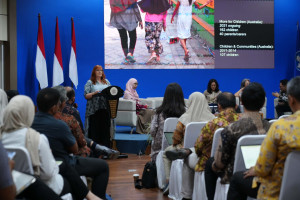
Within a child-centered framework, poverty encompasses material, opportunity, and relational dimensions. The material dimension concerns limited resources and access to basic facilities. The opportunity dimension includes children’s limited choices when it comes to learning, accessing healthcare, playing, resting, and participating in social life.
The relational dimension concerns children’s relationships with their families, friends, teachers, and other people who provide support.
“Children almost always begin by talking about the people who matter to them, especially their families, but also their friends, teachers, and people in their communities,” Bessell said.
These three dimensions can overlap in children’s experiences. Inadequate household facilities, for example, may coincide with difficulties attending school, feelings of shame, discrimination, and concerns about their parents’ circumstances.
Bessell gave examples of children who must use public toilets because their homes lack sanitation facilities, as well as children who worry about their fathers working hard and returning home exhausted.
These experiences show that child poverty is not always visible through income measurements. Material conditions, opportunities, and social relationships can shape experiences of poverty at the same time.
For this reason, Bessell divides policy responses into three approaches: patching, reforming, and transforming. Patching focuses on urgent needs, such as food and school supplies. Reforming involves changing policies to make systems fairer, while transforming addresses the ideas and structures that perpetuate inequality.
Bessell argued that various Indonesian policies, including social assistance, school meals, education, and health insurance, play important roles. However, ensuring access must go hand in hand with attention to quality and equity.
This perspective is also consistent with Mubyarto’s ideas on the importance of institutions, equitable distribution, justice, ethics, and sustainability in development. In her view, economic growth is not enough unless it is accompanied by a reduction in social inequality.
Author: Zabrina Kumara
Editor: Gusti Grehenson
Post-Editor: Priyananda
Photo: Firsto, Antara