


Colorectal cancer (CRC), commonly known as bowel cancer, is the third most common cancer in Indonesia and the fourth leading cause of cancer-related deaths. Yogyakarta Special Region (DIY) faces a similar challenge. Based on data from the Yogyakarta Population-Based Cancer Registry (RKBP DIY), CRC is the third most common cancer in the region after breast and cervical cancer and is the most common cancer among men. Compared with 2022, its incidence is projected to increase by 71 percent by 2050, while mortality is expected to rise by 85 percent.
Susanna Hilda Hutajulu, a Professor of Internal Medicine, Hematology, and Medical Oncology at the Faculty of Medicine, Public Health, and Nursing (FK-KMK UGM), found that at Dr. Sardjito Hospital, 50 percent of newly diagnosed patients sought medical attention more than one month after experiencing symptoms. Meanwhile, 49 percent of other patients waited four months before receiving a diagnosis.
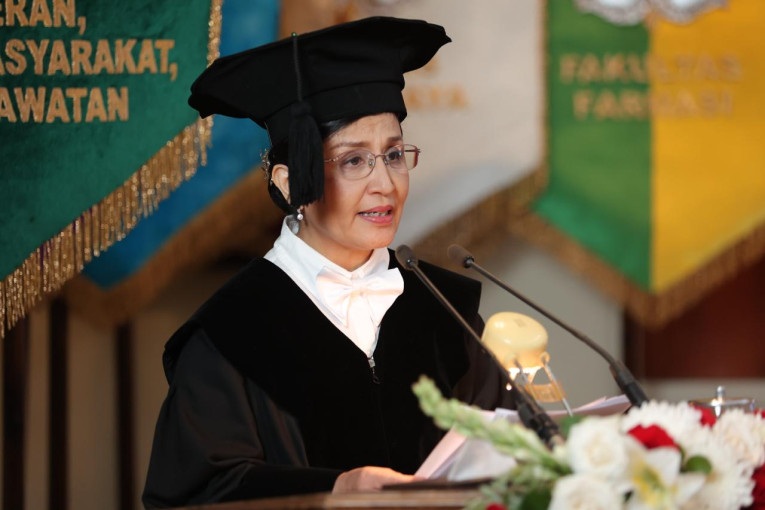
“Some patients consider bowel cancer to be an unserious disease, are afraid to seek medical attention, do not feel pain, and face financial barriers,” Susanna said in her inaugural professorial speech on Thursday (Nov. 12) at the Senate Hall of UGM’s Central Building.
In her inaugural speech, titled “Kajian Multi Dimensi tentang beban kanker kolorektal: Ajakan untuk bertindak dari Yogyakarta” (“A Multidimensional Study of the Colorectal Cancer Burden: A Call to Action from Yogyakarta”), Susanna explained that the general risk factors for bowel cancer include being male, being over 50 years old, obesity, smoking, and a family history of the disease.
Early symptoms of bowel cancer include changes in bowel habits, abdominal problems, and weight loss. However, only 43 percent of respondents understood the early symptoms, while only 17 percent understood the risk factors. Despite this, 23 percent of individuals would only undergo screening after symptoms appeared.
“This indicates a misconception among the public that requires informative educational interventions on the importance of screening,” she explained.

She noted that bowel cancer risk factors can be divided into non-modifiable and modifiable factors. The lack of local research data exploring these factors has meant that public education interventions have often relied on data from outside Indonesia, which may not necessarily align with local cultural contexts.
Age is a non-modifiable risk factor. Several modifiable factors, including educational level, exposure to tobacco smoke, and dietary patterns, have been confirmed by local studies. Physical activity has also been shown to reduce the risk.
“One unique finding concerns the Body Mass Index, as local studies show that not only obesity but also poor nutrition and being underweight can increase the risk,” Susanna said.
According to her, the health burden of bowel cancer also stems from the health system, including limitations in infrastructure, diagnostic and cancer treatment equipment, the number and quality of medical specialists, funding from both universal health coverage and private sources, and an inefficient referral system.
With support from the International Cancer Foundation, a team from Dr. Sardjito Hospital and FK-KMK UGM initiated a screening program covering 25 community health centers in Sleman. The initiative is being carried out in synergy with programs run by the Ministry of Health.
An initial analysis of 175 people found that only 84 percent (147 people) of respondents were willing to undergo a risk assessment, while 50 percent (87 people) were willing to undergo fecal occult blood testing, of whom 20 percent tested positive. These findings indicate that some members of the public are not yet motivated to undergo screening despite being at risk.
In addition, individuals with positive results need to be referred promptly for further confirmation to prevent delays in diagnosis.
“This data is very important for establishing a screening organization. The success of the program should not be measured only by the number of people screened, but also by how many complete follow-up procedures and receive early treatment,” Susanna said.
On the occasion, Susanna highlighted four calls to action to ensure that individuals have opportunities to be identified early, accurately diagnosed, and optimally treated.
First, cancer registration and research must be strengthened as a basis for evidence-based policymaking. This requires stronger legal frameworks, regional and national coordination, data quality and standardization, data reporting, infrastructure, dedicated funding at various levels of health authorities, implementation team capacity, and opportunities for cancer research and data use by health authorities.
Second, education, organized screening, and referral systems should be expanded to accelerate diagnosis. According to her, tailored education will be more effective.
In addition, health professional education should be prioritized to improve symptom recognition, screening implementation, and effective referral processes, thereby facilitating treatment.
Third, multidisciplinary services should be strengthened, while access to molecular diagnostics and precision therapy should be improved. This requires organizational structures, support for regular meetings, discussion protocols, formalized standard operating procedures for cancer management, and accreditation for subspecialty education based on TMD.
Through targeted, evidence-based investment, patient management can become more efficient for both patients and health insurance providers.
Fourth, cross-sectoral collaboration should be established to ensure that primary through tertiary prevention measures are properly implemented and evaluated. A multidisciplinary approach to cancer management can reduce the burden on the health system while focusing on improving patient outcomes, management efficacy, and time and cost efficiency.
However, its implementation in Indonesia remains fragmented, unlike in developed countries where such approaches are mandatory, supported by incentives, and incorporated into hospital accreditation requirements.
In closing, Susanna said that advances in health should not be measured solely by developments in science and technology, but also by the number of cases that can be prevented and the delivery of optimal treatment.
“Progress is not measured by advances in medical knowledge and treatment technology, but by the increasing number of cases that can be prevented, patients diagnosed at an early stage, and improved survival among patients through optimal treatment,” Susanna concluded.
Author: Jesi
Editor: Gusti Grehenson
Post-editor: Zabrina Kumara
Photo: Firsto