


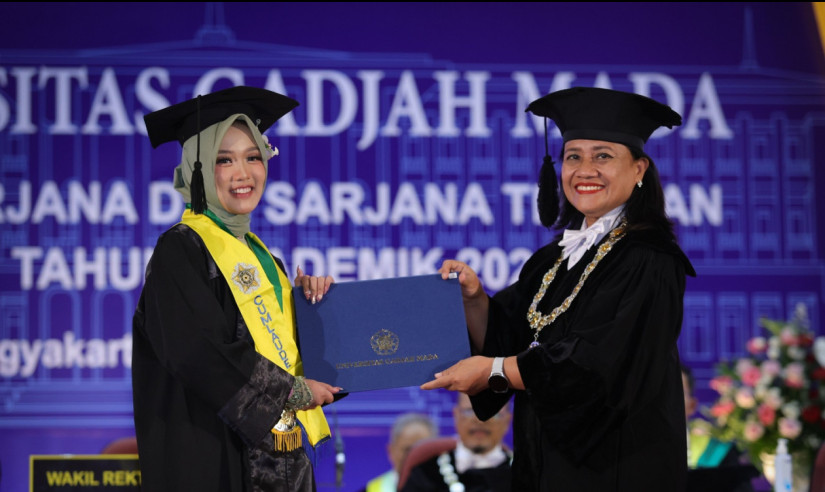
Universitas Gadjah Mada has once again conferred degrees on 1,353 graduates from its undergraduate and applied bachelor’s programs during Period II of the 2025/2026 academic year. Of the total graduates, 1,201 completed the Undergraduate Program, including six international students, while 152 graduated from the Applied Bachelor’s Program. The ceremony also included 20 graduates from previous periods. By gender, 763 graduates (56.39%) were female, and 590 (43.61%) were male.
The Vice Rector for Education and Teaching, Professor Wening Udasmoro, who presided over the ceremony, stated that completing an undergraduate program marks a point of departure for entering the professional world with confidence. UGM graduates, she emphasized, must possess audacity and tenacity, as they have been equipped with strong and comprehensive foundations as scholars graduating from a world-class university.
“You were born from a people-oriented university, an institution that is humble and deeply committed to serving society. At the same time, you come from a respected university whose contributions are eagerly anticipated at both national and global levels. Use this social capital as a gateway to the world you aspire to enter. May success and a smooth career path await you all. We keep you in our prayers,” Professor Wening said at Grha Sabha Pramana, Bulaksumur, on Wednesday (Feb. 25).
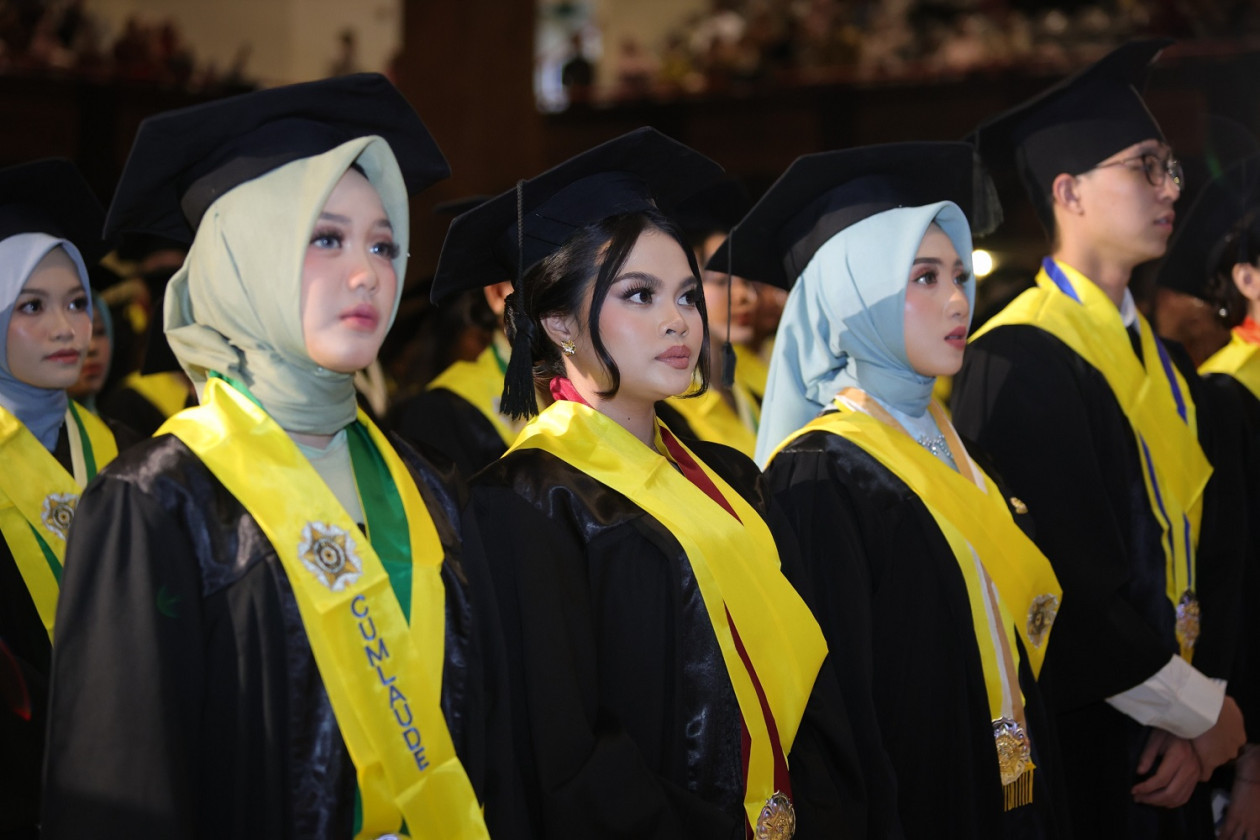
The average study period for Undergraduate Program graduates was 4 years and 2 months, while for the Applied Bachelor’s Program it was 4 years and 6 months. Marlyn Ivana Trigita achieved the shortest study duration in the Undergraduate Program of the Psychology Study Program, Faculty of Psychology (Psychology UGM), completing her studies in 3 years, 2 months, and 1 day. Meanwhile, the shortest completion time in the Applied Bachelor’s Program was recorded by Khairana Zata Dini from the Veterinary Technology Study Program, Vocational College, who graduated in 3 years, 11 months, and 2 days.
The average age of Undergraduate Program graduates was 23 years, 6 months, and 15 days, while the average age for Applied Bachelor’s Program graduates was 23 years, 6 months, and 16 days. The youngest graduate this period was Tiara Amanda Pramesti Gumay from the Dentistry Study Program, Faculty of Dentistry (FKG UGM), who completed her studies at the age of 20 years, 1 month, and 16 days. For the Applied Bachelor’s Program, the youngest graduate was Roif Ilham Bahrul ‘Ulum from the Instrumentation and Control Engineering Technology Study Program, Vocational College, who completed his studies at 21 years, 7 months, and 28 days.
A total of 742 undergraduate graduates (61.78%) earned the distinction of cum laude. Of these, 420 graduates (34.97%) graduated with a Very Satisfactory classification, 17 graduates (1.41%) with a Satisfactory classification, and 22 graduates (1.83%) graduated without distinction. In the Applied Bachelor’s Program, two graduates (1.32%) earned cum laude distinction, 149 graduates (98.03%) graduated with a Very Satisfactory classification, and one graduate (0.66%) received a Satisfactory classification. The average cumulative grade point average (GPA) for undergraduate graduates in Period II was 3.53, while the average GPA for Applied Bachelor’s Program graduates was 3.59.
The highest GPA in the undergraduate program, a perfect 4.00, was achieved by Zufa Pasha Sabina from the Nursing Science Study Program, Faculty of Medicine, Public Health, and Nursing (FK-KMK UGM), who also graduated cum laude. Meanwhile, the highest GPA in the Applied Bachelor’s Program was achieved by Eva Alyanda Umi Khasanah from the Public Sector Accounting Study Program at the Vocational College, graduating with a GPA of 3.91.
“I extend my congratulations to those who have achieved outstanding accomplishments, and I share in the joy of all graduates today,” Professor Udasmoro added.
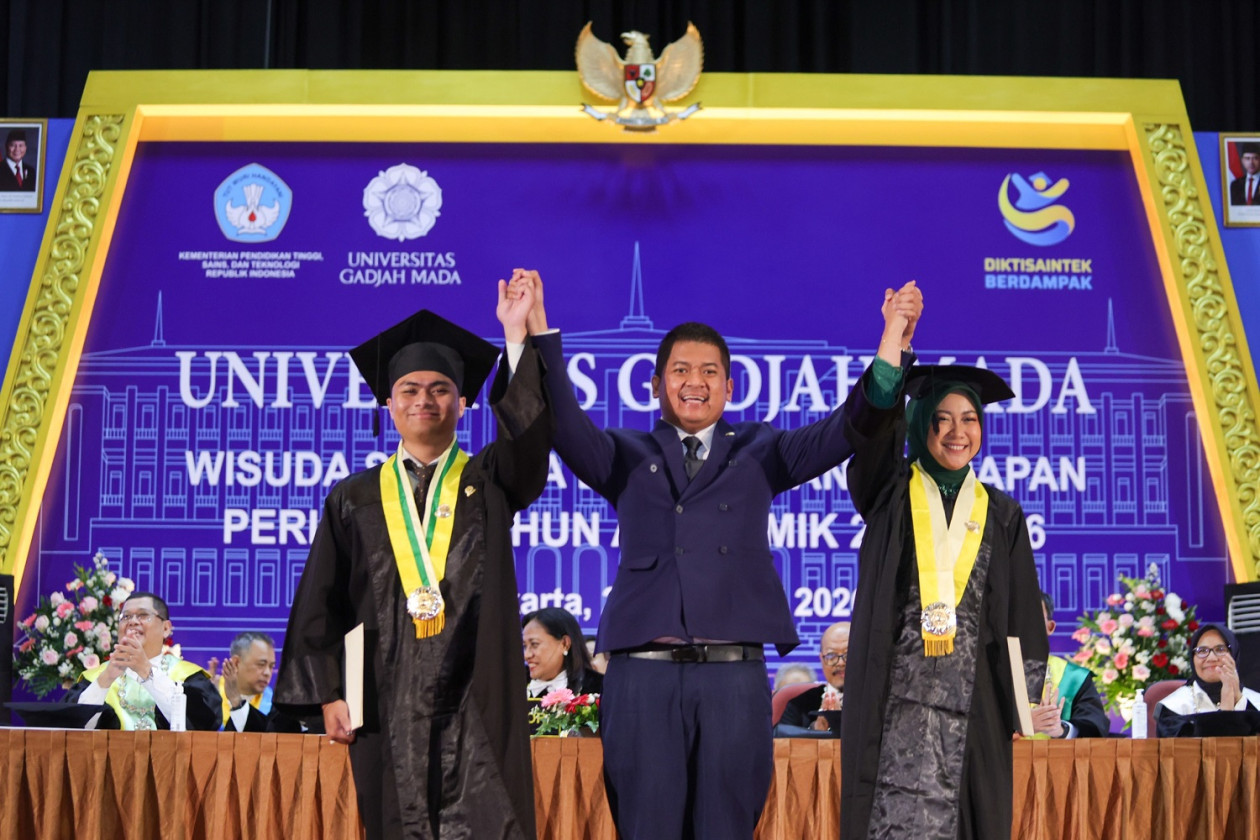
Chair of Data and Digital Affairs at PP Kagama, Daniel Oscar Baskoro, remarked that UGM graduates are living in an era where artificial intelligence and robots are no longer fiction but colleagues and tangible challenges. Jobs that once felt secure are now transforming. Translators, legal reviewers, designers, analysts, and others are increasingly confronted with machines capable of reading, writing, assessing, and even “creating” within seconds.
“What does this mean? We are living in a time when life is not about being comfortable with existing conditions, but about being agile in reading and enacting change, especially amid rapid technological development,” he said.
In response to these conditions, Daniel shared a guiding principle he consistently upholds: what matters most is not the “what,” but the “how.” It is not merely about the degree, the diploma, or even the UGM label, but about how graduates continuously create, remain adaptive, uphold integrity, and make meaningful contributions. Amid waves of global disruption, he noted, Indonesia holds significant opportunities, with many projections placing the country among the world’s top economies by 2045. However, such opportunities will not automatically translate into results. All parties are expected to prepare with competence, character, and the courage to take on roles.
“Wherever you may anchor yourselves, serving as public officials, building villages, founding startups, conducting laboratory research, or pursuing corporate careers—be individuals who are sensitive to the pulse of the times, especially the pulse of the economy. Do not worry; everyone can become a hero in their respective fields,” he said.
Representing the graduates, Anugrah A.I. Julio Wejati from the Faculty of Social and Political Sciences (Fisipol UGM) stated that, as a generation that grew up as digital natives, UGM graduates are familiar with artificial intelligence and social media. Nevertheless, amid the glitter of the digital world, public opinion often perceives them as an appealing, idea-rich generation, yet one that is easily shaken by pressure and reality.
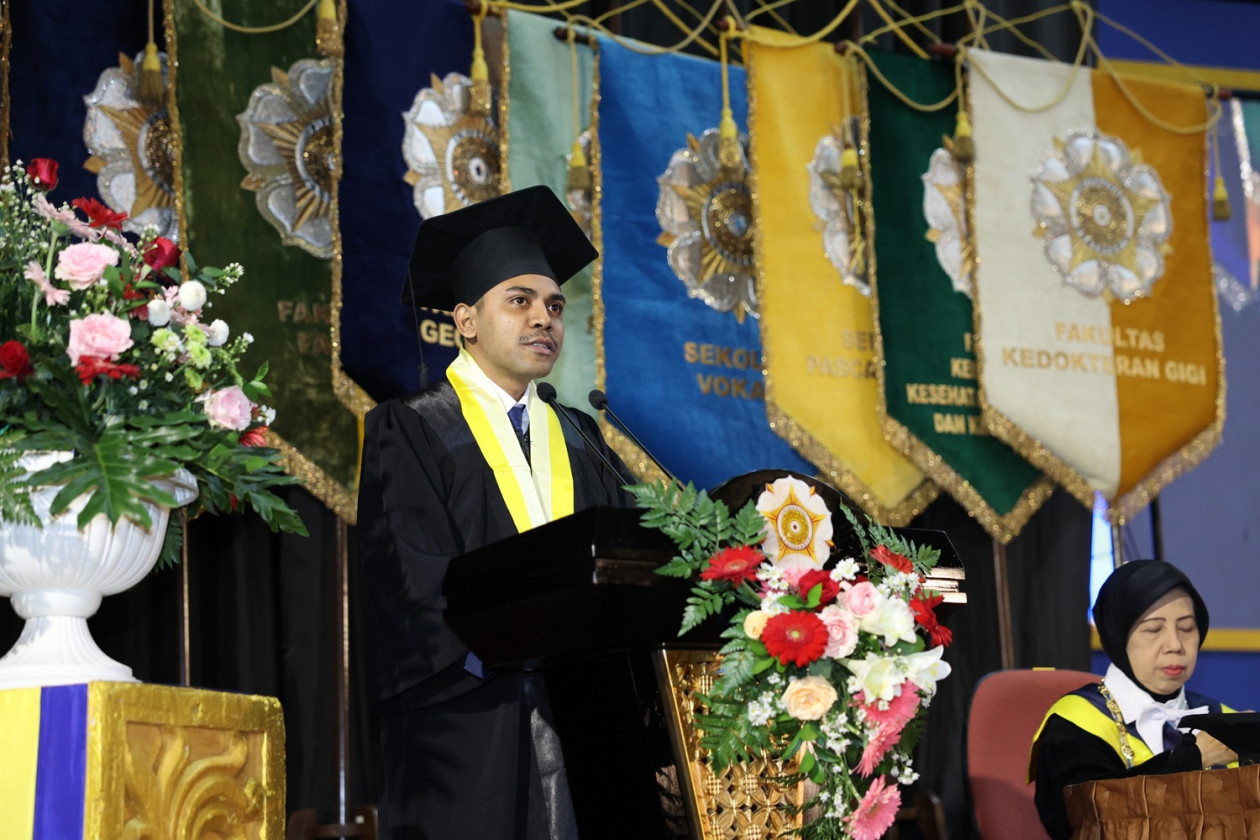
“Alongside this, there are concerns that the demographic bonus could turn into a disaster if university graduates are unprepared to compete. Society also faces its own issue, the ‘Death of Expertise’, where truth can be distorted by algorithms and short-term interests. It must be acknowledged that this could become a harsh reality around us, and if left unaddressed, it may lead to serious consequences in the future,” he said.
To overcome doubts during his studies at UGM, Julio, a young man from Papua, held firmly to the principle of the three Bs: Belajar (Learn), Berusaha (Strive), and Berdoa (Pray). He also believes in the Javanese philosophy “Urip Iku Urup”, that life is not merely about breathing, but about bringing benefit and light to others and to the environment.
“Some may view UGM graduates as elitist, residing only in major cities. However, we would like to affirm that the knowledge we have gained here is a mandate to build the nation. Our experience in the UGM Community Service Program (KKN-PPM UGM) has proven that we must engage directly with communities and feel the pulse of life at Indonesia’s outermost frontiers,” he explained.
Author: Agung Nugroho
Post-editor: Zabrina Kumara
Photo: Firsto and Donnie