


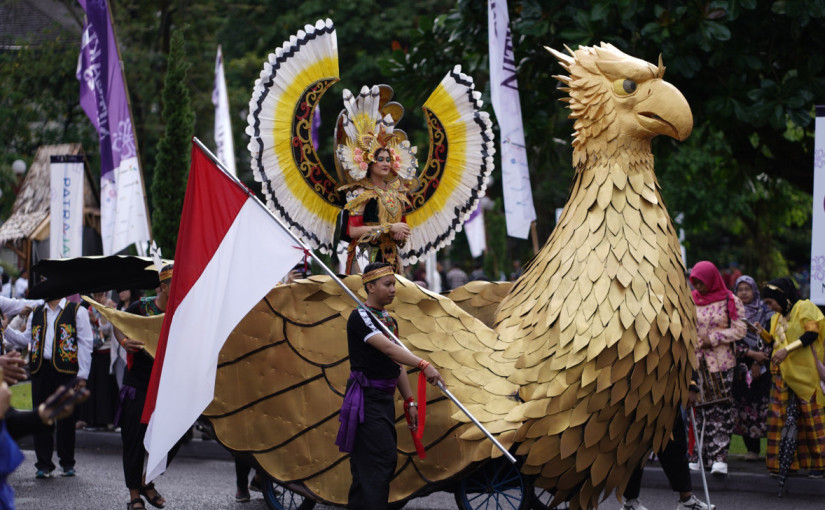
A total of 1,900 participants from 52 community groups enlivened the Nitilaku cultural parade held as part of Universitas Gadjah Mada (UGM)’s 76th Anniversary celebrations on Sunday (Dec. 14).
The event was attended by parade groups representing UGM faculties and schools, Kagama chapters from various regions, as well as hobby communities within the UGM environment. The procession route started from the UGM Boulevard gate and concluded at the Balairung courtyard.
The Nitilaku participants were officially flagged off by the Chair of the 76th UGM Anniversary Committee, Professor Suryono, together with a representative of Kagama. Carrying the theme Busana Wastra Nusantara, each parade group showcased the richness and diversity of traditional Indonesian textiles as symbols of cultural identity and regional pride.

According to the Rector of UGM, Professor Ova Emilia, the Nitilaku cultural procession has become a tradition to commemorate UGM’s history, from its origins at the Yogyakarta Palace to its relocation to the Bulaksumur campus.
She emphasized that the close ties forged by this history must be preserved, serving as a symbol of the enduring synergy among the palace, the university, and the wider community.
On the occasion, the rector also expressed her sincere appreciation for the participation of Kagama members from Sabang to Merauke. She noted that their involvement demonstrates the strong and lasting bond between Kagama members and their alma mater.
“Thank you to all Kagama members for your participation in organizing the annual Nitilaku as part of UGM’s 76th Anniversary. May Nitilaku continue to bring benefits and strengthen the contributions of both the university and Kagama,” said the rector after welcoming the parade participants at the Balairung courtyard.

The Chair of the Central Executive Board of Kagama, Basuki Hadimuljono, expressed his pride in UGM for its nationally and internationally recognized credibility. For this reason, he invited Kagama members to be grateful for the opportunity they once had to study at UGM.
Hadimuljono also reminded attendees that the annual Nitilaku event carries three key meanings. First, it serves as a reminder that UGM is rooted in Indonesia’s struggle as the nation’s oldest university. Second, it encourages appreciation of every stage of the journey experienced while studying at UGM, not merely the outcomes. Third, it inspires alumni to continue carrying the torch of the nation’s struggle through education.

“The annual Nitilaku holds meaning for Kagama as a reminder of our roots, our life journey, and our responsibility to continue carrying the torch of national progress toward a better Indonesia,” Hadimuljono said.
The 2025 Nitilaku event also marked the official inauguration of the Tari Guyub Nusantara by the Rector of UGM, symbolized by the striking of a keprak (an iron bell used in wayang performances).
The dance, initiated by Kagama’s Arts and Sports Division, was born from the archipelago’s rhythm and is envisioned as a cultural greeting from Indonesia. Anon Suneko served as the choreographer and music arranger for the Tari Guyub Nusantara.

The Angklung Gita Danisa Gama ensemble of the UGM Dharma Wanita Association also presented four musical pieces performed by 270 participants, the majority of whom were women. The event concluded with a performance by NdarBoy Genk, who entertained the cultural parade participants with several songs.
Author: Jesi
Editor: Gusti Grehenson
Post-editor: Rajendra Arya
Photographer: Firsto Adi