


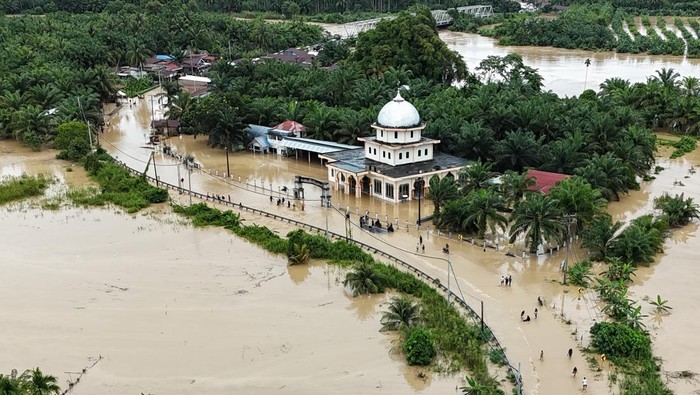
Floods and landslides that struck Aceh, North Sumatra, and West Sumatra since late November continue to leave severe impacts on communities. As of Thursday (Dec. 4), the National Disaster Management Agency (BNPB) reported 776 fatalities and 564 people still missing. Despite public pressure, the government has not yet designated the disasters in Sumatra as a national disaster.
Responding to the situation, Professor Djati Mardiatno, a Disaster Management Expert at the Center for Disaster Studies, Universitas Gadjah Mada (PSBA UGM), emphasized that determining national disaster status must follow a hierarchical mechanism rather than relying solely on casualty numbers or the extent of damage.
He explained that when a disaster occurs, local disaster management agencies, such as the Regional Disaster Management Agency (BPBD), are the first to be responsible. As long as local governments remain able to perform their functions in handling and coordinating responses with relevant stakeholders, the national disaster status need not be declared.
“There are technical, institutional, and administrative coordination criteria that must be met. As long as the region can still manage the situation, it is not an issue. Local governments are the front line,” he said in an interview on Thursday (Dec. 4).
He stated that an escalation of status may occur if the district or municipal government is no longer able to manage disaster impacts. The escalation process begins with an official declaration from the regional leader to the provincial government.
If the provincial government is also unable to respond effectively and declares a state of emergency, then the central government may take over disaster management.
“Before moving up a level, the region must first declare an emergency status. Only then does it proceed to the province, and finally to the national level if the region is indeed unable to respond,” he explained.
Professor Mardiatno asserted that the decision not to immediately declare a national disaster aims to avoid paralyzing local bureaucracies. If disaster-handling authority is centralized too quickly, local agencies, which understand the needs of their regions, may be unable to function optimally in technical field operations.
“If it is designated a national disaster, then what next? Local authorities are actually still able to conduct search, rescue, and evacuation operations. But when the status is immediately shifted to the central level, all central teams arrive while local agencies that can still operate end up having no space,” he said.
Regarding disaster budget allocation, he argued that funding should focus on strengthening prevention and mitigation efforts, rather than only on the emergency and recovery phases. He added that investment in prevention is more efficient than bearing the cost of post-disaster recovery.
Budget cuts, he warned, risk eliminating programs essential to mitigation, including public education, hazard mapping, early-warning system development, and funding for evacuation support.
“In principle, disaster management funds should be at least one percent of the total budget. And the majority should not be allocated to emergency or post-disaster phases, but to pre-disaster efforts,” he said.
The professor further noted that disaster-related budgets are not only held by BNPB or BPBD but are distributed across various agencies, ministries, and local organizations.
Therefore, he stressed the importance of each region having a Disaster Management Plan (RPB) to ensure clear and efficient budgeting and role distribution. He emphasized the need to involve multiple stakeholders, including communities and the private sector, in long-term disaster management schemes.
He added that the series of tropical cyclones over the past decade should serve as a critical signal for Indonesia to enhance its hydrometeorological preparedness. According to him, regional preparedness is the primary factor in minimizing the impact of disasters.
He highlighted that although the National Meteorology, Climatology, and Geophysics Center (BMKG) had issued early warnings before the events, they were not followed by systematic responses from local governments.
Therefore, he underscored that disaster preparedness must not depend solely on the type of hazard but on the readiness of the regional response system to act upon early warnings.
“What must be ensured is the region’s readiness to respond to early warnings, not merely having a contingency plan, but actually activating it,” he concluded.
Author: Cyntia Noviana
Editor: Gusti Grehenson
Post-editor: Rajendra Arya
Photograph: Antara