


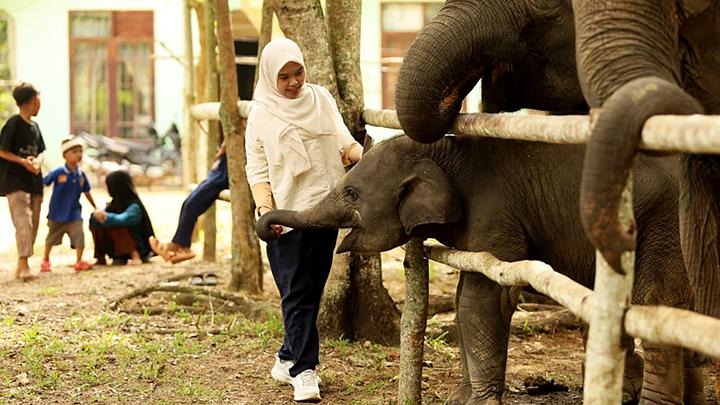
The death of another elephant calf has occurred once again, raising serious concerns. The calf, named Nurlaila, commonly called Laila, who was being treated at the Sebanga Elephant Conservation Center in Bengkalis Regency, Riau, died on Saturday (Nov. 22, 2025).
Laila had appeared less active since Thursday (Nov. 20, 2025), raising concerns that prompted a medical team to conduct an examination. The team found that her appetite for food and water remained good, and her body temperature remained normal.
Although on Saturday, Laila was heard screaming in the early hours of the morning, the elephant was still awake and vocalizing at 05:00 WIB before she was eventually found dead at 05:30 WIB. The veterinary team from the Riau Natural Resources Conservation Agency (BBKSDA Riau) subsequently carried out a necropsy on Laila.
Professor Raden Wisnu Nurcahyo of the Faculty of Veterinary Medicine at Universitas Gadjah Mada (FKH UGM) expressed his concern over the repeated deaths of elephant calves.
“There should be vigilance or concrete actions to save elephants. There must be assistance for other elephants that are still alive. If no emergency action is taken, this will certainly continue and happen again,” the professor said on Wednesday (Dec. 3, 2025).
Regarding this latest case, Professor Nurcahyo explained that the cause of death was likely EEHV (Elephant endotheliotropic herpesvirus), as the calf was under 10 years old, similar to the previous case of Tari, another elephant calf that had died earlier.
“Usually, such rapid deaths are caused by a virus, unlike chronic cases. Acute cases progress very quickly,” Professor Nurcahyo explained.
He further added that the deaths of elephant calves would certainly affect herd conditions and population sustainability, making regeneration increasingly difficult.
This situation is exacerbated by the weakening condition of adult elephants and their declining roaming capacity, which over time leads to death.
He assessed that elephant habitats are now increasingly degraded due to land-use changes, burning, development, mining, and other activities. This has resulted in severe habitat fragmentation and shrinking living spaces.
“This will lead to inbreeding or mating between close relatives, which produces unfavorable outcomes. With poor genetic quality, diseases will emerge, and the elephants will also be genetically weaker,” he elaborated.
In addition, Professor Nurcahyo described the contrasting conditions of elephant calves and their mothers in the wild, where the calves are generally more physically resilient.
This is because mothers encourage their calves to be more active and to consume natural food sources that strengthen immunity.
When ill, wild elephants have the instinct to consume certain types of leaves, a phenomenon known as Self-medication in Wildlife Behavior.
“For example, there may be a case where a mother elephant becomes ill and weak, then is found by forest rangers and treated at an elephant training center, meaning she and her calf must rely on food supplied by caretakers. Their food intake becomes limited, and their instincts are lost. If that happens, the situation is very different,” he said.
According to Professor Nurcahyo, in light of the continued deaths of elephant calves, there must be a firm commitment from the government.
The government can involve non-governmental organizations (NGOs) that have long been engaged in elephant conservation efforts, as well as veterinary professionals who care about elephant health and safety.
“Essentially, routine behavioral monitoring, physical examinations, and blood sampling must be conducted so that medical intervention can be carried out. For elephants that die, proper sanitation should also be implemented to ensure viruses do not contaminate the area,” the professor concluded.
Author: Alena Damaris
Editor: Gusti Grehenson
Post-editor: Lintang Andwyna
Photograph: Tempo