


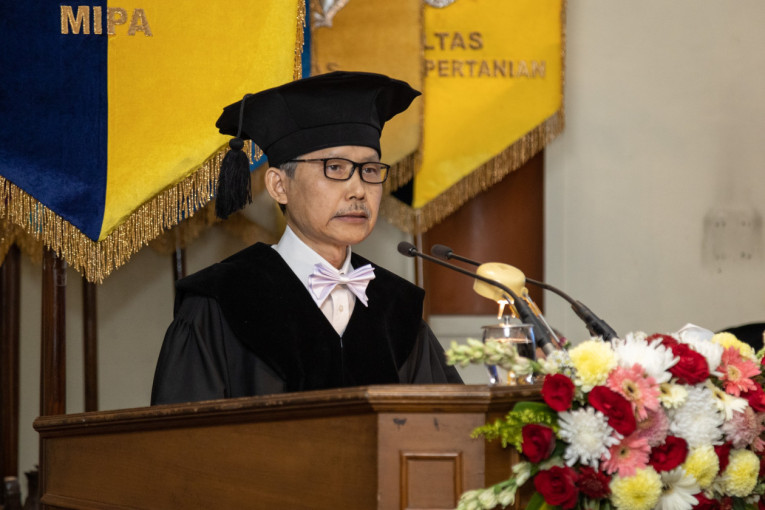
A Computer Science lecturer at the Faculty of Mathematics and Natural Sciences of Universitas Gadjah Mada (FMIPA UGM), Dr. Suprapto, was officially inaugurated as a professor in the field of Formal Methods on Thursday (Dec. 4) at the Senate Hall, UGM Central Office.
In his inaugural address titled “Formal Methods in the Era of Artificial Intelligence: A Historical Review and an Evolving Role,” the newly appointed Professor Suprapto explained that over the past few decades, software complexity has become an increasingly significant challenge in the verification of critical systems.
Correctly verifying software behavior has become a demanding task given the growing complexity of modern software. Therefore, the challenge of software verification cannot be ignored. Nevertheless, many major companies have found solutions to this problem by applying formal methods.
“In their early application, formal methods were generally limited to academia and defense. As computational demands in the industrial world increased, the need for correctness guarantees also grew,” he explained.
Early applications of formal methods included NASA’s use of formal methods in flight control systems, the adoption of formal specifications in European railway systems, and Intel’s application of model checking.
In addition, formal methods have been applied in translation to ensure that the semantic meaning of a source representation is preserved when translated into a target representation.
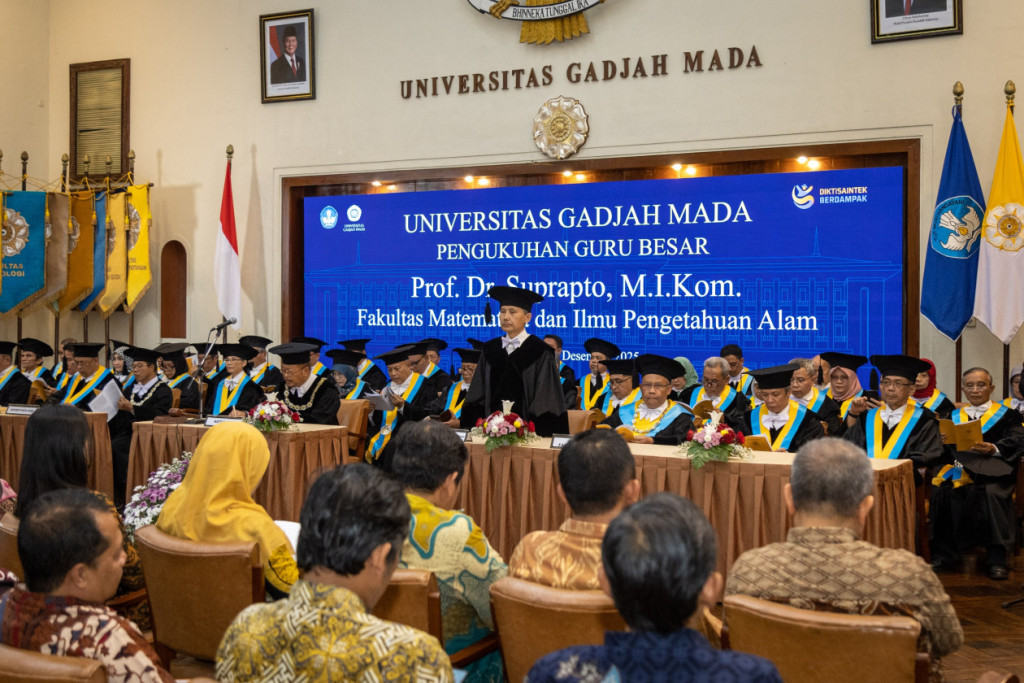
Furthermore, Professor Suprapto explained that formal methods initially required significant mathematical expertise and were generally applied to small, highly controlled systems. However, over time, researchers have made efforts to ensure that formal methods can scale to large code bases.
“These efforts have transformed formal methods from a purely theoretical study into a multidisciplinary field that integrates elements of logic, computer science, software engineering, and system design,” he said.
Technological transformation has driven the increased use of formal methods. In the era before artificial intelligence became dominant, formal methods had already established a clear role as a process of verification and validation for traditional computational processes.
“This is because such systems are largely deterministic, rule-based, and explicitly designed, making them highly suitable for rigorous logic-based reasoning provided by formal methods,” he elaborated.
Before the dominance of AI, formal methods were regarded as the gold standard for system assurance, as they successfully enhanced the clarity of design and specifications, supported modular reasoning and abstraction, and enabled reproducibility and auditability of software behavior.
According to Professor Suprapto, the evolution of formal methods from basic logic to advanced applications in AI demonstrates not only the resilience of mathematical rigor but also the need for adaptation and innovation in addressing fundamentally new systems.
Therefore, formal methods and AI are complementary rather than competing approaches.
“AI provides capability, adaptation, learning, and pattern recognition from data, while formal methods provide structure, correctness, and verifiable guarantees,” he explained.
Chair of the UGM Professorial Board, Professor M. Baiquni, stated that Professor Suprapto is one of 539 active professors at UGM. At FMIPA UGM, he is among 57 active professors out of a total of 79 professors.
Author: Salwa
Editor: Gusti Grehenson
Post-editor: Rajendra Arya
Photographer: Donnie Trisfian