


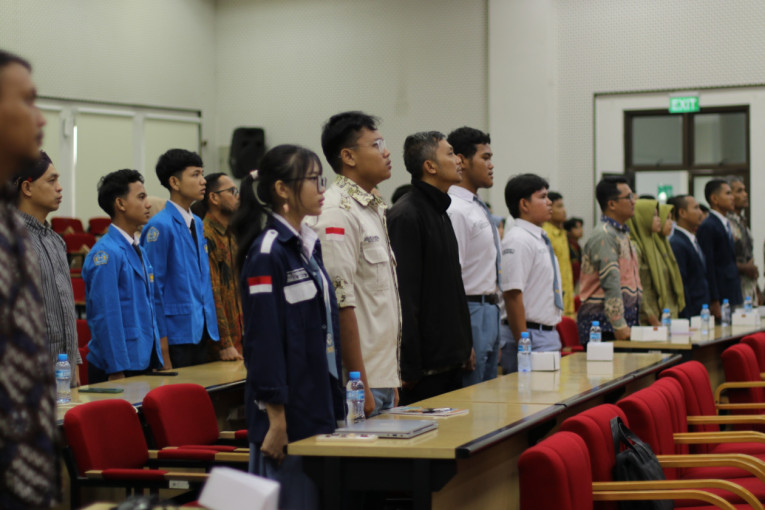
Road safety awareness is the responsibility of all parties, including vehicle users, regulators, and educators. Fundamentally, safety must become habitual for everyone rather than a temporary step. Therefore, cultivating a safety culture consistently was the focus of the Road Safety Education Training organized by the Graduate School of Universitas Gadjah Mada (SPs UGM) on May 21-22, 2026. A total of 31 junior and senior high school student representatives from across the Special Region of Yogyakarta (DIY) participated in the program, which was held at the Graduate School Auditorium of UGM.
Dean of SPs UGM, Professor Siti Malkhamah, stated that the activity was part of the university’s community service efforts in response to the high number of traffic accidents. According to her, the participating students were selected individuals expected to become pioneers of road safety in their respective schools.
“This program does not belong solely to UGM or the ministry, but to all of us. The success of this activity depends on the active participation of teachers, students, and everyone involved,” she said on Friday (May. 22).
Professor Malkhamah explained that participants received instruction through a Massive Open Online Course (MOOC) system developed by UGM in collaboration with the Directorate of Academic Policy and Innovation (DKIA).
The road safety system materials are accessible online for students and teachers in their respective schools. She added that the program is part of the implementation of the National General Plan for Road Traffic and Transportation Safety (RUNK), which aims to achieve an 80 percent reduction in traffic accidents.

She also highlighted the higher number of traffic accidents among young people. Based on the data, the majority of fatalities by traffic accidents fall within the 15-34 age group. Professor Malkhamah lamented that 81 percent of the victims were motorcycle users. Additionally, around 68 percent did not yet possess a driver’s license.
“We hope to establish a culture of safety and traffic discipline that supports a sustainable transportation system,” she said.
Meanwhile, a representative from the Youth and Sports Education Office of DIY, Tukiman, expressed appreciation to SPs UGM for initiating the program. According to him, road safety training is an important part of developing students’ competencies and legal awareness.
“You must become agents of change for orderly traffic behavior and set an example for your friends at school,” he said.
Meanwhile, a lecturer from the Department of Civil and Environmental Engineering at the Faculty of Engineering UGM (FT UGM), Mukhammad Rizka Fahmi Amrozi, explained that the MOOC-based road safety education program is part of the broader “Decade of Action for Road Safety 2021-2030.” He explained that the main target of road safety efforts is not to eliminate accidents entirely, but to reduce fatalities and serious injuries.

He also noted the importance of shared responsibility in road safety. Amrozi stated that accidents cannot be blamed solely on drivers because responsibility must be shared among the government, educators, and the public as road users.
“When discussing accidents, such incidents will always occur because achieving zero accidents is impossible, so the focus should be on reducing fatalities. We can no longer simply blame human error; instead, we must adopt a shared responsibility approach,” Fahmi said.
Regarding the learning materials, the speaker explained that the MOOC road safety education program was designed to be flexible. The learning modules include theory, pretests, post-tests, and online discussions. He added that MOOC-based learning can later be followed by practical sessions using driving simulators and safety riding training.
“We hope students will not only understand the theory but also gain experience and emotional maturity while driving. This training of trainers is expected to produce agents of change for road safety in schools,” he said.
Another speaker, Arumdyah Widiati, had the opportunity to explain the technical aspects of the learning system. Participants were provided access to the UGM MOOC platform, which included a learning dashboard on road safety.
She explained that three modules are currently available to participants: general road safety education, cycling and pedestrian safety, and motorcycle safety.
Furthermore, she explained that in each module, participants can access learning videos, quizzes, and reading materials. Arumdyah added that certificates are also provided for every completed assignment.
“Certificates can be obtained after participants complete the learning series in each module, including watching videos, completing quizzes with a minimum passing grade of 80 percent, and accessing the required reading materials,” she said.
Author/Photographer: Hanifah
Editor: Gusti Grehenson
Post-editor: Jasmine Ferdian