


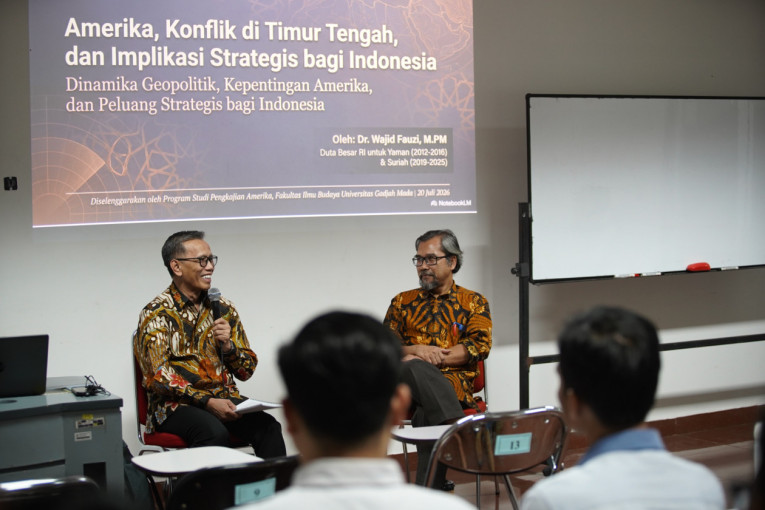
Ongoing conflicts across the Middle East cannot be understood without examining the region’s long history, geography, political rivalries, and competing strategic interests, according to former Indonesian Ambassador to Yemen and Syria Dr. Wajid Fauzi.
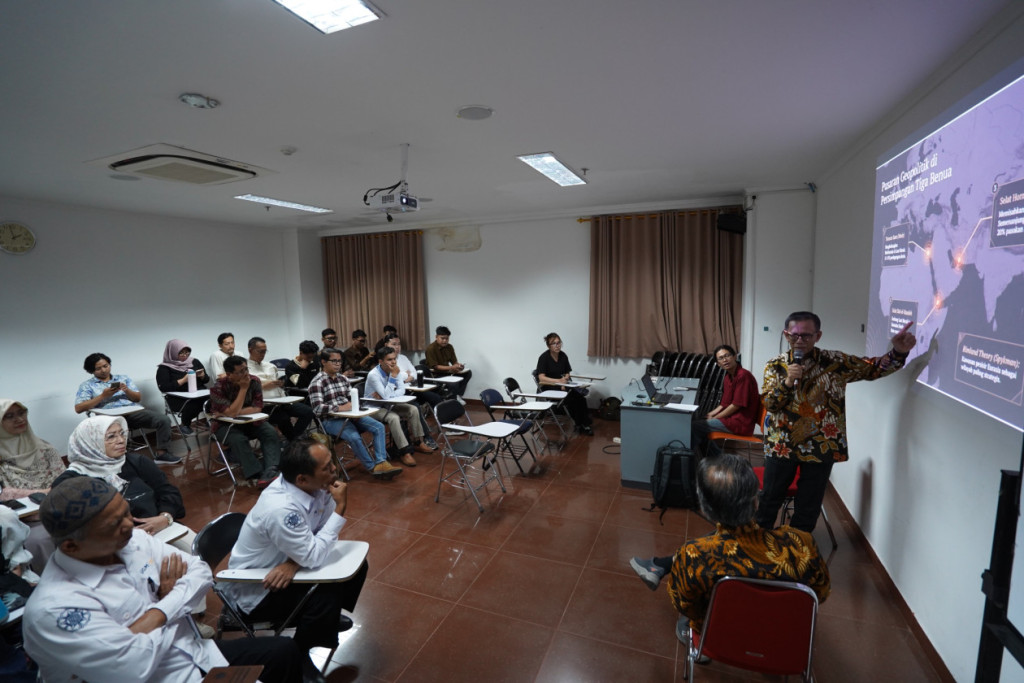
Speaking at a public lecture titled “Amerika, Konflik di Timur Tengah dan Implikasi bagi Indonesia” (America, Conflict in the Middle East, and Its Implications for Indonesia) on Monday (July 20) at the Soegondo Building, Faculty of Cultural Sciences, Universitas Gadjah Mada (FIB UGM), Dr. Fauzi said geography plays a central role in shaping political and security dynamics in the region.
“Geography is never neutral. It can be a source of strategic advantage, but it can also become a source of conflict,” he said.
According to Dr. Fauzi, the Middle East represents a complex intersection of history, politics, economics, and security. Understanding conflicts in the region therefore requires more than examining individual events or military confrontations.
Dr. Fauzi described the Palestinian conflict as one of the longest-running conflicts of the modern era, shaped by a series of historical and political developments, including the dissolution of the Ottoman Empire, the British Mandate for Palestine, the Balfour Declaration, and the establishment of Israel.
For Palestinians, the mass displacement associated with the events surrounding the establishment of Israel is remembered as the Nakba, or catastrophe.
“The Palestinian conflict is not merely a territorial dispute. It also involves questions of sovereignty, legitimacy, international law, and the status of Jerusalem, which carries historical, political, and religious significance,” he explained.
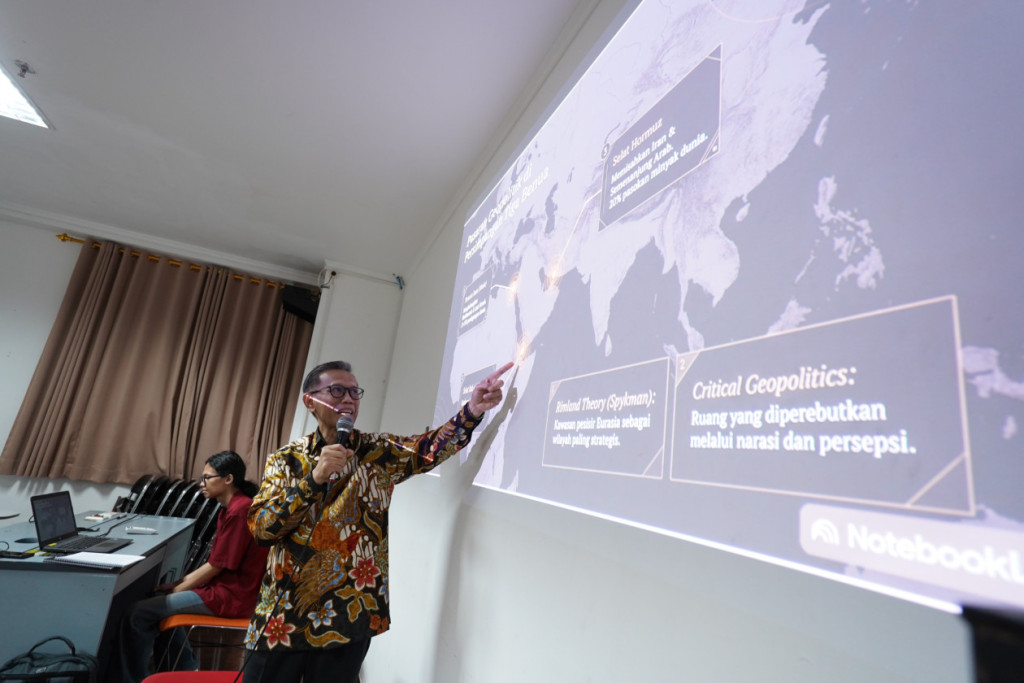
In Indonesia, the Palestinian issue is generally viewed through the lenses of colonialism and humanitarian concerns, contributing to strong public solidarity with Palestine. At the same time, academic and international debates involve competing narratives, including differing interpretations of concepts such as occupation and self-defense, as well as contrasting views of Hamas.
“The Palestinian conflict has many layers. Competing narratives are employed by each side to legitimize their respective positions,” he said.
Beyond Palestine, Dr. Fauzi discussed conflicts in Yemen, Syria, and Sudan, as well as the enduring rivalry between Iran and Israel.
In Yemen, a domestic conflict developed into a broader regional confrontation involving Saudi Arabia and Iran. The country’s location near the Bab el-Mandeb Strait, one of the world’s major maritime chokepoints, adds to its strategic importance.
Dr. Fauzi emphasized that the human consequences of conflict should not be overlooked when examining its geopolitical dimensions.
“War is not just a number but a tragic humanitarian experience. People who have never lived in conflict zones imagine explosions as New Year’s Eve fireworks. In reality, every explosion represents a direct threat to life,” he said.
The Syrian conflict similarly evolved through several stages, beginning with demonstrations in 2011 before developing into a domestic war and eventually becoming an arena for regional and international power competition.
The fall of Bashar al-Assad’s government in late 2024 marked a major turning point in Syria’s political landscape and altered the strategic calculations of several countries involved in the region.
Dr. Fauzi also highlighted Sudan’s strategic significance because of its location along the Red Sea. Continued competition between the Sudanese Armed Forces and the Rapid Support Forces could have implications for regional and international maritime security.
Meanwhile, the rivalry between Iran and Israel extends beyond conventional military confrontation to intelligence operations, cyber warfare, and the activities of regional armed groups.
Dr. Fauzi referred to Iran’s network of regional partners and allied groups, commonly described as the “Axis of Resistance,” which has included Hezbollah in Lebanon, armed groups in Iraq, and Palestinian groups. The network has been an important element of Iran’s regional strategy.
“This interconnectedness explains the Regional Security Complex theory, which argues that conflicts across the Middle East influence one another and cannot be understood in isolation,” he said.
Dr. Fauzi said the Middle East remains strategically important not only because of its energy resources but also because it sits at the crossroads of major international trade routes and competing geopolitical interests.
Drawing on Muhammad Rabie’s book US-Arab Relations in the New Millennium, he outlined five major US interests in the region: maintaining access to energy resources, protecting Israel’s security, safeguarding international trade routes, preventing the emergence of regional powers that challenge US interests, and maintaining an international political and economic order favorable to the United States.
He traced US involvement in the Middle East to the early post-World War II period, including President Harry S. Truman’s recognition of Israel in 1948 and subsequent policies such as the Eisenhower Doctrine and Carter Doctrine.
Following the September 11, 2001 attacks, US involvement also expanded through the global war on terrorism, including a stronger military presence around strategic waterways such as the Strait of Hormuz, Bab el-Mandeb Strait, the Red Sea, and the Persian Gulf.
From the US perspective, such involvement has been framed partly around protecting freedom of navigation and regional security. Critics, however, have viewed it as an expression of American military power and geopolitical influence.
Concluding his lecture, Dr. Fauzi emphasized that the Middle East should not be viewed simply as a region defined by conflict.
Rather, we must understand every dispute within its broader historical, political, economic, and strategic context.
“Behind every political decision lies a national interest. Behind every intervention lies strategic calculation. Behind every narrative lies an effort to build legitimacy. And behind every map we see lies an ongoing struggle over power, identity, ideology, security, and the future,” he said.
For Dr. Fauzi, studying the Middle East does not require simply determining which side is right or wrong. It requires examining competing perspectives, distinguishing facts from opinions, and understanding how national interests shape political narratives.
“Studying the Middle East is not simply about learning another region of the world. It is ultimately about understanding ourselves and what we must prepare to safeguard our nation’s independence,” he concluded.
Author & Photo: Jelita Agustine
Editor: Gusti Grehenson
Post-Editor: Jasmine Ferdian