


Indonesia’s capital market has recently experienced turbulence triggered by policies from Morgan Stanley Capital International (MSCI), a global index provider, which has suspended the assessment of several Indonesian stocks deemed driven more by stock manipulation than by fundamental strength. Strengthening capital market integrity through structural reforms and enhanced law enforcement is expected to help address geopolitical dynamics and negative global sentiment.
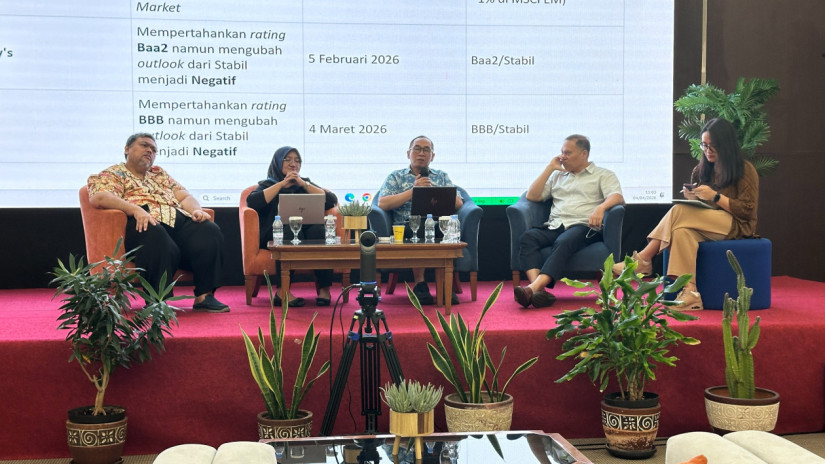
This issue was highlighted during a National Seminar titled “Red Flag in Indonesia’s Capital Market Governance: Addressing Economic Governance Challenges and Capital Market Stability Strategies” held at the 9th Floor Auditorium, Tower B, Master of Laws (MIH) UGM, Jakarta Campus.
Professor Sugarda, Professor of Business Law at the UGM Faculty of Law (Law UGM), stated that the main issue in the capital market is not merely regulatory techniques but a crisis of trust caused by weak institutional independence and legal certainty.
“Inconsistencies in domestic law result in high economic costs. Low legal certainty increases business risks, which ultimately leads to higher operational costs. That is the main issue we face,” said Professor Sugarda in a statement released to the media on Thursday (Apr. 10).
Dr. Yanuar Rizky, an economist and President Director of PT Bejana Investidata Globalindo, noted that Indonesia’s capital market is currently more dominated by stock manipulation than by fundamental strength.
According to him, the Financial Services Authority (OJK) has failed to enforce the law firmly and transparently. The threat of a downgrade in Indonesia’s market status by MSCI is not merely a technical issue but a warning signal of deteriorating national fiscal conditions.
To address these challenges, Yanuar emphasized the need to strengthen both law enforcement and sanctions implementation to improve Indonesia’s capital market’s “red report card” on governance.
“Our exchange will face increasing issues and integrity violations. What is needed is a financial services authority and stock exchange authority capable of enforcing the law,” he said.
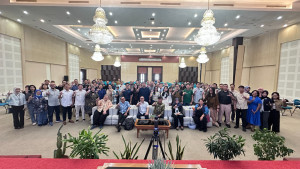
Responding to these criticisms, Deputy Director at the Department of Investment Management and Regional Capital Market Supervision of OJK, Tara Setyaningtyas, stated that OJK continues to optimize and evaluate its internal business processes. OJK is also committed to maintaining capital market integrity through structural reforms and strengthened law enforcement, in response to geopolitical dynamics and negative global sentiment.
“OJK is working to optimize internal processes and tighten administrative and criminal sanctions to create a more transparent, accountable, and internationally competitive capital market,” she said.
Professor Hikmahanto Juwana, Professor of International Law at the Faculty of Law, Universitas Indonesia (UI), highlighted that the red flag in Indonesia’s capital market governance stems from weak institutional independence amid political intervention and the widespread use of geopolitical narratives by speculators to manipulate stock prices.
He urged OJK and stock exchange authorities to move away from a compromise-based approach to administrative sanctions toward more progressive, swift, and investor-oriented enforcement, particularly to protect retail investors who are most vulnerable to exploitation in an unhealthy capital market ecosystem.
“Our challenge going forward is consistency. The capital market will never be healthy as long as authorities can still be dictated by political intervention and financial power,” he stated.
Meanwhile, Vice Dean for Research, Community Service, and Information Systems at Law UGM Heribertus Jaka Triyana, expressed that the seminar on capital market governance could serve as both a resource and a means to enhance understanding of current capital market developments.
“I hope this seminar can be used to improve understanding of capital market developments as one of the indicators of Indonesia’s economic growth,” he said.
Author: Jesi
Editor: Gusti Grehenson
Post-editor: Jasmine Ferdian
Photo: MIH FH UGM Documentation