


The phenomenon of judicial review (Peninjauan Kembali or PK) at the Supreme Court of the Republic of Indonesia has increasingly shifted in function, becoming either a “second-level court” or merely an ordinary legal remedy. Between 2020 and 2024, an average of 61.31% of PK applications were filed directly from legally binding first-instance court decisions, without going through an appeal or cassation.
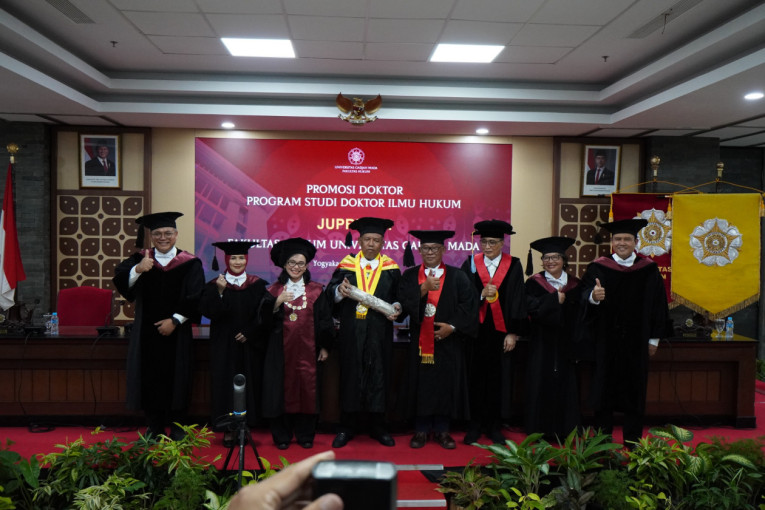
“I observe an overlap between misapplication of law as grounds for cassation and judicial oversight or clear error as grounds for judicial review,” Supreme Court Justice Jupriyadi said during his open doctoral promotion examination in the Doctoral Program in Law at the Faculty of Law, Universitas Gadjah Mada (Law UGM), on Friday (Apr. 10), at the Auditorium of Building B, Faculty of Law UGM.
Serving as promoter was Professor Marcus Priyo Gunarto, with co-promoter Dr. Dani Krisnawati. The examination panel consisted of Dr. Supriyadi, Sri Wiyanti Eddyono, Ph.D., Professor Sunarto, and Binziad Kadafi, Ph.D.

In his dissertation titled “Reformulating Judicial Review as an Extraordinary Legal Remedy in Criminal Cases within Indonesia’s Judicial Practice,” Jupriyadi proposed the need for clear parameters defining “judicial oversight” or “manifest error” to distinguish them from grounds for cassation. This aims to minimize judicial subjectivity and prevent overlapping legal interpretations, ensuring a more consistent judicial process that provides legal certainty and guarantees justice for applicants.
In response to the enactment of the new Criminal Procedure Code (KUHAP Baru, Law No. 20 of 2025), which still includes a clause on judicial oversight, Jupriyadi firmly urged the Supreme Court to promptly issue a Supreme Court Regulation (Perma) as a technical guideline. He emphasized that standardizing these criteria is crucial to maintaining the integrity of the highest judicial institution.
“I recommend that parameters or criteria for judicial oversight or manifest error be formalized in the form of a Perma, a Supreme Court Circular Letter (SEMA), or even a Government Regulation,” Jupriyadi stressed.
According to Jupriyadi, the maximum number of judicial review filings should be limited to 1, except in cases involving novum or decisive new evidence. This provision has also been stipulated in the new KUHAP.
“Every case must come to an end. Judicial review should only occur once, except on the grounds of novum,” he said.
Author: Jesi
Editor: Gusti Grehenson
Post-editor: Jasmine
Photo: Faculty of Law UGM Public Relations