


The character and behavior of debtor-entrepreneurs are the most decisive factors in ensuring smooth credit repayment, particularly under unsecured micro Kredit Usaha Rakyat (KUR) schemes. This is because the risk of default in unsecured microcredit is more closely tied to the debtor’s behavior and business processes.
“In unsecured microcredit, default risk is more determined by behavioral aspects and business processes than by the presence of collateral or financial indicators alone,” said Kartini Sally, a doctoral student in the Doctoral Program in Leadership and Policy Innovation at Universitas Gadjah Mada (UGM).
The statement was conveyed when she was explaining her dissertation, which highlights new challenges in managing unsecured microcredit in Indonesia, during an interview on Tuesday (Jan. 6).
According to Sally, these findings send an important message to the banking industry, including commercial banks and rural banks (Bank Perkreditan Rakyat/BPR), not to rely solely on administrative approaches in distributing microcredit.
She emphasized that strengthening unsecured microcredit cannot be separated from a broader policy ecosystem.
“The success of microcredit is highly influenced by process quality from the earliest stages, ranging from debtor selection and post-credit monitoring to business mentoring,” Sally explained.
Therefore, Sally added, banks should not merely act as financing providers but also position themselves as business partners for micro and small enterprises.
This makes Sally’s dissertation findings relevant in supporting the national financial inclusion agenda, not only by expanding access to financing but also by ensuring business sustainability for debtors and maintaining the stability of banking portfolios in the medium and long term.
Her research further confirms that the conventional 5C principles of credit assessment are no longer fully adequate for identifying risks in microenterprise lending.
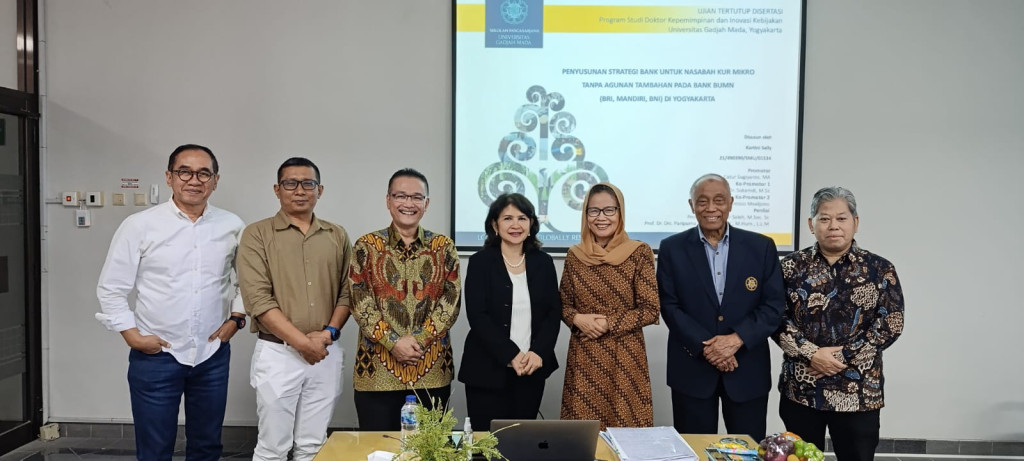
Professor Catur Sugiyanto, as the dissertation supervisor, assessed the findings as highly relevant to the challenges of national financial inclusion.
Meanwhile, co-supervisor Professor Djoko Santoso Mulyono added that the dissertation offers opportunities to improve microcredit risk management policies, making them more contextual and sustainable.
“Banks need to strengthen character-based initial assessments and enhance business mentoring, rather than relying solely on restructuring once problem loans emerge,” Professor Catur Sugiyanto said.
Professor Paripurna P. Sugarda, serving as an examiner, also stated that the dissertation findings are not only relevant to the KUR context in Indonesia but also enrich academic and policy discourse on the transformation of microfinance, as outlined in The Microfinance Revolution.
According to him, the dissertation contributes to strengthening a paradigm of institutionally sustainable microfinance by emphasizing that effective management of micro KUR requires a shift from a credit rationing logic toward a disciplined, commercial, and adaptive financial inclusion approach.
Through these findings, UGM once again affirms its role in producing policy-relevant research with tangible impact on strengthening the banking system and national economic development.
The dissertation also serves as a tribute to the late Professor Sukamdi, who, during his lifetime, acted as a co-supervisor and made significant contributions to enriching the socio-economic perspectives and understanding of household dynamics in microenterprise research.
Author: Lintang Andwyna
Editor: Gusti Grehenson
Post-editor: Rajendra Arya
Illustration: Freepik