


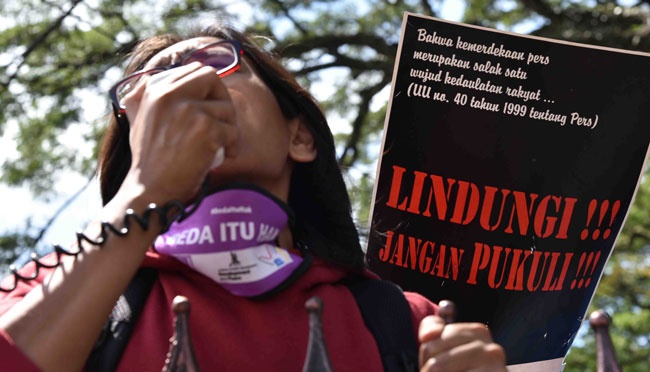
The commemoration of National Press Day on Feb. 9 was marked by the release of the 2025 Press Freedom Index, which recorded a slight increase. Based on data from Litbang Kompas, the index rose by 0.8 percent to 69.44. According to Ana Nadhya Abrar, a Professor of Journalism at Universitas Gadjah Mada (UGM), the increase places Indonesia’s press freedom index in the “free” category. The index consists of three categories: not free (0–30), partly free (31–60), and free (61–100).
Based on these results, Professor Abrar said the improvement could be considered somewhat reassuring, as Indonesia’s press freedom score is closer to the “partly free” threshold. Nevertheless, he cautioned that this sense of relief should not lead journalists and media companies to become complacent.
“What is most important is to immediately formulate a roadmap to continue the struggle for press freedom,” he said on Tuesday (Feb. 10).
Beyond journalists and media organizations, Professor Abrar emphasized that the public should also play an active role in safeguarding press freedom and ensuring that journalists can work freely and safely. He noted that there are many ways to help ensure press freedom, including solidarity between the public and journalists in defending it.
Another approach is to use social media to disseminate information and raise public awareness, and to collaborate with institutions that have long been committed to defending press freedom.
“Protection can also be sought from authorized institutions,” he explained.
Professor Abrar acknowledged that civil society continues to fight for press freedom because the press ultimately serves the public interest. Even if media organizations generate revenue from their professional work, he stressed that this is not their primary objective.
“The main purpose of the press is to serve the truth for the benefit of society,” he explained.
In carrying out their work, Professor Abrar noted that the press often has to deal with government institutions, interest groups, business actors, and radical or extremist groups. These parties, he said, possess the power to commit acts of violence against journalists and have the potential to violate press freedom.
Moreover, they may also violate human rights.
“That is why efforts to defend press freedom must go hand in hand with the struggle for human rights. In essence, it becomes a struggle for press freedom and human rights,” he explained.
Equally important, Professor Abrar added, is the need for media organizations to provide journalists with ample space to work independently and free from pressure. This includes protecting sources of information and journalists’ privacy, as well as respecting the public’s right to know and right to express opinions.
Media organizations are also expected to uphold high standards of journalistic ethics and refrain from censoring or restricting media content.
“In this regard, the government must not act harshly toward the press, must not treat the media as political enemies, and must respect standard journalistic procedures,” he said.
Unfortunately, Professor Abrar observed that the government has not fully respected press freedom, including the public’s right to know and the right to express opinions. He cited the government’s response to Tempo magazine’s main report dated Feb. 2–8, 2026, which stated that President Prabowo and his delegation used two Garuda Indonesia aircraft with first-class facilities during an overseas visit.
Instead of exercising its right of reply to Tempo, the government, through Cabinet Secretary Teddy Wijaya, immediately declared the report untrue.
For the professor, the government’s action can be described as taking a “political” route. Such a response, he said, reflects a disregard for procedures outlined in Law No. 40 of 1999 on the press. Articles 5 and 6 of the law state that the press is obliged to serve the right of reply and the right of correction.
However, the government, he argued, ignored these provisions and treated the press as a political subordinate.
“In a situation like this, we are left uncertain about how the government actually perceives press freedom. This uncertainty leads us to question whether the government truly respects press freedom and whether we can expect it to help defend press freedom in Indonesia,” he concluded.
Author: Agung Nugroho
Post-editor: Zabrina Kumara Putri
Photograph: Tempo.co