


Advances in technology, such as virtual reality, have brought fresh opportunities to healthcare innovation, including in the management of postpartum hemorrhage experienced by mothers after childbirth. Through virtual reality (VR), midwives and healthcare professionals can conduct more realistic simulations before encountering actual patients, particularly for cases that are rarely found in the field, in a safe setting without risking patient harm.
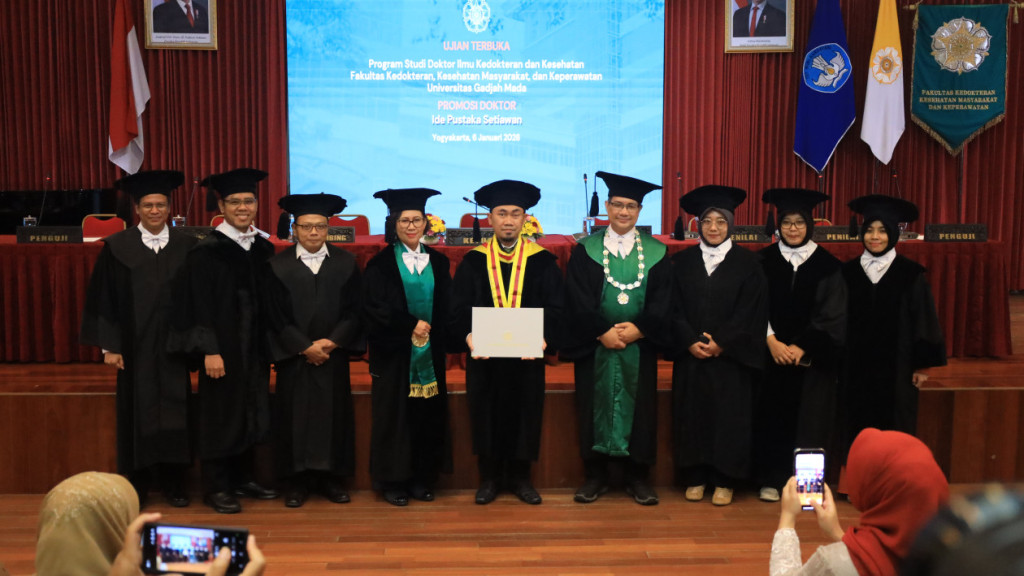
This was highlighted during the open doctoral promotion examination of Dr. Ide Pustaka Setiawan, held at the auditorium of the Faculty of Medicine, Public Health, and Nursing, Universitas Gadjah Mada (FK-KMK UGM), on Tuesday (Jan. 6).
His dissertation, titled “Development of Virtual Reality for the Management of Postpartum Hemorrhage to Improve the Knowledge and Skills of Practicing Midwives”, was supervised by Professor Ova Emilia as Promoter, with Dr. Yoyo Suhoyo serving as Co-Promoter.
In his presentation, Dr. Setiawan explained that users of virtual reality experienced a significant increase in learning focus and overall learning experience during the educational process.
Together with his team, he developed the VR project to ensure participants could achieve a deep level of immersion, closely resembling real clinical conditions.
“We developed a VR prototype that truly allows users to enter a three-dimensional virtual world and experience immersive learning. They can encounter scenarios similar to real postpartum hemorrhage cases, which is a key advantage compared to other products,” he said.
He further explained that the first phase of his research aimed to measure midwives’ competency levels in the Special Region of Yogyakarta through an online survey, as existing literature had not yet provided reliable data on this issue.
Dr. Setiawan outlined three main aspects assessed: knowledge, perceived readiness, and perceived ability. The findings showed approximately 57.5% for knowledge, 60% for perceived ability, and 90% for perceived readiness.
Through VR-based learning methods, the obgyn specialist noted that users gained new experiences, particularly in handling rare clinical cases. He explained that postpartum hemorrhage itself is an uncommon case, and some healthcare workers may have never encountered it directly in practice.
“Experience exposure can be created through VR. Our research results indicate improvements in skills and readiness as a result of this method,” he said.
In addition, VR allows learning materials to be reviewed repeatedly and supports more independent learning.
“We aim to present these learning experiences in a safe, standardized environment without harming patients, and we hope this can be fully realized,” he added.
He also explained that the research roadmap remains extensive. In addition to requiring broader dissemination, future implementation is expected not to be limited to midwives alone but to extend to anyone involved in assisting childbirth, including doctors and other healthcare professionals.
Author: Leony
Editor: Gusti Grehenson
Post-editor: Rajendra Arya
Photographs: FK-KMK UGM