


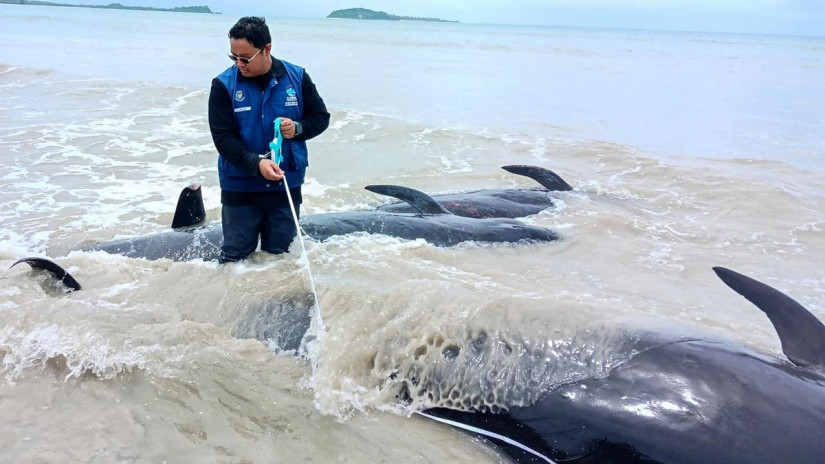
Dozens of pilot whales were found stranded along the coast of Mbadokai Beach, Deranitan Village, and Fuafuni Village in Southwest Rote, Rote Ndao, East Nusa Tenggara (NTT), on Monday (March 9), shocking local residents. Of the total 55 stranded pilot whales, 21, comprising 4 calves and 17 adults, were found dead, while the remaining 34 were successfully herded back to the sea.
A lecturer at the UGM Faculty of Biology (Biology UGM), Akbar Reza, expressed concern over the deaths of the stranded pilot whales. Pilot whales are a species under full conservation protection. Moreover, Akbar noted that globally, according to data from the International Union for Conservation of Nature (IUCN), there is no comprehensive global population data available.
“Based on IUCN data, we do not have global population figures, so we do not know whether their population is increasing, decreasing, stable, or otherwise,” he said on Tuesday (March 31).
He also highlighted that this incident serves as an alarm about ecological disturbances in the surrounding waters, especially since such events are not the first.
In previous years, similar strandings have occurred, including 50 pilot whales stranded in Alor in 2024, 11 in Sabu Raijua in 2020, and 52 in Madura.
“These incidents have indeed happened several times. However, even if they occur frequently, it does not mean they are natural,” he explained.
Akbar added that such incidents frequently recur in the NTT region, the Sawu Sea, and areas west of Kupang, as these locations lie along annual migration routes. During this season, from early to mid-year, pilot whales migrate from the south, moving from the colder waters near Antarctica in Australia to warmer tropical waters.
Beyond pilot whales, a collaborative study by BRIN and James Cook University in Australia revealed that from the 1990s to 2021, more than 20 whale and dolphin species stranded in Indonesian waters.
“Other recorded species include bottlenose dolphins. Three years ago, three large blue whales were also found stranded dead. Dugongs and whale sharks have also been recorded, and large whales are often stranded in Yogyakarta waters at the end and beginning of the year,” he explained.
To determine the exact causes of such strandings, Akbar said a necropsy is required, similar to autopsies conducted on humans to determine causes of death. Based on previous necropsy data from the National Marine Conservation Area Center, in collaboration with Biology UGM, several findings have emerged, including damage to echolocation organs in these animals.
“The current necropsy process is still ongoing,” he said.
Echolocation is essential for whales to navigate and locate food through reflections of sound waves. Several factors may damage this organ, including interference from human activities that emit sound waves, as well as damage from parasites or environmental pollutants, such as plastics, fishing nets, and ship debris. Overlapping sound-producing activities include dense ship traffic, seismic surveys, earthquakes, and oil and gas exploration using sonar.
“These conditions can lead to whale strandings,” he explained.
Additionally, some areas in NTT have muddy and sandy substrates, which reduce sound-wave reflections compared to harder surfaces such as coral and rock.
“When echolocation organs are damaged, the situation becomes worse. If pilot whales or similar species move into shallow waters, they cannot detect whether the water is shallow or deep. It is as if their sensor is broken, leading them to become stranded,” he added.
Pilot whales are also highly social animals that live in groups. If the group leader, typically an adult female, becomes disoriented or has difficulty, it can affect the entire group.
Furthermore, whales are sensitive to environmental changes, including water pollution, heavy metals, and even solar storms. However, confirming these factors requires necropsy; otherwise, they remain hypotheses.
“The strongest assumptions are noise pollution and water contamination, including poor water quality, plastics, and fishing net waste,” he said.
To mitigate such incidents, understanding whale movement patterns is crucial, although research in this area remains limited. This knowledge could help redirect shipping routes during certain periods to avoid acoustic or physical collisions with whales. In New Zealand, for instance, a program called PilotPulse provides early warnings, enabling authorities to anticipate and respond when whales are approaching or at risk of stranding.
When strandings occur, the most critical aspect is having proper handling protocols in place and returning the animals to the sea as quickly as possible. Basic guidelines include not sitting on the whales, avoiding selfies, and ensuring their blowholes are not obstructed.
“If the blowhole is covered, it can accelerate death, weaken the animal, and increase the risk of overheating due to their thick blubber, which requires constant cooling with water. These protocols are essential to reduce mortality, alongside necropsy,” he explained.
However, conducting necropsies remains a challenge due to the limited number of veterinarians with the necessary expertise, particularly for large animals such as whales, which require specialized skills.
“Necropsy remains a limitation, not only because of the shortage of veterinarians but also due to limited equipment. Yet, it is crucial for understanding the causes of death,” he concluded.
Author: Leony
Editor: Gusti Grehenson
Post-editor: Jasmine Ferdian
Photo: AFP