


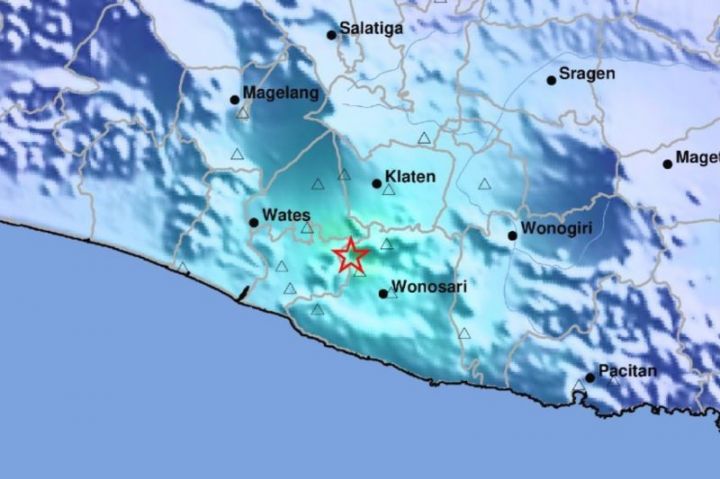
A series of earthquakes shook several areas in the southern part of Java Island on Tuesday (Jan. 27). The first earthquake, measuring magnitude 5.7, occurred at 8:20 a.m. WIB, with its epicenter located approximately 24 kilometers southeast of Pacitan, East Java, at a depth of 122 kilometers. Several hours later, at around 1:15 p.m. WIB, another earthquake occurred with a magnitude of 4.4, with its epicenter situated northeast of Bantul Regency, Special Region of Yogyakarta. This second earthquake was classified as shallow, causing its tremors to be clearly felt by local residents.
An earthquake expert from UGM’s Geological Engineering Department, Dr. Gayatri Indah Marliyani, explained that the earthquake in Pacitan, East Java, could be categorized as an intraslab earthquake, as its source originated from within a subducting oceanic plate, commonly referred to as a slab.
“Deformation occurs when the plate continues to be pushed downward, causing it to change shape and shift. These changes and movements within the plate trigger earthquakes,” the expert explained on Wednesday (Jan. 28).
Regarding the differences in magnitude, strength, and source characteristics between the two events, Dr. Marliyani noted that these factors led to distinct effects on the public.
She revealed that the morning earthquake felt like a swaying motion, while the subsequent earthquake felt more like a sudden jolt.
“The differences in effects felt by the public are influenced by the earthquake’s location. A larger magnitude combined with vertical movement causes the seismic waves to propagate upward, resulting in a wider impact,” Dr. Marliyani explained.
Meanwhile, according to her, the second earthquake in the Special Region of Yogyakarta occurred within an active fault zone, namely the Opak Fault. Although the epicenters of the two earthquakes differed, the second event may have been triggered by stress transfer from the first.
“It is this stress that makes the plate unstable and causes it to move, allowing an earthquake to occur,” she explained.
Nevertheless, Dr. Marliyani stated that the second earthquake did not have the potential to trigger a tsunami or aftershocks.
“The earthquake’s magnitude was not very large, so the likelihood of aftershocks is small. Therefore, there is no need to be overly concerned,” she advised.
The occurrence of two earthquakes on the same day understandably caused public anxiety and concern, particularly as both events produced noticeable tremors in the affected areas.
“The public must always remain alert to earthquakes. Today’s events serve as a reminder that we live in an active tectonic region. Therefore, people must be prepared and responsive in dealing with earthquakes,” she emphasized.
Author: Diyana Khairunnisa
Editor: Gusti Grehenson
Post-editor: Zabrina Kumara Putri
Illustration: BMKG